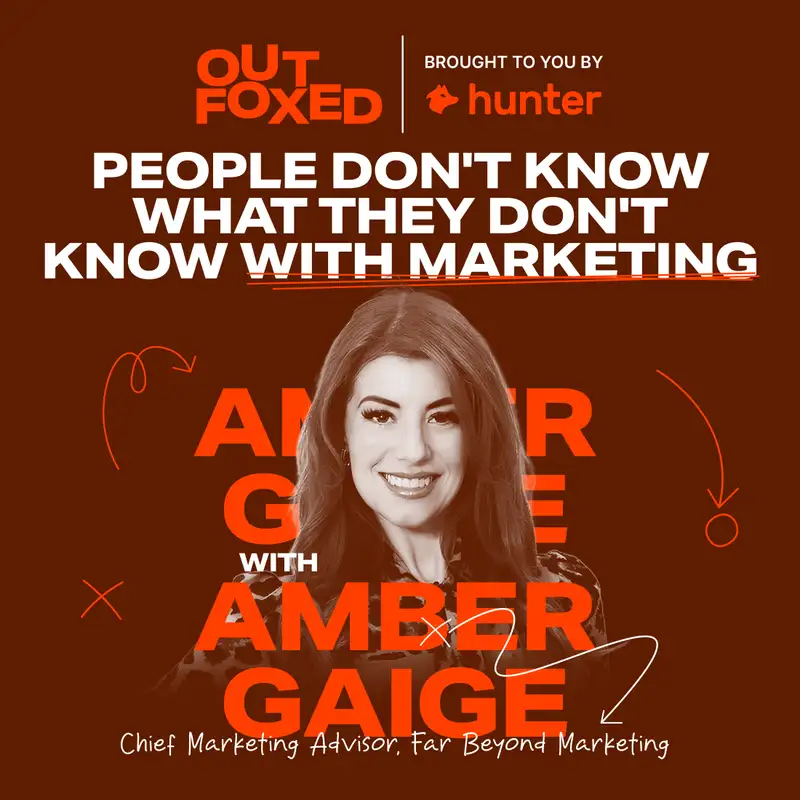
[00:00:00] James: This is Outfoxed, the podcast brought to you by Hunter.io, the trusted B2B lead generation platform built for every professional. Get ready for no playbooks, no posturing, and no egos. This is the show for the builders and not the theorists. Let's get into it.
[00:00:17] Matt: All right, here we are. Another episode where we hope to bring you value and new ideas. And with us today is Amber Gaige from Far Beyond Marketing. Amber, welcome. It's great to see you again. Hey, Matt. It's so fun to be back with you. How you doing today? I love it. Thanks for bringing the energy. Well, I, obviously have spent lots of time chatting with you and enjoyed every minute, but why don't you introduce yourself to our audience?
[00:00:47] Amber: Sure. So I'm a five-foot-nothing redheaded Texas girl, founder of Far Beyond Marketing firm out of Dallas, and a mother of one very rowdy [00:01:00] Taekwondo-loving little boy. My team of 14 and I serve entrepreneurs all around the US, by not giving them marketing that is crap. We serve them by making sure that they have a strategy, clear messaging, and marketing systems that grow their business while they sleep.
[00:01:19] And, I'm also an international best-selling author of the Far Beyond Marketing guidebook, How to Stop Being Duped by Bad Marketing.
[00:01:27] Matt: I love it. How do you decide, "I'm not gonna give crap marketing to people"? 'Cause it just seems.
[00:01:35] Amber: Well, I'm a plumber's daughter, so you know, crap was a way of... No, I'm just kidding.
[00:01:41] I'm a third-generation entrepreneur, Matt, and I firmly believe that people don't know what they don't know when it comes to marketing. And marketing is ever-changing. The beauty and the curse is that it is both creative and analytical. You have to have, the chiaroscuro, as the Italians say, the dark and the light.
[00:01:57] So when we say we're not gonna give them bad, [00:02:00] crap marketing, what we mean is we're going to be collaborative, we're going to be objective, and we're going to be completely transparent so that they know where every dollar goes and exactly what they get out of it so that it moves their operational goals forward.
[00:02:13] Matt: I love it. Comes to warm my heart when I get a chance to talk to people. On this podcast, it's, there's so much energy spent on the big hyper-growth firms, the, you know, the like, "Oh, you know, I was able to lead my startup to a $50 million valuation before exiting." And like, it's such, like the topic du jour.
[00:02:35] But I really love it when you get to talk to somebody who's like, "No, you know what my goal is. My goal is to help small businesses."
[00:02:40] It's to help other entrepreneurs.
[00:02:43] Yeah.
[00:02:43] It's to, like, cut through some of the noise that we know that they deal with. I love that, so thank you. But that's, I'm guessing because you started on the other side of the table.
[00:02:53] Is that right?
[00:02:54] Amber: 100%. Started on the back of a Baco with my dad being a plumber and us having our plumbing business [00:03:00] in the third bedroom of our little house in the suburbs of Dallas. And, when the phone didn't ring, we didn't eat.
[00:03:07] Matt: Yeah.
[00:03:07] Amber: And so I got to see my parents eventually grow into a multimillion-dollar, business conglomerate.
[00:03:15] But it took 30 years for them to get there. And I firmly believe that with the advancement of technology and AI and just personal experience, we can help entrepreneurs grow their businesses faster and, more effectively. But sometimes you're standing on the shoulders of giants, and you have to learn, the hard way.
[00:03:39] And when it comes to spending money on marketing, people usually get acid reflux. They're, you know, "Ugh," you know, "I don't really wanna do that." But that's part of our passion and our goal is to help them to get what they need faster so that then they can turn around and be a blessing to others.
[00:03:55] 'Cause when small business succeeds, the American economy succeeds.
[00:03:59] Matt: I mean, that's the way it's supposed [00:04:00] to be. I feel like, people have forgotten that lately, but I agree with that.
[00:04:03] Amber: Sure.
[00:04:04] Matt: Did you expect to build your own agency? Was that something that was kinda always in the cards, or did that come to you later?
[00:04:12] Amber: No, it absolutely came to me later through twists and turns of life. You know, little people called children come into your world and turn your entire world upside down. You go, "Oh, all right." No, originally I was on the path to being an opera singer. Graduated from Baylor University despite my burnt orange
[00:04:29] and, thought that I would travel the world and sing opera, and loved it for a very long time. You don't make much money as a soprano in an overly saturated world of the performing arts. Came back, worked in the family business. Thought, "Cool, I'm gonna run the family business," alongside of working with my family, was challenged to start my first marketing company in 2013, which scaled so quickly that private equity picked it up in 2018.
[00:04:58] Matt: Nice.
[00:04:58] Amber: And the condition of sale was that I went [00:05:00] with it. So then I left family business, so there's another twist and turn. Loved private equity, thought I'd stay in that. Then I had a baby and discovered you kinda have to be home with these little people. They kinda need you.
[00:05:12] Little bit.
[00:05:12] And then I came back to my entrepreneurial roots and went, "Oh, this is my calling.
[00:05:17] This is my passion. This is my heart. I wanna serve fellow entrepreneurs." And when Zig Ziglar said, "If you help enough people get what they want, you'll never have to worry about getting what you want."
[00:05:25] Matt: That's a great quote. Sometimes it's, you forget to fall back to the classics. That's a good one.
[00:05:31] But so, okay,
[00:05:32] you,
[00:05:33] like many of us, have, you've been in a marketing role. You've helped build organizations. You're now on your own. You're doing your, you're doing something that's very much different, right? Like helping yourself, helping your own business versus helping others can be rewarding, it can be maddening.
[00:05:51] It can be — both — you know, you can, it can lead to hair-pulling to some extremes and others. Like,
[00:05:57] Yeah.
[00:05:58] Was there a moment that you [00:06:00] remember thinking, "Okay, I have, like, I think I should start an agency." Do you remember the moment where you, where that, like, hit you and you said,
[00:06:07] Yeah.
[00:06:07] Okay, this is, I think, gonna be the next step?
[00:06:10] Amber: Yeah. Yeah, it was.
[00:06:11] What was it?
[00:06:11] I was serving as the chief marketing officer and chief information officer of a family-owned company, in Wisconsin, and they laid me off two weeks before Christmas, and they laid me off after me and my colleagues had gotten them profitable for the first time in, I think close to a decade, using the marketing systems and processes that we had put in place only 18 months earlier.
[00:06:36] I remember thinking, "You son of a bitch. Thanks for the kick in the ass after
[00:06:41] Yeah.
[00:06:42] all the hard work. Screw you. I'm gonna go do what I did for you for other people, and I'm gonna get paid myself and not rely on you for a paycheck." So it might've been a double birdie situation, if you know what I mean.
[00:06:53] Matt: How long did it take you before you figured out that was the right choice?
[00:06:59] Amber: A week? [00:07:00]
[00:07:02] Matt: I was like, there's a lot of, mental calculus happening here.
[00:07:06] Amber: Let me think. A week? A month? When did I first get paid? I don't know.
[00:07:12] That was it though.
[00:07:12] I'm not sure to this day it was the right choice, Matt. Daily I wake up and go, "What the hell am I doing?"
[00:07:19] Matt: Now, I doubt that daily you think, "What am I doing?" Although, you probably might ask yourself if you need to hire a few more people maybe. Is that, yeah.
[00:07:28] Speaker 6: Yeah. We're very blessed. We've got a great team
[00:07:31] Amber: of 14 who, serve our clients, and we like having a family atmosphere around here.
[00:07:36] I'm in our executive office in beautiful Adriatica, and we have clients that we have four desks in an executive office suite. And our clients come and sit next to us right next to the desk, and we saddle up beside them and go, "What's up? How can we help?"
[00:07:48] I love that.
[00:07:48] So we love to keep it face to face like that.
[00:07:50] Matt: That's really great. That's, and you know, it feels like increasingly in the last, you know, 20 years as it's become easier and easier to be remote in every [00:08:00] capacity, I feel like there's a little bit of almost, a pull back to some face-to-face business. Like I, you know, I was actually, I was planning my week and there was a moment where I'm like, "Oh yeah, there's an opportunity to be face to face."
[00:08:13] And I feel like my, desire to do those things today is different than it was five years ago. Are you finding that as well with you and your clients?
[00:08:22] Amber: Most definitely. I think people are paying a premium for face to face because we lacked it for so long and we took it for granted. And now when you're willing to meet with someone and share your time in person, it builds rapport almost immediately.
[00:08:38] Matt: They know how much it means now almost, right? Yeah. Like we took it for granted for decades. It was just, you know, business as usual. But now I feel like people really go, "God, that was, you didn't have to come. That was important." Like, it matters more, right?
[00:08:51] Amber: Yeah. Yeah. We just did a complete rebrand and website overhaul for a area chamber of commerce.
[00:08:57] And I was shocked when the president of the chamber said, "You're the [00:09:00] only marketing firm that responded and asked for an in-person meeting and, met with us to talk about this project." I was shocked.
[00:09:09] Matt: Interesting.
[00:09:10] Amber: Yeah.
[00:09:10] Matt: Everybody else was just, "Hey, here's our pitch over Zoom," and... Wow. Yep. Interesting.
[00:09:15] Amber: Or over email or, yeah.
[00:09:17] Yeah. Wow. We were like, "No. Come to our office. Speak to us in person. Get in front of our whiteboard."
[00:09:21] Matt: Interesting.
So how many clients do you
[00:09:37] currently work with?
[00:09:40] Amber: I think we're somewhere between 75 and 100.
[00:09:42] Matt: Okay. Is there a pattern that has emerged about, like, one of the first things you have to do to educate your clients? Like, you're coming in, you're saying, "Okay, I'm gonna help you solve this marketing problem.
[00:09:54] We've got an agency. We're trusted. We're face to face." And then you get back [00:10:00] and you're like, "Gosh, it feels like two out of three of these meetings I end up having to tell this story." Is there something that you find that you lean a little bit more heavily on in terms of, like, educating and just kind of setting expectations at the beginning?
[00:10:12] Amber: Yeah. Two major principles that are also what my book is based on that. Okay. Number one is clarity of message. So frequently, our clients do not understand why no one's paying attention to what they're saying.
[00:10:27] And so we take them back to the basics. In their website performance, we show them how clarity of message is impacting the number of visitors and lack of conversions.
[00:10:38] In their social media, in basically every marketing tactic, if you cannot effectively compel someone to do business with you in two seconds or less, you have lost them. So clarity of message is huge. The other thing that we take them back to is that operational goals set the [00:11:00] direction and budget for marketing goals, not the other way around, as so many business owners have been preconditioned to believe.
[00:11:07] Because they've been said, "We do magic fairy dust, and we'll grow your business, so here, just give us a check. And as long as you give us a check, your business is gonna grow" and then it doesn't work, and they get pissed off. So it's actually the opposite, where we say, "Okay, you need to start by telling us how you're gonna measure success.
[00:11:25] Because if you don't tell us that in the beginning, this relationship is doomed to fail."
[00:11:30] Matt: And I'm assuming they typically say, "Oh, well, it's grow revenues," right? It's, there's, like, some top level... How do you take them? And I don't want you to, like, give away your service here, but, like, what's a, what's an example path where you're like, "Okay, yes, you need to simplify.
[00:11:43] You need to focus. What are your goals next year?" And then they're gonna tell you, "Oh, you know, we've gotta increase revenues by X, X." Do you walk them through the — do you have them take you through that process, or do you go straight to, "Okay, well, based on that, here's what you're gonna have to do from a marketing perspective"?[00:12:00]
[00:12:00] How do you typically steer those conversations?
[00:12:02] Amber: Yeah, it's typically a combination of what you just said, Matt. So we listen. We ask a lot of questions about the infrastructure of the business, lack thereof, etc. And then we come back to them with a marketing audit with a questionnaire, and we ask them to give us access to information that they currently have.
[00:12:21] And then the intersection of those two buckets tell us what's missing and what tactics are going to empower them the most quickly. And then we devise, either they go into one of our standard packages that is all-encompassing to grow quickly, or we devise an a la carte option, and we start setting up systems for them so that, again, from the beginning, there is total transparency, and they see the intersection of what marketing is doing in real life, inbound calls, website visitors, ticket averages.
[00:12:57] We give every client who wants it, and why wouldn't you [00:13:00] want it, an executive dashboard of how the marketing is performing from the get-go.
[00:13:05] Matt: Do you find that you guys typically partner as an agency because they don't have a marketing team and they need, like, sort of like almost like a fractional support system to help them with all their marketing needs?
[00:13:18] Or is it that you're typically helping marketing teams figure out how to expand their current footprint? Like, do you find that there's a common pattern there?
[00:13:29] Amber: You know, it's interesting. Yes, Matt, we have actually four, ideal client profiles, ICPs.
[00:13:34] Okay.
[00:13:35] And, two of the four are what you just described.
[00:13:38] We serve marketing managers who are in-house who need resources, advice, strategy, and platforms. We also serve those who do not have that and need to completely outsource because they don't wanna add to head count. The other one we serve is who we talked about earlier, the small business owner who doesn't know where to [00:14:00] begin.
[00:14:00] We devise an entire entrepreneurial marketing system that we literally hand them for one flat price, and then we have a marketing course that empowers them with resources. And then the fourth ICP is the enterprise level national brand where we partner with franchisors mainly through our vendor relationships of franchise attorneys and M&A firms to help them standardize and streamline national marketing buys for efficiency.
[00:14:32] Matt: No, that's super interesting. I don't think we talked about the franchises before. That's like, that's its own whole entire thing, right? Like, especially when you've got like a national brand but then the local off, like the local locations still have to somehow muster up a way to supplement their marketing efforts from,
[00:14:49] like, you know, great, so Chili's runs nationwide ads occasionally. Doesn't help the local Dallas Chili's get more people in, right? Right. That's a really interesting, do you [00:15:00] spend a lot of time with that industry or is that just like, one of the, yeah, okay.
[00:15:04] Amber: Yeah. Yeah, we do. That's definitely a niche for us, 'cause I have a very strong franchising background.
[00:15:09] Okay.
[00:15:09] And so yeah, marketing for franchising is totally different as an ICP.
[00:15:16] Matt: That's interesting. That's, I feel like that is an industry that has somehow created a bubble for itself that like they can operate with like almost no public understanding of like how that business operates.
[00:15:29] The idea of a franchise model, I think if you grow up around it you get it. But if you haven't been directly exposed, like you just think all Chili's are Chili's, right?
[00:15:38] Right.
[00:15:39] I'm just
[00:15:39] picking on Chili's as an example.
[00:15:40] Amber: Right. Yeah.
[00:15:41] Matt: Yeah. But that's kind of fascinating. Did you, was that a strategic thing or did you get pulled into that?
[00:15:50] Amber: I definitely got pulled into that because of my background in franchising.
[00:15:53] Matt: Yeah.
[00:15:53] Amber: Because I spent so many years in the family franchise business. I was very blessed to have a connection of other people [00:16:00] in franchising who came to me and said, "Hey, let's work together." And then it just kind of went on from there.
[00:16:05] And then I'm in part of some C-level networking groups that serve a lot of franchisors. People who are creating their franchises need help with branding, et cetera. So it was a combination of history and experience.
[00:16:16] Matt: What's, for people who've never been exposed, so they, vaguely understand there's this idea of a franchise model, but they've never been exposed.
[00:16:24] What are, like, two or three of the biggest differences about how that business model typically goes to market versus, you know, your traditional B2B business in any other category?
[00:16:34] Amber: Sure. Really, it boils down to control. So as a franchisee, you do not control the brand messaging, you do not control the, marketing dollars.
[00:16:44] So you usually don't even control your own website, and sometimes you don't control your marketing tactics either.
[00:16:52] So you are limited in terms of what you can do to market your own business. [00:17:00] And the laws of your franchise agreement are what dictate, the level of flexibility that a franchisee has. But for the most part, it really boils down to, strategic control on a local level.
[00:17:13] Matt: That makes sense. For those of you listening or watching, depending on when this comes out, if you're over the age of 40, this is how the Quiznos Spongmonkey ads, this is how your local franchise got stuck with those.
[00:17:28] Amber: It's so true.
[00:17:29] Matt: Is a corporate decision was made that you had no control over. Okay. Yeah.
[00:17:34] Amber: Yeah.
[00:17:34] Matt: I think that's a, so you end up with, in your seat, Amber, are you working with the local locations, or are you working with corporate typically? 'Cause you said national rollout, I think, when you were describing it.
[00:17:47] Amber: You know, Matt, we work with both. We work with both.
[00:17:50] Matt: Okay.
[00:17:50] Amber: I've spoken with, just this week I was speaking with a local franchisee of a Dallas-based franchise.
[00:17:58] And so we [00:18:00] were helping them with some of their infrastructure. And then in my networking group, I was having a conversation with an attorney vendor partner. He goes, "Oh, yeah, I know the franchisor of that group that you're talking about. Let's go have a meeting with them and talk about how you actually roll this out to the whole group."
[00:18:15] And then we've had fractional agreements with national brands that come across us and go, "Hey, our operators in 32 markets are struggling. Can we run a pilot to see if you can get down our cost per call?" Sure, we can do that. So we're very blessed to be able to speak both languages because we've done both.
[00:18:34] Matt: Yeah.
[00:18:34] Amber: And the game is different for franchisor versus franchisee. Two completely different goals. And they don't have to be at an impasse. They can work in parallel, and they do very well when everyone is speaking the same language.
[00:18:48] Matt: Right. Right. Which is the tricky part.
[00:18:50] Amber: Yeah ...
[00:18:51] Matt: But I mean, that's like, I think every marketing team on Earth has someone in an organization they have to figure out how to communicate with.
[00:18:58] That seems like whether it's [00:19:00] sales, whether you're internal or whether you're external, and it's, C-levels that don't understand why that's gonna take time and cost money, I feel,
[00:19:08] Amber: Who would've thought.
[00:19:09] Matt: Feels like that's the, that's
[00:19:11] the perpetual need for marketing.
[00:19:13] Amber: Yeah.
[00:19:13] Matt: Okay, so practically speaking,
[00:19:16] so you built an agency.
[00:19:17] You were blessed enough to get that first customer, or you were lucky enough, not lucky enough, but like, you know, put in an interesting position to be able to leverage a knowledge of, you know, some niche industries. Like, what, if you can remember back, of course you can, but, like, if you're willing to talk about it, go back to, like, the first hundred.
[00:19:38] So you've got customer one, maybe you've got customer two through word of mouth, people who know you.
[00:19:42] You're trying to go from customers three to whatever. How do you build that? Are you the salesperson? Do you hire a salesperson? Like, like, how do you start building a business from zero as a, as an entrepreneur?
[00:19:56] Amber: Prayer. Sleepless nights. [00:20:00] Wine.
[00:20:01] Matt: Okay. All three are repeatable, so, okay. So, so far so good.
[00:20:04] Amber: Absolutely. Yeah, I mean, like W-H-I-N-E and the W-I-N-E. Yeah, absolutely. No, I, you wear all hats. When you start your own business, unless you are privileged to have, some onboarding cash and an investor, it's very different, right?
[00:20:20] But when you are bootstrapping a business together—
[00:20:23] Matt: Yeah.
[00:20:23] Amber: You wear all the hats. So I'm still on every sales call. I'm on every sales call because I want my voice and my strategy to touch every single client, and I'm a bit of a control freak. But it was me and it was the, and it was my pastor's wife who came alongside me and said, "I can help you with emails, and I can help you with some basic, you know, graphic design fulfillment.
[00:20:45] And, hey, I'm really good at QuickBooks. I can set that up." I mean, it was just two girls and a couple of laptops going, "Please hire us for your marketing needs."
[00:20:54] Matt: Okay.
[00:20:56] Amber: We got scrappy.
[00:20:58] Matt: And you guys chugged away at that until what number? [00:21:00]
[00:21:02] Amber: Let's see, probably 10.
[00:21:05] Matt: Okay.
[00:21:05] Amber: Probably the first 10 clients is when we went, "Oh, we need some systems in place.
[00:21:10] And, we, probably need some more help, and we need to find some outsource partners who can crank out these websites faster." And, you know, the game is different from 1 to 10, 10 to 20, 20 to 50, 50 to 100. You know, it's just like any other business. The more that you get more clients, the more efficient you really need to become so that you don't lose your shirt and your operating profit, right?
[00:21:34] And I think you're constantly reinvesting into your business. So, I was told from a very young age systems run a business. People are always expendable, including the owner. So if you don't build your business based on systems, then your business is doomed to fail. I have a goal of building a business that will run without me.
[00:21:56] Matt: Right.
[00:21:56] Amber: And I think that's the goal of most entrepreneurs. Like, let me go [00:22:00] sip a Mai Tai in a hammock and let my business grow while I'm gone. That's the ultimate dream, right? But the reality is if you put all of your eggs in the basket of people, you're gonna be disappointed every single time, including in yourself.
[00:22:13] So you have to build incremental systems and documentation into your business.
[00:22:18] Zach: Today's episode is brought to you by Hunter.io, the B2B lead generation platform made for every professional. Whether it's prospecting, fundraising, recruiting, link building, or just trying to connect with the right people, Hunter makes it easy
Even if you are somebody who likes process or thinks of themselves as process-oriented, that's a tough thing. Like, figuring out... And 'cause I think, like, the energy that enables somebody to be an entrepreneur in the first place is generally, you know, you tend to be higher energy.
[00:22:54] You tend to be more either social or you really understand a specific problem, right? And you see [00:23:00] a unique take on it. But then going into that, and when you start to actually implement that and try to build that business, who you need to be changes.
[00:23:09] Amber: Yes.
[00:23:10] Matt: And that constant change I think is a positive thing with entrepreneurs.
[00:23:15] It's the kinda thing you probably have to have. But it's also the thing that I think leads a lot of them to not be great at operating.
[00:23:22] Amber: Yes.
[00:23:22] Matt: And, like, figuring out how do you not lose your soul while learning how to become a better operator, that I think is a place where a lot of people kind of fall out of love with being an entrepreneur and running their own business.
[00:23:36] Did you ever have moments like that, or did your, did the people around you, did you see them having moments like that?
[00:23:42] Amber: Most definitely, Matt. Most definitely. I think you have two classic types of entrepreneurs. You have the rainmakers, who are those sales-oriented, gregarious, outgoing, love their customers, and hold that customer list tight to the chest.
[00:23:55] Matt: Yeah.
[00:23:55] Amber: Right? They're gonna make it rain, and nobody else can make it rain like they can. So, you know, [00:24:00] give me, give me, give me.
[00:24:01] Matt: Yeah.
[00:24:01] Amber: Right? And then you have the entrepreneurial operators who are systems-minded, and they go, "Someone else needs to go make it rain, because I have a product or a service that I am really, really good at, and I'm not going to outsource my secret sauce to empower other people to do it, 'cause no one can do it as well as me."
[00:24:21] Both are control freaks.
[00:24:28] Own it, love it, get used it. You just are. But the entrepreneurs who are successful are the ones that empower and delegate.
[00:24:34] Matt: Right.
[00:24:35] Amber: When you empower other people, and when you hire people who are better than you to delegate your lesser strengths, that's when your business grows. Because you can't do it all.
[00:24:47] Matt: Right. There's confusion sometimes, right? As an entrepreneur, you feel like this is supposed to be on you, right?
[00:24:54] Like, there's, like, a little bit of hero syndrome in it, it seems like sometimes
[00:24:57] Amber: Yeah.
[00:24:57] Matt: where you're like, "Oh, I can't just hire somebody [00:25:00] for that." And, I think to me it's always been about can you figure out as an entrepreneur how to project your vision,
[00:25:07] Amber: Yes.
[00:25:08] Matt: In a way that not only gets people to understand it, but gets them to buy in?
[00:25:11] And that control freak part, it's like that need for control, it's because you know how clear the vision is in your head.
[00:25:19] Amber: Yes.
[00:25:20] Matt: But the real success or failure comes in that communications piece. Can I translate that vision to others, right?
[00:25:28] Amber: So true. You have to take your ego out of it so much.
[00:25:31] I believe that the entrepreneurs that I admire the most are the people that are the greatest servants to their team and to their company by getting out of the way and letting other people lead and drive and have different ideas than them. We are powerful as a team.
[00:25:51] Matt: No, but if you're controlling, if you have that control freak in you, like that's like the ultimate internal
[00:25:57] struggle, right?
[00:25:57] Amber: Oh, yeah.
[00:25:57] Matt: Like how do I let go and control at the [00:26:00] same time? It's like,
[00:26:00] Amber: Yeah, yeah.
[00:26:02] Speaker 6: You surround yourself
[00:26:02] Amber: with people that are not afraid to speak truth to you, that go, "You need to let this go."
[00:26:08] Matt: How did you do that? Like, did, was, is it just that you're blessed with not having a lot of ego, or did, were there,
[00:26:14] things that you learned or techniques that you developed to deal with that?
[00:26:18] Amber: Yeah, getting banged up and bruised in life will certainly kill your ego, and that's definitely- Okay, so- That's definitely what happened to me. I think when you get knocked down enough, you know, the Holy Spirit goes, "Are you getting this yet?"
[00:26:29] Yeah. That definitely helps when your ego
[00:26:32] Matt: Okay.
[00:26:32] Amber: gets trashed. But I also made the best investment that I could have made in myself and my business, and I hired a business coach early.
[00:26:40] Interesting.
[00:26:40] Even when I couldn't afford one, first thing I did.
[00:26:43] Matt: How did you, okay, so why was that such an important early investment for you at the time?
[00:26:48] Not now that you look back on it and it was successful, but at the time, what made you say, "Okay, I know this is gonna be pushing it, but it's the right thing to do"?
[00:26:57] Amber: Because I couldn't break through the brick walls. I didn't [00:27:00] have the answers to the questions that I needed. I was consuming data and information and reading books, and I was hungry to succeed, but I knew that I didn't have all the answers.
[00:27:09] And I knew that there were people that did because they were already successful doing the things that I aspired to do. So even though I couldn't afford a business coach right out of the gate, I could at least get in a mastermind and listen to other people, right? 'Cause that was less expensive. So first you start with that mastermind or that group coaching, and you're like, "Okay.
[00:27:27] All right. I can put this into practice," right? And you're taking your notes on your monthly webinars or whatever. And then you move into having your own coach, and I think, again, as you learn, humble yourself and implement things that people, that you can't see the forest for the trees. So that business coach is the one that goes, "Have you looked at it from this perspective?"
[00:27:49] That's how I knew I had to have it, because I was like, "I'm not making progress, and I'm not gonna make progress until I get answers to these questions, and there's someone out there [00:28:00] that's already cracked this egg."
[00:28:02] Matt: The mastermind thing is interesting because, this is, sorry, this is a weird topic for me too, because I'm constantly both acknowledging that this is a really valuable thing and also acknowledging I have no idea where to go and find the info.
[00:28:25] But, like, everybody benefits from a mentor. It just, it is a business relationship.
[00:28:29] Amber: Yeah.
[00:28:29] Matt: But it's not a customer relationship. Right. It's somebody who you can learn , but yeah, like, finding those people, everybody benefits, but finding them is hard. And the mastermind thing is kind of interesting 'cause it can give you the zero-to-one feedback that you need.
[00:28:42] It doesn't have to be one-to-one. How did you find the right, did you have to try a bunch of them?
[00:28:47] Amber: Oh, yeah. Oh yeah, for sure.
[00:28:49] Matt: Okay.
[00:28:49] Amber: I don't, think we ever get anything right the first time. I mean, as my grandmother from Oklahoma used to say, "Baby girl, a blind squirrel finds a nut every once in a while."
[00:28:57] So you know, I was very [00:29:00] blessed with a network, being a StoryBrand guide.
[00:29:03] Okay.
[00:29:03] I had access to a community of a few hundred people globally that I could ask who were also passionate about marketing, so that was my first one. And then you branch out and you find people that have found community in other networking groups, maybe a chamber of commerce, maybe a industry-specific networking group, maybe a geocentric networking group, people that share common clients with you.
[00:29:28] So you're gonna get different perspectives from different industry leaders that you can put into your own company.
[00:29:34] Matt: That's interesting. For those of us who've maybe gone to some of these networking events, not had a lot of success for whatever reason, I don't wanna try to pontificate on why people don't get a lot of value out of networking functions, but like was there, is there a technique or a thing that you learned that like helped you get actual value out of networking, like face-to-face networking events?
[00:29:57] Was there something you learned about that?
[00:29:59] Amber: Yeah, [00:30:00] not all of them are worth their salt. You're exactly right. Okay. I mean, some are just a giant waste of time. So some of them are just bad. Yeah, some of them you're just like, "Why am I here? Oh my gosh." I, think it's all about finding the right people and finding your niche and understanding who your ideal client target is.
[00:30:17] When you know that, then it's easier to find a networking group that's gonna help you. So for me, you know, it was pouring into women's groups.
[00:30:25] Okay.
[00:30:25] We're very fortunate as female business owners in this day and age. I mean, we are front and center. We haven't always been. Ask my mom what it was like to be in the oil industry in the '80s, right?
[00:30:35] It's very different. But there are plenty of niche industries now that you can find, but I think you have to begin with, what do I want to intentionally get out of this networking experience? If you go into it with that, then you automatically get more out of it. It either fulfilled your needs or it didn't.
[00:30:54] Matt: Interesting. Now, if you are more introverted, and there's lots of, you know, we deal with all [00:31:00] kinds of industries, so all over the map. You know, PR, recruitment, software is an obvious one. And I often find that founders tend to fall into one of two categories. They are either social and a little bit more outgoing and really comfortable with that, whether they're on the sales side or not.
[00:31:18] They're just more comfortable going out and doing that. But on the other side of that are those who honestly are probably a little bit more like me, very introverted, and kind of they go to these things and it's, there's like, "Okay, well, how do I get out of my own shell? How do I..." Like I'm great if you want to have a conversation about something meaningful, but if you want to have small talk, like I'm a pretty awkward guy.
[00:31:37] I'm just not good at that.
[00:31:39] Amber: I don't believe that.
[00:31:39] Matt: No, it's really true. I like, I follow just enough obscure sports that I don't know what anybody's talking about in football, so I'm just like, "Yeah, but I can, I'll chat college basketball if you want." Yeah, nobody, everybody just stares at me. And they're like,
[00:31:52] Amber: Curling?
[00:31:53] Do you have conversations about curling? That is awkward. No, I'm just kidding.
[00:31:56] Matt: It would be, but I just know not to bring it up.
[00:31:58] Amber: Oh, okay. Well, sorry. See? [00:32:00] Epic fail right there. I just made it awkward.
[00:32:01] Matt: No. See, it's a great sport though, but it's really weird. Any sport that includes brooms is a weird sport.
[00:32:06] Amber: I mean, I agree with that, right? Why would you do that for sport? Like I just don't understand.
[00:32:11] Matt: I mean, you can do that for, you can get paid to do it probably a lot better than as a sport.
[00:32:16] Amber: Yeah.
[00:32:16] Matt: Like brooming
[00:32:17] Amber: Yeah.
[00:32:17] Matt: As a career is,
[00:32:18] Amber: Right. it's a little awkward.
[00:32:20] Matt: Probably not something to pursue.
[00:32:20] Amber: Yeah. For sure.
[00:32:21] Matt: Not very transferable.
[00:32:22] Amber: No. Now day drinking, that's a sport I can get behind, anyway.
[00:32:27] Matt: Texas.
[00:32:32] Amber: Boy howdy. Anyway, what were we saying?
[00:32:35] Matt: So, you know, you brought up ICP.
[00:32:37]
[00:32:37] Matt: I think one of the things that especially smaller businesses and entrepreneurs struggle with is they often have a very specific idea of who their customer is. It often looks like them.
[00:32:49] And beyond that, they really don't know what the process is to figure out an ICP.
[00:32:57] How, like, I would love to hear both, like, how you [00:33:00] learned that originally and then how, if there's any tricks that you tell your clients, like, "Hey, this is where you start when you need to really figure out who your ICP is."
[00:33:08] Amber: Yeah. Well, in the beginning, you're so hungry for revenue gen that you will take anything,
[00:33:13] Matt: Right.
[00:33:13] Amber: everyone and their dog. You're like, "Yep!"-
[00:33:15] Matt: Right.
[00:33:15] Amber: “I can do that. Yep, I will do that, too," right? So you don't really start with an ICP when you're doing a bootstrap startup, right? We're just hungry.
[00:33:24] Matt: Right.
[00:33:24] Amber: We, yes.
[00:33:25] Matt: Okay, so if I'm an entrepreneur and I'm just getting started, I've hung my shingle and I'm trying to get the third client, I shouldn't be worrying about ICP just yet.
[00:33:32] Amber: No. Get some revenue in the door. Never stop selling,
[00:33:36] Matt: Pay the bills first.
[00:33:37] Amber: As the founder of Clinique said. I mean, you never stop selling.
[00:33:40] Matt: Okay.
[00:33:41] Amber: Right?
[00:33:41] Matt: Great.
[00:33:41] Amber: Just sell. Just focus on revenue, right? But then once you have consistent revenue coming in your door, that's when you need to export that list from QuickBooks of your customer list, put it into ChatGPT, and say, "Analyze this for [00:34:00] consistencies.
[00:34:00] Tell me what common threads exist in this database." And in so doing, and by following several prompts, you can discover your ideal client profile, or ICP. It does not have to be brain surgery. Now, I have been on multimillion dollar projects where we took over 60 years' worth of data and we reverse appended it and heat mapped it and found the saturation levels and the different income levels and analytically applied and then cross-referenced the ideal target client, with the ideal target product.
[00:34:36] You can do it on an enterprise level. But for the majority of your entrepreneurs out there that are doing a million dollars or less a year, QuickBooks and ChatGPT give you all the insights you need to at least start honing in your marketing messaging to solving your ICP's problems with your calls to action and your target offerings.
[00:34:58] When you do that, [00:35:00] then you're gonna start to be known for that niche. Does that make sense?
[00:35:04] Matt: It does. I would cut to a quick plug to tell you that any time you do have your ICP list narrowed down, there's a great place where you can go find their email addresses.
[00:35:14] It's called Hunter.io. This is not a live read.
[00:35:17] I just decided that it was contextually relevant in this moment.
[00:35:20] Amber: My favorite platform, by the way, of all time.
[00:35:23] Matt: I would hope so.
[00:35:23] Amber: I mean,
[00:35:23] Matt: I would hope so, come on.
[00:35:25] Amber: Yeah.
[00:35:25] Matt: But yeah, I think, no, what you said is great. I and I think this is one of the things that I hear from entrepreneurs a lot is like, I don't know who my ICP is, so I'm worried about getting started, or I'm not sure, like I've had three clients, they're all very different.
[00:35:39] I don't know which one is actually the ICP. Like there's, sometimes it's not the industry they're in. Sometimes it's the kind of service provided and the specific challenge they have in the org. And I think often that gets lost in the ICP 'cause everybody thinks, oh, it's like it's industry, it's revenue size, but it's not always that.
[00:35:56] And I imagine in the early days before you had that [00:36:00] sort of an ICP defined, it probably was more around a problem either inside the org or outside of the org. I'm curious, did you find that it was more often one versus the other?
[00:36:11] Amber: Yeah. Usually, it was an outside the org problem, especially being in marketing, right?
[00:36:16] So the problem was our website isn't working, the problem is our phone isn't ringing, the problem is, I don't know, I'm spending $100,000 in marketing a year and I don't understand why I'm getting a negative, ROI, right? So I think as you discover who is paying your bills for what services, that definitely narrows down your ICP.
[00:36:37] Matt: Yeah. I'm sure you had a client at some point that wasn't a good fit.
[00:36:42] Amber: Just one?
[00:36:44] Matt: There you go. I was gonna assume it was at least one. Surely it's gotta be one. There has to be one in there somewhere. I'm sure everybody else is blissfully happy, but like-
[00:36:52] Amber: Oh, sure, yeah. We're perfect.
[00:36:54] Speaker: What happens when you get that first
[00:36:56] Matt: one where you're like, "Okay, well, that just didn't work out."
[00:36:58] Amber: Yeah.
[00:36:58] Matt: Do you guys have, like, a good [00:37:00] retro process for, like, because, like, I, know when I've spoken to entrepreneurs, they're just like, "Gosh, I assumed that everything about that business is why that interaction between us failed." And so they start almost, like, over-indexing on an, a counter or an anti-ICP.
[00:37:17] Like, well, that one didn't work, so none of them are probably gonna work. Like, sometimes there can be an overreaction. Like, did you ever have that situation when somebody failed and you were like, you know, there's always that, "Is it me?" moment? And how did you guys get through that?
[00:37:30] Amber: Yeah, I mean, it's an incredibly painful lesson for you and your team, right?
[00:37:34] I mean, you have to own your mistakes. And, I'll tell you, we're not perfect. We tell our clients, we're not the perfect fit for everyone. We're gonna tell you what not to do as much as what we tell you what to do with your marketing, and a lot of people don't wanna hear that. But there are also just operational oversights when you miss the mark.
[00:37:53] And I think a client relationship in marketing is a lot like a dance because you can't do, we can't [00:38:00] do our job until the other person gives us the information that we need, right? So when you're dancing, the woman never takes her eyes off of the man. It's the man's job to do air traffic control and watch the dance floor.
[00:38:12] It's the woman's job to follow the nonverbal cues on the dance floor, right? By holding that strong frame, by pushing, by pulling, by tilting. You know, those kind of things. Can you tell I did some ballroom dancing for a time in my younger years?
[00:38:25] Matt: Recently, yeah, yeah.
[00:38:26] Yeah, I'm getting that.
[00:38:27] Amber: A long time ago, yeah.
[00:38:28] So the point being, if you don't have that good client-vendor communication, if you don't have trust established, if you aren't able to move that ball down the field, since we're talking about sports and it's football season in Texas, I had to throw some kind of colloquialism in there, then you are not going to be successful.
[00:38:48] And there are some who will not communicate with you and will not give you what you need, and they will blame you for that. And they will say, "You didn't give me this." And it's like, "Well, yeah, but I have 16 emails where I [00:39:00] asked you for it.” You can't win them all. And so you just have to take that real objective stance and go, "We suck at this.
[00:39:09] This is an area where we have let down five clients in the last month and we can't do this service anymore." Or you have to look at it and go, "Is there a way that we pivot and ask for information differently and maybe become more successful in this area?" You really have to take the emotion out of it.
[00:39:29] Cry into your coffee, then put on your big girl panties and move on.
[00:39:32] Matt: That's how I like to start every day. Yeah. It's, I think it's, I think it's important.
[00:39:49] One of the things that I remember you mentioned to me, I think it was on our first call, and you mentioned it earlier, you mentioned StoryBrand. Do you mind describing what [00:40:00] that is and why that was relevant for you and your firm?
[00:40:04] Amber: Yeah, absolutely. So StoryBrand is a seven-part framework created by Donald Miller from, he's currently in Tennessee, but he's originally a Texas boy.
[00:40:13] Hey, Don. And what he did was he took the guesswork out of clarifying a company's message by applying the proven multimillion-dollar framework that all bestselling movies follow. Don was a great author before he became a great marketer and now a great speaker. But what he found was that storytelling is a sense-making device, and when you are able to bring an audience into, a story that pulls at the heart, then they pay attention to your brand.
[00:40:47] And by becoming certified as a StoryBrand guide, that really became the basis of my marketing firm. And I didn't initially set out to do that. I got certified while working for someone else and then [00:41:00] applied it to that company, saw the fantastic results, and knew I could make a career out of it. So StoryBranding your business allows you to use a seven-part framework to clarify your message, apply it to all your different marketing tactics, and usually they say that you see about a 10X return once you have followed the steps.
[00:41:24] Matt: It's super interesting because I'll tell you that's, it's gotten so easy over the last 20 years with more and more technology to think about marketing from a analytical standpoint.
[00:41:35] To look at performance, to treat all marketing like performance marketing, and to just look at the numbers and just AB test your way to perfection. And I think, yes, it is true, there's lots of frameworks that allow you to sort of analyze your way to perfection. But I feel like the piece that's missing is the part that is actually the most crucial, which is the fact that people make decisions, they make buying decisions through emotion.[00:42:00]
[00:42:00] And not being able to capture that. And as, and look, software companies are probably the worst at this, so and it's probably why it's top of mind for me. It's so easy to get caught up in the tech. It's so, easy to get caught up in the solution. That it's so, you lose sight of the fact that, like, the other person has a million messages they're gonna see today.
[00:42:23] And they're gonna see a million new ones tomorrow. And, like, the way you cut through that is it's not just catering to emotions, but it's trying to tell a story. And I think that's, the fact that you found that, applied it in one, but realized how that applies almost more broadly, do you get the sense that's because most brands struggle skip storytelling?
[00:42:42] Is it because, like, you get so close to it, it becomes really hard to take a step back and tell the story?
[00:42:47] Amber: Yeah, especially the technical aspects that, or the technical industries like what you just said. I mean, we're working with an energy company out of California. We worked with a mineral company, a mining company, a manufacturing company.
[00:42:59] How do you make that [00:43:00] sound sexy and appealing? I mean, when you are really into the tech, you have to very much dumb it down so that people will appreciate the solutions that you're bringing through your tech. And it's very difficult to get away from industry speak and appeal to the problem
[00:43:20] of that ideal customer, right? But when you do that, people care less about how you do it and lean into more the fact that you can do it. So it's more of leaning into that aspirational identity and simplifying how they do business with you the more technical you are, I think.
[00:43:36] Matt: You know, it's interesting.
[00:43:37] If you, do you think that generative AI is gonna make it more or less important for, like, storytelling for your brand?
[00:43:47] Amber: I think generative AI is going to help with storytelling because it's gonna help people to get out of their own way, but you are never going to replace the human connection with technology. That's why people are gonna pay more for strategy.
[00:44:18] They're gonna pay more for that, what we talked about earlier, that premium one-on-one connection, because every single problem has three parts: philosophical, tangible, and aspirational. And you gotta touch on all three of those problems to get someone to identify with you.
[00:44:38] Matt: Yeah, that's interesting.
[00:44:39] I love it.
[00:44:39] Amber, it's always fun to talk to you. You remind me of, things that I need to make sure I'm thinking about whenever we chat.
[00:44:47] You're sweet.
[00:44:47] I think every time we talk, I, like, go off and I just, like, stare at our website for a few minutes. I'm just like, "God, what... I... That's so dry." You know? That's always my takeaway with our stuff.
[00:44:56] I'm just... I always feel like it's very dry. But, no, this was really great. [00:45:00] It's great to see you. And for everybody who's attending, I know we've already dropped some great plugs, but, tell them where they can find you.
[00:45:07] Amber: Yeah, find us online, farbeyondmarketing.com. Find us on Instagram. Find us on Facebook.
[00:45:12] Find us on YouTube. We're more than happy to help. You can download a copy of our book in PDF format. You can get a copy of the entrepreneurial toolkit. We're here to serve.
[00:45:20] Matt: And if they wanna go to Dallas, Texas, to see you face to face, what's the best next step?
[00:45:24] Amber: We'll get some great barbecue, so just, you know, go to our website, fill out a form, say, "I wanna have barbecue with Amber," and we'll talk.
[00:45:30] Matt: I love it. Well, and then I might have to take you up on that.
[00:45:33] Amber: Come on.
[00:45:33] Matt: I'm a little barbecue poor right now.
[00:45:35] Amber: Oh, let's go.
[00:45:36] Matt: Let's do it. I need some Texas barbecue. All right, Amber, absolutely wonderful. Thank you for giving us, part of your Monday. Appreciate it.
[00:45:44] Amber: Thanks for having me, Matt.
[00:45:45] Always a joy. Take care.
[00:45:47] Matt: See ya.
[00:45:47] James: If you like what you heard, please like, subscribe, and explore even more of the Outfoxed community by visiting www.outfoxed.hunter.io.