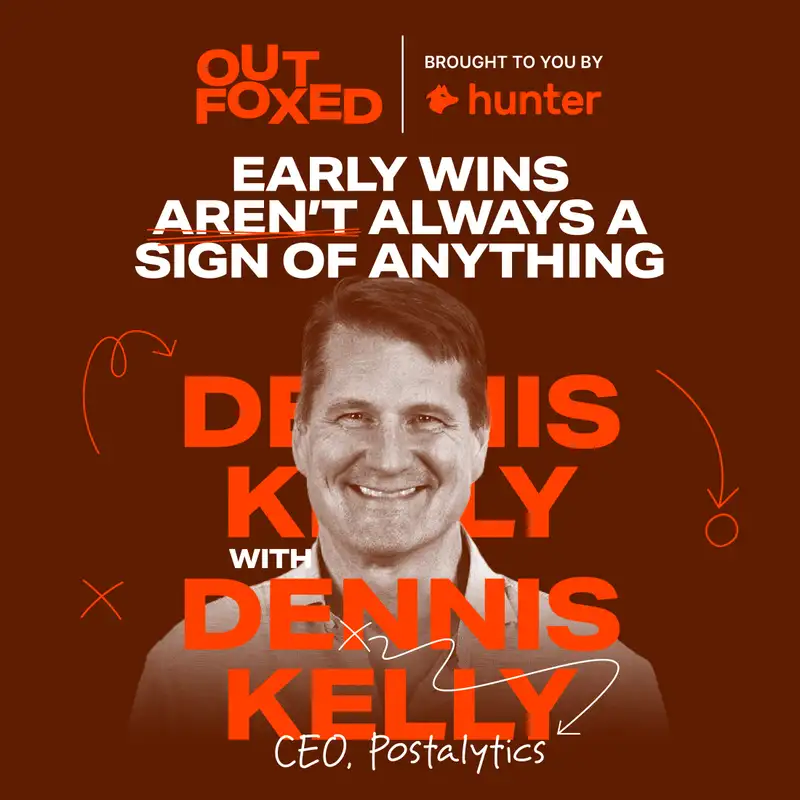
OutFoxed Ep. 7 - Dennis Kelly
===
[00:00:00] Speaker 2: This is Outfoxed, the podcast brought to you by hunter.io, the trusted B2B lead generation platform built for every professional. Get ready for no playbooks, no posturing, and no egos. I'm your host Hunter's head of marketing, James Milam, and my guest today is Dennis Kelly, the founder and CEO of direct mail automation provider post alytics.
[00:00:23] Speaker 2: Let's get into it.
[00:00:25] James: Alright, I am joined today by Dennis Kelly, the CEO of Postalytics.
[00:00:30] James: How are you doing, Dennis?
[00:00:31] Dennis: Doing great, James. it's great to be on today.
[00:00:35] James: I am really excited. You know, a couple of months ago, I took part in your podcast over at Postalytics and just had a blast and I know that we were talking a lot about The Office and, my obsession with memes and gifs from the show.
[00:00:52] James: But it kind of led into this conversation about sort of, the journey of Postalytics and sort of talking a bit about Hunter [00:01:00] and, the role of cold email and direct mail, and, you know, really having a, multi-channel approach to outreach. And I just wanted to invite you onto the show because I think that you have a really interesting story
[00:01:12] James: and I'm excited for you to be able to share that with everyone today.
[00:01:16] Dennis: Well, thank you. and if I can, you know, exceed Michael Scott's leadership, capabilities, at least to present that information to the audience, I'll be very happy today.
[00:01:32] James: So, something that we'd like to start off with, Dennis.
[00:01:35] James: It's, a bit of a, soft way to get into the conversation and, you know,one of the things I've been looking at recently is, is some survey data that we conducted a survey, a couple of weeks ago and it was all around multi-channel.
[00:01:49] James: And it turns out that with multi-channel, when you have more than one channel that you're using, so whether that's cold email or direct mail, you almost double your success rate [00:02:00] in terms of outreach, in terms of lead generation. How do you feel about the role of direct mail in a marketing mix in 2026, like how do you, like, how important do you think having something like direct mail is in the mix?
[00:02:16] Dennis: Well, I think for certain industries and use cases, direct mail can be very important and it can add a differentiated touch to a multi-channel or an omni-channel marketing strategy, you know? We are all faced with overwhelmingly crowded email boxes. We all are mass deleting emails, hundreds of emails a day, our spam filters are working overtime to separate, [00:03:00] emails into different folders of ours.
[00:03:04] Dennis: And we're bombarded with digital ads, digital messages from a million different sources. And so, one of the things that direct mail can do because the physical mailbox is a little less crowded than it used to be, is that it can offer, the marketer a chance to connect directly with an individual, in
[00:03:32] Dennis: a way that is tangible and different than the strategies that the vast majority of marketers and salespeople are following. And so, you know, as a standalone marketing channel, it has effectiveness and it can do things, for folks. but we find the same thing that when used in [00:04:00] combination with email.
[00:04:02] Dennis: With text messaging, with digital ads, direct mail has a multiplying effect, and it will often trigger a memory of something that was seen previously. There's a lot of research, that has been done around the way that our brains process various types of media, and there's very clear evidence that
[00:04:31] Dennis: when there are multiple senses that are associated with addressing a particular ad or message, then there's a far higher recall and a deeper penetration of that message in that brand, in our brains. And so direct mail is a scalable model. Has a [00:05:00] scalable way of, letting you reach out and connect in that tangible way.
[00:05:06] Dennis: That can both reinforce messages that are being seen in other channels, as well as, introducing people into a concept that perhaps then gets, built out over other channels over time. And so, we see a lot of this, it's a large part of the reason why we created Postalytics was to facilitate
[00:05:30] Dennis: an easier way to manage direct mail as a part of a multi-channel strategy.
[00:05:37] James: Yeah. I love what, you guys are doing, you know, in a previous life when I was the, when I was the marketing manager at a telecom, a B2B telecom business back in England, we ran a golden ticket competition.
[00:05:52] James: And it combined direct mail with cold calling, with cold email, with display ads, and a little bit of [00:06:00] door-to-door canvassing. And what you're saying there in terms of just like engaging, like different sensories, being engaged, like that is a perfect example for me where I can go Yes, exactly like what you're saying absolutely is true because
[00:06:13] James: we tried some of these campaigns using just one or two channels that didn't involve direct mail and that didn't involve door-to-door canvassing. And I'm not saying for every person that's listening today, that's something that. Maybe it's applicable to you, but the principle here is that when you can run multiple channels at the same time, you build up this sort of halo effect, you build up this presence that, you know, let's be honest, whether we are targeting SMBs where it's six to nine touch points, or if you're targeting the enterprise, and I think Gartner recently talked about needing 39 plus touch points.
[00:06:48] James: Wow. You should be considering every channel that's available to you and, needless to say, the golden ticket idea is probably one of my cheesiest ideas that I had, and I [00:07:00] can't give credit to myself. it goes to a certain Willy Wonka.
[00:07:04] Dennis: Exactly. Well, I think everybody though, has deepened their, the recesses of their memory,
[00:07:11] Dennis: fond Willy Wonka memories. So I think it was a brilliant stroke on your part.
[00:07:17] James: The whole point of Outfoxed is to really, to help our listeners to kind of understand that they're not alone. A lot of the podcasts in this space, Dennis, I'm sure you, sense this too.
[00:07:30] James: They like to talk about the pie in the sky. They like to talk about everything being sort of perfect through rose-tinted glasses, and that creates this perception that if you follow these five, you know, these five hacks, or if you send 10,000 emails today, you can build a, you know, a $10 million pipeline in 24 hours.
[00:07:48] James: Like, that's not the point about Outfoxed. The point about Outfoxed is to get people like yourself, Dennis, someone who's founded a business and gone through a journey to the point where it's successful, and to hear about how they've [00:08:00] done that. And so there's no better place to start than asking you this really simple question that does evade some people as well when they're asking, talking about their business.
[00:08:11] James: Who is your ideal buyer and how did you get to the point of understanding that ideal buyer?
[00:08:18] Dennis: Well, I think that for those who are interested in silver bullets and hacks, that will instantly create $10 million businesses. I don't have a lot to add because, it's certainly not been my experience.
[00:08:37] Dennis: I've only experienced a lot of pain and hard work in order to get there, so, that's all I have to offer today. So, but, you know, at Postalytics, we have evolved, significantly, as a business, today.
[00:08:58] Dennis: We [00:09:00] identify our ideal customer as organizations that are, we'll call them tech-enabled SMBs. Through mid-market, sized organizations and the majority of our marketing and sales efforts are being devoted to developing these audiences. We have verticalized our go-to-market approach.
[00:09:30] Dennis: And so, we are focused very much on, developing, we'll call them pods of, personnel and expertise in particular industries, that are able to take direct mail, which, you know, in its essence is a very horizontal platform. Right? It's, like email. You know, it's something that every business in the world [00:10:00] could use.
[00:10:01] Dennis: And, you know, you could argue should use to some extent. Taking that very horizontal set of messages around things that we do more efficiently and better than traditional direct mail. And then narrowing them down into use cases that are meaningful for large numbers of people within an industry.
[00:10:26] Dennis: And, you know, at the end of the day, you know, we're selling to marketers. We're selling to marketing managers, directors of marketing, vice presidents, CMOs, and their concerns are really different. And their words, their language, their, the types of campaigns they run, you know, are very different.
[00:10:47] Dennis: You know, we do a lot in Telco, with ISPs and that type of company. Then we also do a lot in healthcare. There could not be [00:11:00] two more different industries, right? And their concerns and their pain points and the things that they're trying to accomplish, right? So what we've learned is that, you know, for us to be successful in these customer segments, we've sort of had to verticalize, our go-to-market approach a bit more than what we had thought of in the beginning.
[00:11:26] Dennis: And we've had quite a, lot of evolution in order to get to that this point as well.
[00:11:31] James: Right. I, love that you, have verticalized. One of the hardest things to do in any organization as a marketer is to have the conversation with the founder that
[00:11:44] James: the messaging right now is too horizontal. Could you talk to us a little bit about this process of how you identify the need to verticalize and then what that actually looks like in practice, Dennis?
[00:11:56] Dennis: Yeah. Yeah, of course. When we launched [00:12:00] Postalytics back in 2017, we launched it as a horizontal platform. We had no thoughts or intentions of verticalizing. The notion was this is MailChimp for direct mail, right? And so we were targeting small business, freemium model, and, entirely a product-led growth, style of company.
[00:12:29] Dennis: And it was successful and, it grew. And we attached ourselves very closely to HubSpot in the beginning. We built the first direct mail integration into HubSpot. And really threw a lot of our marketing efforts at the HubSpot customer base, we launched the product at Inbound. We, you know, we're very, very active and still are very active in the HubSpot ecosystem.
[00:12:58] Dennis: And [00:13:00] you know, even in 2017, HubSpot was a very large company and, you know, is very much a horizontal platform for marketing automation and CRM and other things now. And so just by putting ourselves out there in that community, we were able to attract a wide variety of, customers, various sizes and in every vertical under the sun.
[00:13:28] Dennis: And so we start off swimmingly, you know, with this type of model and we're seeing early signs. We're gonna be the MailChimp of direct mail. And, then, you know, after a couple of years. We started to see that there were some, patterns emerging in the customer base of some industries that were doing, the same thing over and over again, in terms of the types of [00:14:00] campaigns they're running and, then they're scaling within the platform and sending a lot more mail.
[00:14:09] Dennis: You know, at the end of the day, our business model is really a usage based model. And so the more direct mail that you send, we do better. And, so we, it became apparent that we ought to start studying these collections of use cases, which led to the realization that the more sophisticated marketers in the
[00:14:37] Dennis: kind of upper end of the SMB segment through the mid-market were really utilizing the platform to solve similar pain points in the same industry. And so, you know, the use case, the sales conversations, were lining up and they're [00:15:00] very, very similar. And so that's really what led us to have an understanding that one interesting way to scale that would be different than perhaps some of the other companies in our segment that we compete with would be to, think about the product as a platform layer
[00:15:24] Dennis: of execution, and fulfillment from a printing and postage management standpoint, lot of very, you know, common things across all use cases. And then to really refine our go-to-market approach to, narrow the focus of groups of people within the organization to start, you know, building out a deeper relationship with the industry, [00:16:00] and by doing that we mean, well, who are other players in the ecosystems within a particular industry?
[00:16:10] Dennis: Who are the agencies that have gotten, that have specialized and have really developed strong networks and, deep understanding of the pain points and the use cases for different marketing channels within the industry? And then going out and building relationships and being, sponsoring events and, you know, being present in the communities that are built up around vertical industries.
[00:16:40] Dennis: So, you know, that's really been the evolution of the organization to sort of think of ourselves. We still are that horizontal platform, but there's a level of abstraction between the execution engine [00:17:00] that is, underlying our, you know, more specific and vertically oriented, go-to-market approach.
[00:17:09] James: I love what you're saying there, Dennis. I think that the reason why I said that that's a tough conversation that I've tried to face so many times with founders is that, it is a really tough choice to make, right? This idea that you go from potentially having this massive scope to then this really tiny scope. Tiny, you know, it's relative, but the thing that we talk about at the top of the show is the Outfoxed is not about theory.
[00:17:35] James: Well, the theory here clearly is, well written, you know, it's crossing the chasm. It's this idea that you should be able to, find a network that you can then scale from early, early adopters through to an early majority. You've actually done this, like you've actually done this with Postalytics.
[00:17:50] James: You've understood the verticals that are really resonating and you've been able to build tall with those verticals, but that's a sort of [00:18:00] open-mindedness that makes me wonder something that, you know, we've asked Rand Fishkin in a previous episode and I would love to ask you, Dennis. Have you had to pivot the business at any point?
[00:18:09] James: And if you have, like what did that look like and why did that come about?
[00:18:13] Dennis: Well, perhaps the, open-mindedness was a forced, crowbar stuck into the side of my head and ripped open because of the pain being experienced in an initial version of this thing. And so, we have adapted significantly. And, I think
[00:18:35] Dennis: those experiences when you do experience the pain associated with a pretty drastic pivot, it opens up your mind a bit more to more of a continual refinement of strategy. So prior to Postalytics, [00:19:00] my partner and I had launched a company called Boingnet. It was a evolution of a side project that my technical co-founder had built, and it was in the direct mail space.
[00:19:17] Dennis: and, it, rather than replacing the current direct mail process with a tech-based solution, it was a tech. That could be inserted into the traditional direct mail process, typically by a commercial printer that was trying to offer additional marketing services, which many of them do. And so that original product was aimed
[00:19:51] Dennis: to provide these commercial printers, direct mail agencies and other players in [00:20:00] the, legacy direct mail ecosystem tools to offer digital marketing components that augmented their direct mail capabilities so that they could be the providers of omnichannel or multichannel marketing strategies. And so we built a product that, enabled, the offline to online ramp with QR codes and personalized URLs, landing page tools where personalization could be layered in, email marketing, text messaging that could all surround the data set being used to drive a direct mail campaign.
[00:20:46] Dennis: And the thinking was, well, we got some really great feedback from some early customers. We got picked up by Chrysler in a deal very early, so there are a lot of really [00:21:00] positive signals around this model. And, but as we started to add staff and started to spend money, we were seeing that the sales cycles were
[00:21:15] Dennis: dragging on, and they were much, much longer than what we had modeled or what we had anticipated in the middle of a MarTech revolution, say 2015, right? Like the MarTech thing is exploding, we're trying to disrupt this legacy marketing channel through this approach and the velocity of adoption. Both during the sales process and then post-sale from an implementation standpoint, that velocity was just not matching anything that we were expecting.
[00:21:52] Dennis: So we're having problems, but, well, there are obvious solutions to problems.
[00:21:57] Dennis: So change messaging, [00:22:00] change people, change some marketing strategies, sell the different segments and nothing was really moving the needle. So, you know, we were very frustrated and, along the way we started to hear from small to mid-size businesses that had invested heavily in their CRM and market automation tools.
[00:22:33] Dennis: And they find us online because of some keywords and things that we were doing. And, you know, they would say, Hey, you know, you guys are kind of living in between the direct mail world and the digital world, and you're providing all these tools, you know, can you make direct mail easier for us? You know, we've just invested all this time and money into building out Salesforce [00:23:00] or HubSpot, and we wanna leverage our investment in this channel.
[00:23:06] Dennis: But the channel is being, you know, processed entirely offline through exporting and spreadsheeting and email and FTP and meetings with people and all this project management, it's completely disconnected from our investment. And, after hearing that a few times, it became very clear to us that we were attacking the wrong problem.
[00:23:39] Dennis: That the problem of the legacy direct mail ecosystem was not the problem of the end user of direct mail. And while we were solving what we thought was would be the key problem [00:24:00] to gain distribution, what we came to realize was that there's a reason why this channel hasn't adopted technology, and it's not because of the end users, it's because of the legacy providers of direct mail that they, you know, they were just not very good at adopting technology and rolling it out and selling something different.
[00:24:33] Dennis: And so we thought, these are the guys we need to disrupt.
[00:24:37] Zach: Today's episode is brought to you by hunter.io, the B2B lead generation platform made for every professional, whether it's prospecting, fundraising, recruiting, link building, or just trying to connect with the right people. Hunter makes it easy.
[00:24:53] James: I've spoken to hundreds of founders and in like, in just in a research capacity and something I've found [00:25:00] quite consistent is what you're describing here, which is that they think there's a problem.
[00:25:04] James: They had the right intent to think there was that problem, it wasn't an ego thing. They just thought that they had, there was a problem, but it wasn't until they went through a journey like you're describing, that they could actually get to realize that it was the wrong problem. Do you think this would've happened
[00:25:16] James: but for that growing pain period?
[00:25:20] Dennis: Certainly not with the mental processing power of this founder. he had to go through the pain point to, in order to, arrive here. It certainly was the logical conclusion, at least from our perspective, that the folks that control 95% of the market
[00:25:48] Dennis: would be the people to lead that market to the next step. And only in retrospect could we understand that there were some fundamental reasons [00:26:00] that had, that created the problem in the first place for those people that, and that ultimately the existing traditional ecosystem was the thing that needed to be disrupted in order to really make direct mail
[00:26:18] Dennis: an equal partner at the table, in the CRMs and marketing automation tools and in the, you know, multichannel marketing world.
[00:26:28] James: One of the things that stands out to me is obviously you went through this phase, and you had to grow and reflect and change. But then also you've, launched Postalytics and you've, completely, it sounds like it's, kind of changed the trajectory.
[00:26:44] James: What is that, what was one lesson that you took from this whole experience that you think, oof, if I could have talked to Dennis from, you know, 11 years ago, I would've told him this?
[00:26:55] Dennis: I think it all really boiled down for us [00:27:00] to the, perspective of understanding early feedback and, you know, early quick wins are not necessarily a sign of anything.
[00:27:16] Dennis: They can be very random and, that, you know, the fact that you see a problem, you solve a problem and people buy it fairly quickly in small volumes, does not necessarily translate to a business model that will grow for a long period of time to be a large business. And, while you can certainly extrapolate and make the case for that to happen with those early wins.
[00:27:55] Dennis: I would advise folks now to discount [00:28:00] early wins and to take a more measured and disciplined approach to, and, maybe more of a skeptical approach to, the early success of a product and, really start poking holes in it as best you can early on. It's so hard to do because of the emotion attached to the process of actually creating that first product, right?
[00:28:35] Dennis: So it's not an easy task, but it could end up saving people a lot of time and money and heartache. If you are able to identify, that that early success may or may not be a good signal and [00:29:00] that, you should reserve judgment on the thing that will actually be the first real hook that your business can establish in a particular market.
[00:29:12] James: That is brilliant advice. There's one thing that I want to ask though. It is difficult I think for founders to hear feedback that is not positive. But the only way you can get to feedback that's not positive is by asking the right questions. Like, if you don't know how to ask the right questions in a user feedback session, or you didn't close that deal, and you just had like, Hey, why?
[00:29:38] James: Like, and you're, trying to find out what, the reason is. If someone says to you, oh, you know, you were great, or we just chose another provider, like, that's not enough. What is an example of a question along those lines where you were able to, ask a question that got to the real core of the issue about why, [00:30:00] this original iteration of, Postalytics was not the right fit for a buyer?
[00:30:07] Dennis: So in the original distribution model we had, really a two step process. We would sell the product into the organization. Typically executive level, Hey, we wanna try something new in our business, you know, we've got a good solution to help you, try this out. And we, you know, these, every print service provider
[00:30:45] Dennis: has felt the need to expand their offering, right? For a lot of obvious reasons. And so offering a digital, a method to do that via digital means is, attractive, [00:31:00] to folks that are running these organizations. The problem is that then, in order for the product to actually take hold. Their sales teams have to sell it.
[00:31:16] Dennis: And so it was really not a problem selling to these organizations and getting 'em to buy into the concept. The problem ended up in the sell through and what we didn't anticipate is that, the industry's sales organizations. Are filled with veteran salespeople, who are somewhat, for lack of better phrase, free agents that are pretty much straight commissioned salespeople that will move from printer to printer, bring their book of business with them, [00:32:00] and the appetite for massive change in selling something that is unfamiliar
[00:32:09] Dennis: was very, low. And so the types of questions that we ended up getting to, were really with the sales teams of these folks and asking, you know, why is this not selling? Why, what is, what are the, friction points that you're getting in the sales process? And really what we learned is that they had no interest at the end of the day.
[00:32:41] Dennis: They just, ignored it and really thought it was superficial and, not important to the objectives of those salespeople. And, so then that realization led us to understand that there's a fundamental [00:33:00] problem with the business models and the distribution models of those organizations.
[00:33:06] Dennis: And it was a mistake to try to attach ourselves to them in the beginning. And so we had to, we needed to ask questions of the people that would be actually selling the service, and we didn't get there for quite some time. We didn't get down to that level and start having those interactions until we were a couple of years in.
[00:33:30] James: But you did get to those questions and you did pivot. So if that was sort of the old distribution model, the old way of kind of promoting and getting visibility for the product, tell me about right now,
[00:33:42] James: what is the most effective channel that you're using right now to grow Postalytics in terms of top of the funnel.
[00:33:49] Dennis: The top of the funnel is no question. It is still SEO. And you know, we invested in SEO very heavily from day [00:34:00] one, with the notion that the other players in the industry who we were attempting to disrupt had almost zero investment in SEO.
[00:34:14] Dennis: And so it was a wide open category, for us. We were able to establish some foundational content strategies and website work that have allowed us to build a very strong presence in SEO. And, you know, those same processes seem to be working well in the LLM-based, you know, optimization that folks are, you know, worrying about now.
[00:34:51] Dennis: And so by far and away from the top of the funnel standpoint, that is, has been and is our [00:35:00] most effective channel. We use direct mail to augment, inbound interest. And so if you were to connect with Postalytics and express some interest, we would do a bunch of work inside of our HubSpot instance and figure out, hey, you know, James is an ICP.
[00:35:26] Dennis: And so we're gonna trigger a letter from Dennis, the CEO to James, the CMO, that is personalized and is offering a high value piece of content as a thank you for, you know, expressing interest and, you know, but you have to hit the QR code in order to do, to access it. And then we're capturing that which is triggering off the next step in the journey.
[00:35:53] Dennis: So we do, we use direct mail for use cases that are [00:36:00] traditionally not used, that direct mail is not used for, and so, that, it's a part of our stack and it's, a tool, within our stack, but it's one of many.
[00:36:16] James: I think it's so important to drink your own champagne. I know people say eat your own dog food, but we'll say drink your own champagne.
[00:36:22] James: We're gonna
[00:36:22] James: much better
[00:36:22] James: be a bit classy here. It's so important to drink your own champagne And what you're describing there, which to me sounds like a veto letter, which is like such a staple of a sales cycle. Like to have that in your, nurturing cycle is awesome.
[00:36:40] James: So let's say that I bite, I reply, or sorry, I scan the QR code, I get further into the funnel.
[00:36:49] James: Am I going to be talking to you at some point? Are you gonna be pitching me? How does that look?
[00:36:53] Dennis: You will be getting video content, [00:37:00] that features me, as a part of the sequencing of messages that go out. But you'll be hearing from a rep who has been assigned to the vertical that you are operating in.
[00:37:15] Dennis: And that rep will be attempting to establish, a relationship based on their understanding of the common pain points and use cases of the particular vertical.
[00:37:27] James: I love that. When we talk to founders, they're reluctant to say that they are salespeople or that they do any form of selling when they run outreach.
[00:37:37] James: Do you, at any stage in the Postalytics journey, have you considered yourself to be a salesperson?
[00:37:44] Dennis: I am a salesperson. I always have been. It's my, it was my initial job outta college. It was my initial track through the business world and so I [00:38:00] enjoy selling. I enjoy working with customers, working with partners.
[00:38:06] Dennis: I love spending time on product, but I, have a technical co-founder, who is, it's really his purview. So, yeah, I'm much more, I think, interested in speaking to customers, than other founders because of my background I would guess.
[00:38:27] James: Do you think it's purely psychological to say, no, I'm a sales, I'm not a sales person?
[00:38:32] James: Because if you are, even if you are a technical founder, let's say there's not a co-founder here. This, you're just a founder, but you're more of a technical mindset. You ultimately have to find people who you have built the product slash solution for. So whether you call it selling, prospecting, networking, surely it's psychological.
[00:38:55] Dennis: There's no question that[00:39:00]
[00:39:01] Dennis: you must embrace the power of your product, the power of the thing that you have so carefully diligently built with all of your might and all of your strength. You've created this thing and it was so hard to do. You have to recognize that and, you have to, pivot any type of hesitancy. You have to talk about it into almost a zealous passion to promote, to evangelize maybe is the right word, right?
[00:39:52] Dennis: And to talk to anybody who has any interest at all in talking to you, you have [00:40:00] to sort of take that, all that energy and use it to spread the word, to find, you know, early customers, to build great relationships with people that you trust. So that as you are building your business, you can reach back out to them and you can get honest feedback about new features and, product direction and roadmap and, have honest conversations about how your CS team is doing with things.
[00:40:34] Dennis: And, you know, all of those things that are foundational to building a great business involve communicating with customers or prospects. And so, I know that some people become wildly successful by creating such brilliance in software [00:41:00] that, you know, everything is apparent and people will use things without any explanation, but it's pretty rare that that happens.
[00:41:09] Dennis: And so, without that, it really requires that human element.
[00:41:18] James: Right, exactly. And I think that there's an element of this as well where you have to be prepared to be embarrassed, to be rejected. Like that's gonna come at some point. Why would you not want that to be at the beginning of the process where you can learn quickly and sort of, you know, set your path, outright. I think
[00:41:40] James: given that it's Hunter that is obviously bringing you this podcast, I have to ask you about cold email. What is the best cold email you have received and what was good about it?
[00:41:54] Dennis: Let me start with some things that are not good. Inserting events into my calendar [00:42:00] through cold email. There is nothing that infuriates me more, than abusing the calendaring standard to insert events into my calendar without my permission.
[00:42:19] Dennis: Things like that, that are hacky, spammy are things that, I find objectionable. The cold emails that work for me that I find interesting are very topical, very, pain point focused. And so I received an email last week from someone that [00:43:00] was pitching a social media, sort of management tool and they figured out that we had been using HubSpot's built in social media scheduler.
[00:43:20] Dennis: And I'm sure there's some ways of that folks like that can determine these things. So, this person sent an email acknowledging what I found to be the single biggest pain point associated with HubSpot's social media, meeting scheduler, and offered a solution in the subject line. And you know, it's a pain point that I've been
[00:43:52] Dennis: furious about for some time, and it caught my attention, responded, had a demo [00:44:00] yesterday, and we are well on our way to having a relationship with this company. And it was done through a lot of research by that person and in creating a subject line in an email that was highly personalized to
[00:44:20] Dennis: our particular pain.
[00:44:21] James: That is, it's so obvious, isn't it? It's so obvious what you need to do, but people don't do it. 96% of emails go unresponded. Cold emails I should qualify that. 96% of cold emails go unresponded, like the ones that get responded to. They're relevant, they're personal, and they give you a reason to trust. Clearly that person
[00:44:49] James: did their research and pinpointed you to reach out to, and it's paid off. Like that's how, I [00:45:00] sound like I'm preaching, but it, is painfully simple how to do this, and it is my hope that more people can send you those sort of emails that actually are relevant. You may not have got the timing correct.
[00:45:14] James: They may have got the timing completely incorrect. You may have just gone through, your HubSpot renewal and they just missed you by a couple of weeks and you, you know, just don't have budget now, for instance. But they, the quality of the message there and the relevance sounds like it speaks for itself.
[00:45:33] Dennis: It does, it does. And it contrasts and stands out against so many other emails. There's this current trend where I'm getting emails that address me as Mr. Just, Mr. It'll say, Hey, Mr. and then not, Mr. Kelly. Let's just say Mr. And I'm getting these, you know, 5, 10 a day, and [00:46:00] I'm thinking, who are the people that have coached these SDRs to do this?
[00:46:05] Dennis: I guess it's a pattern interrupt, right? Like I'm expecting to see, so maybe that is the hook, but it's not gonna work with me anyway.
[00:46:18] James: I don't think it's gonna work with many people. Dennis.
[00:46:24] James: I have had a, I've had a blast talking to you today. I hope that our listeners, founders, marketers, sales people alike, there's plenty of advice that Dennis has given from today's episode that I think we could all walk away with. If I could ask you one last question, and this is a, you know, this doesn't have to be business related, but what is right now in your reading podcast or, just anything sort of entertainment list that you're really enjoying?
[00:46:54] Dennis: Well, I am very [00:47:00] concerned. About the state of the US economy heading into 2026. And so I am spending a lot of time trying to understand, where we may be heading, with a, likely rise in inflation, a likely AI bubble popping, in the stock market, asset values diminishing, real estate getting held up.
[00:47:34] Dennis: So there are a lot of very, unsettled signs in the US economy that I'm trying to get my head wrapped around right now. And so I spent a lot of time, reading and thinking about how to position the company and of course, the Kelly family, to, you know, be in a position to [00:48:00] do as well as we can in this environment.
[00:48:03] Dennis: it's a very challenging time. there's a lot of fluidity and a lot of things that we haven't seen before that are impacting the macroeconomic environment. And so, I'm a bit of an economics nerd. And, so, I enjoy digging in and sinking my teeth into the macroeconomic context of the environment we're dealing with.
[00:48:32] Dennis: Probably not very fun.
[00:48:36] James: We all have different ideas of fun. I'm not sure you think that is fun, but I think you think it's valuable and like everything today, it's been incredibly valuable. So, Dennis, thank you so much for the last 50+ minutes of talking with me. And for our listeners, thank you for joining us and if you, have any questions about Postalytics, wanna speak to Dennis himself,
[00:48:58] James: there'll be information about how to [00:49:00] contact him within the description of the show. But for now, thank you Dennis, for joining us on Outfoxed.
[00:49:05] Dennis: James, always a pleasure to connect with you and, so happy to speak with the audience today.
[00:49:11] James: Thanks, Dennis. If you like what you heard, please like, subscribe
[00:49:15] James: and explore even more of the Outfox community by visiting www.outfoxed.hunter.io.