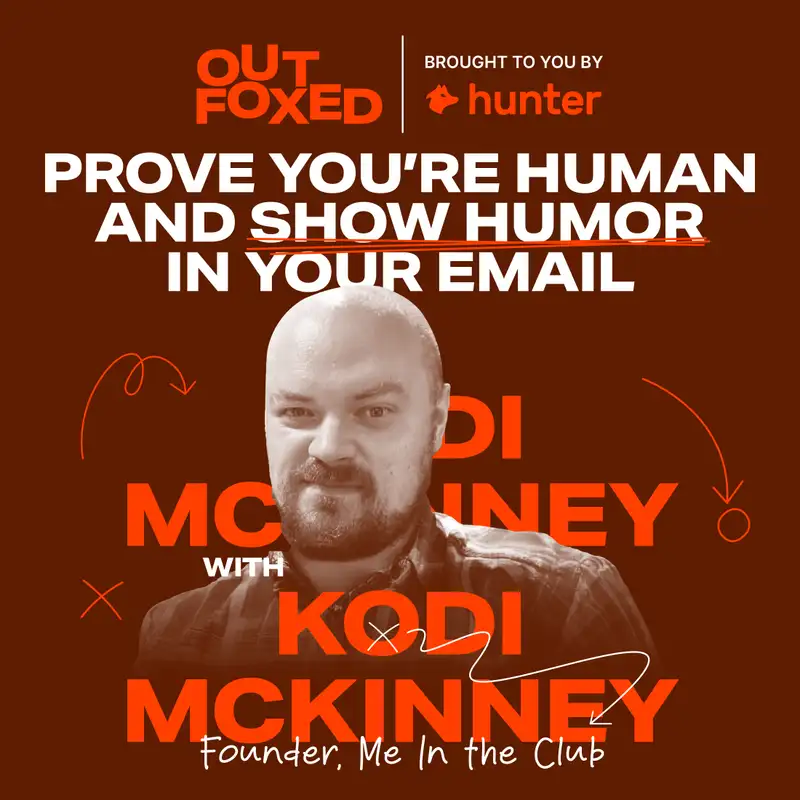
Outfoxed · Ep 11 · Kodi McKinney no subs
===
[00:00:00] Speaker: This is Out Foxed, the podcast brought to you by hunter.io, the trusted B2B lead generation platform built for every professional. Get ready to know playbooks. No posturing and no egos. This is the show for the builders and not the theorists. Let's get into it.
[00:00:17] James: Today we are joined by Kodi McKinney, who is someone that I have spent a considerate amount of time talking to in the last couple of months, and someone that I've really kind of grown quite fond of. And it's someone that we have wanted to bring onto the podcast after we spoke to Spike Johnson early in the show and who was a photojournalist.
[00:00:38] James: And I think there's a really good, a kind of really good comparison here to have between Kodi and Spike in their stories. And so, Kodi, welcome to Outfoxed.
[00:00:49] Kodi: Thanks for having me, James. I very much appreciate being here.
[00:00:53] James: You have one of the more unique, kind of stories to tell our audience, I think on Outfoxed, [00:01:00] and one of the things that really I enjoyed over the last couple of, you know, times that we've spoken is just hearing about
[00:01:05] James: you're from a media and entertainment background and that is something that we don't typically hear much of when it comes to things like, you know, lead generation. Tell us a little bit about me and the club.
[00:01:18] Kodi: Well, you know, I, will say, I do come from that kind of entertainment background where friends of mine used to come to me and be like, so,
[00:01:25] Kodi: what do you do? How is your job real? When I was doing radio promotion 15 years ago, much less once I'd gotten through to the point of, you know, doing what I do now, which is, you know, now what I do is I'm a growth marketing expert for companies and artists alike. So, I work with creative businesses under their go-to-market strategy and then help execute them.
[00:01:46] Kodi: And that in, you know, in tech and in healthcare and some of these, in some of these more established businesses that are used to being scrappy and raising capital, you know, they call what I do, you know, being a [00:02:00] fractional CMO. And in the music industry, they just call it wearing a few hats at once.
[00:02:06] Kodi: And this is one of those things, you know, it's like, yes, I have owned a music marketing agency, you know, with, my old business partners, that, you know, I've had that for almost a decade. And so, you know, I'm not just somebody off the street who said, I'm going to do this now, but I still know that by the nature of what I do, people talk to me and they go, excuse me, what's your deal?
[00:02:29] Kodi: How is this a, how is this a thing that you've fallen into? It's like, well, this is, you know, quite literally what I've wanted to do for my entire life, and so I continue doing it.
[00:02:38] James: I love that. I mean, the fact that you're doing something that you wanted to do for the whole, you know, for the whole of your life.
[00:02:45] James: This has been something that's been of a passion to you. And you'd be able to answer that way. But whereas for me, Kodi, when people ask me sort of, what have you always wanted to do? And obviously I, gravitate towards marketing eventually, but my background, I have eight years of [00:03:00] education in law.
[00:03:01] Kodi: Okay.
[00:03:01] James: And I have two, law degrees, but I'm not practicing law. So, you know, for you that's great. Like this is something that's always meant something to you and you've been able to turn it into something that is more than just a passion. It's something that, you know, you're growing and that's why we love getting people like yourself onto the show because I think you have a very interesting story to tell us about growing, you know, growing as a person and growing as a growth marketer, specifically in the entertainment industry.
[00:03:30] Kodi: Yeah. And you know, I think~ I think that, ~that from where I'm sitting, you know, there is, there are a lot of interesting analogs between all these different businesses where they, that I deal with across a lot of different industries where, ultimately, everybody's trying to figure out what the secret sauce is for how they grow their business, right?
[00:03:49] Kodi: And there are so many people who think they have, you know, the get it quick solution. On any kind of basis, you know, [00:04:00] they, say, oh, well, you know, you can just run Meta ads and do everything that you need to do. Or, oh, you know, like, you should find, you know, these bot armies to post on Reddit for you with accounts that have been left dormant for six years so that they're not gonna get flagged on different forms.
[00:04:15] Kodi: There are all these different types of little hacks that, you know, become popular in different parts of the marketing world and I really do think what it comes down to, and I know that we're going to be talking about this a good bit, is it really does come down to how you make people feel and how you do what you can to still provide mutual value when you have conversations with new people and come to them from a perspective of how do I leverage this into something bigger for everybody?
[00:04:47] Kodi: And, it's not the, sort of things that you can easily automate. It's the sort of thing that you have to be willing to, to do and then you have to be, you know, obviously open to tools to help you do that.
[00:04:59] James: Right. [00:05:00] And I think that why, I think why we've got along so well in our conversation, Kodi, is that, you know, from my perspective, and I was talking to a colleague about this recently, as a B2B marketer, it's almost like you have a box that you have to sit inside.
[00:05:15] James: You can't be too creative. You can't be too personal. Like those seem to be the unwritten rules whereas I feel like what you're gonna share today is going to help marketers that are listening, founders that are listening, growth marketers, even, you know, being very specific to think outside of the box and to your point, think about how what we're doing, no matter what industry we're serving, is actually trying to make a human connection.
[00:05:39] James: And I think that is something that I've, I would love to kind of get your take on, like, I think that's a great place to start is really sort of how, what are the challenges that you face in terms of, you know, talking to artists, talking to people who are in the entertainment industry and helping them with promoting themselves?
[00:05:57] James: Like, is that something they're comfortable with? Do they [00:06:00] have the a like the business acumen to know what they need to be doing? What do you find?
[00:06:04] Kodi: I, you know, I think there's a lot of different things that you see. You know, I think that one of the things that I focus on a lot with artists that I work with
[00:06:14] Kodi: is helping either nurture that business acumen or develop it if they, you know, if it's something that they're, open to. If that's not something they have, that's okay because we haven't necessarily asked artists to do the entire thing from, top to bottom until very recently in the music industry.
[00:06:34] Kodi: You know, it really is with the advent of social media and the modern influencer economy. That we've put artists in this role of yeah, you know, you should be doing everything yourself and you should be able to, you know, constantly post content with very minimal supervision that's still productive for what you're doing, while also, you know, sitting down and writing full length albums.
[00:06:58] Kodi: And [00:07:00] it's a really strange position to be putting an artist in without any access to business training. You know, I don't think that we expect out of traditional startups, you know, startups, you have, you know, you have incubators, you have lunch and learns, you have fancy breakfasts where you get to meet other startup people.
[00:07:19] Kodi: I'm going to one of those next Tuesday, and I'm sitting here thinking, man, you know, this is, imagine if you had nice little, get together breakfast for people who were just musicians in the creator economy. But, you know, that's not really something that, that happens. You know, we, put a lot of,
[00:07:38] Kodi: we, we do this thing where we expect musicians in many cases to be full, you know, just full service entrepreneurs is really the best way I can explain it with, without actually giving them the tools to do so. We both look at it as, oh, that's a nice hobby you have. And also, [00:08:00] okay, well how do you make revenue doing it?
[00:08:02] Kodi: And, you know, it becomes this weird double-edged sword where we both don't take it seriously and also, you know, ask them to take it incredibly seriously.
[00:08:14] James: I think that what you're saying here, Kodi, is something that is going to resonate with our listeners because we do have a lot of solopreneurs, a lot of side hustlers that are listening right now.
[00:08:25] James: And you know, I've gone through phases as well where I've kind of done side hustles and yes, I have a bit of advantage in terms of I have the business acumen, but maybe not the same level of creativity as someone else in, you know, who you are helping. But I think though, what would be great to hear is sort of how do you approach providing that, that education and those tools to those people that perhaps are not feeling comfortable? Because I know for a fact
[00:08:55] James: that the people listening, there's gonna be a good segment that will feel the same and, [00:09:00] that's, you know, something that's definitely gonna be applicable regardless of the fact that, you know, obviously you are helping more creative types.
[00:09:06] Kodi: So one of the things that I do from the jump in and keep in mind, I've worked with literally thousands of artists in my career.
[00:09:13] Kodi: One of the first things I do from a jump is, you know, I avoid all pretense if I'm working with a new person. You know, the assumption that, you know, there's, you know, one way to do, you know, a record rollout or one way to build somebody's business for the next year to a year and a half of their life and build a go to market strategy for them, that it's just a logical fallacy, and we wouldn't believe that if we were talking to startups.
[00:09:40] Kodi: So we can't really believe it for people who are putting music on the internet. Yeah, it's a silly thing to do. You know, we're asking them to follow through marketing channels that just have a slightly different shape from what, you know, people who aren't in the music industry are used to. So that's one of the first things.
[00:09:58] Kodi: And so I always come to it [00:10:00] from the approach of how do I make something that is easily digestible that you can refer to repeatedly? And still actually help you with it and guide you through it in a way where we can have real conversations together. And what I usually do when I'm starting with a new artist is I have something called the discovery package that I personally run where, and it is not, you know, the sort of quintessential
[00:10:26] Kodi: you know, coaching vehicle or whatever. I take it quite a bit more seriously than that. I don't go from the perspective of, yes, you know, I'm on the phone with you and this is the time that it takes. It's, you know, I'm helping build something with you, and this is the time that it takes.
[00:10:43] Kodi: So what I do is, first of all, I go through everything they have that's public facing and I, you know, I put notes together with it. I put all of it into a report similar to like what you would do if you were an agency with a brand new client and that [00:11:00] client was, you know, a ticketing company or something to say.
[00:11:04] Kodi: But you know, the difference is that, first of all, I'm able to do this in, you know, a matter of hours, whereas if you're an agency, you know, sometimes it takes you a couple months to do that sort of thing where you're going through all the different branding elements and that sort of stuff. With me, it's, I know from looking at these things very quickly, what's working on a eye flow level, what doesn't, and so I can put all that together, make these suggestions.
[00:11:30] Kodi: Then what we do is we do an actual follow up call about it, and after that we go to a second stage, which is the strategy portion where I talk them through everything they're gonna need for actually having a real go-to-market strategy they can do. And that's not just, you know, the action items from the previous report by any stretch of the imagination.
[00:11:53] Kodi: That's, you know, you've got touring and mobility strategy that you need to figure out if you're an artist, especially if [00:12:00] you don't have your own agent. Which most artists don't. You know, you've got the actual timeline that you should be thinking out, about for when you're releasing records, when you're releasing new songs, what you're doing to gear up for other things.
[00:12:14] Kodi: You're doing how that all interplays and you know, one component of that is that I also create a bit of an easy, you know, reference sheet where I just line out, you know, what I think your ideal customer profile is how you would find one. And, you know, try to get people to kind of focus on, you know, in the marketing jargon, we call it the unique selling proposition, but for a musician, they're going, what are you talking about? There's millions of artists. It's like, well, sure, but, I bet you have a very specific vantage point and it's very specific viewpoint. We're going to draw it out and I actually try to, you know, work with them on building out how their revenue streams would look and how to look at things in the way where eventually they're going direct to fan [00:13:00] and everything that they're thinking about
[00:13:03] Kodi: with uploading to Spotify or Apple Music or YouTube, all this stuff is perceived as what they need to do on a marketing basis to advance their overall goal of being able to have a sustainable business and continue making music. Because I will tell you the really difficult thing about the music industry is that in my opinion, the truest definition of what makes a middle class musician,
[00:13:27] Kodi: is someone who's not losing money doing it. So just getting to that threshold versus what you and I would associate as being a middle class, you know, worker in the United States, you know, somebody, you know, making a enough money to comfortably have a roof over their head. Usually if a musician's making enough money to have a roof over their head, I would consider them to be an upper class musician.
[00:13:52] Kodi: So there's kind of this, there's this odd thing that happens where what you're trying to do is you're trying to help people [00:14:00] play to win and not play not to lose, because they're usually operating off of super limited income to begin with. And when you're operating off of super limited funding and you're not in that position of,
[00:14:13] Kodi: oh, I can go, you know, ask the SBA for, you know, a loan for my business, you know, because we don't have that kind of establishment yet, you know? Most artists have no idea how to, start an LSE. Sometimes we work on that, you know, these are things that I take a lot of pride on doing together with people where in the entire process we're, you know, we're going through all this, we're making sure they have something to refer back to and then reviewing it.
[00:14:42] Kodi: If they decide that they want, you know, project management assistance from me to actually put teams together for them to get some of these records rolled out. I definitely know the people we negotiate that I try to keep that as reasonable as I can when I do this sort of thing for companies, a lot more of it is about business [00:15:00] development and a lot more about, okay, well which individual people can we get to develop infrastructure for this?
[00:15:06] Kodi: How do we execute having the company at, you know, X point along y timeline? You know, what are the KPIs that we need to be thinking about? You know, that looks a lot more like what you would expect a traditional growth marketing push to look like. But when I do it for artists, there is a lot of handholding because there has to be, and there's also a certain amount of, but I can't do everything for you,
[00:15:31] Kodi: this is me showing you how to do it. And I do have people who get to the end of it and they go. Okay, so, you know, can you be my manager? Like, I'm not a 24/7 manager, but I appreciate the offer. But I can connect to people who might like to do that and,
[00:15:48] James: Right.
[00:15:48] Kodi: I think ultimately that's kind of the strange tension in what it is that I do is, you know, there's a certain type of person who,
[00:15:58] Kodi: you know, really [00:16:00] benefits massively just from having the guidance and because nobody's giving them that guidance and, so much of the industry is held behind. You know, an opaque curtain for 94% of the people trying to enter it. And then in addition to those people, I also have the people who are like, hey, can you help me, you know, get past a million annual recurring revenue?
[00:16:24] Kodi: Like, yeah, sure, okay, let's have the conversation. Let's see where you're at. You know, and so those are just inherently different things.
[00:16:30] James: I definitely want us to dive into a little bit of the more, B2B support that you give. But I would love to, I would love to try and make an analogy. I know that our listeners who are from a SaaS background, they are facing this almighty headwind, which is AI.
[00:16:52] James: AI has to be in everything. AI has to be the leading benefit, even though it's not leading feature, even though it's not. Would you [00:17:00] say that for music artists, if AI is this disruptive, force that is essentially changing everything in terms of go to market for people in software companies, how has the introduction of streaming platforms altered.
[00:17:19] James: Advice, advice and support that you give to those artists who clearly need some support, but they've got this goliath that they're now having to face that completely alters the the financials of, everything that you're talking about, helping them with.
[00:17:34] Kodi: So I have a very close friend of mine who I was catching up with the other day, and he made, in my opinion, an amazing point that sums up a lot about new tech.
[00:17:44] Kodi: And I actually elaborate a little bit on this conversation in my newsletter, The Club List, which you can get for free at theclublist.net. he says to me, the thing about new technology is it empowers, and it also takes away, and these are [00:18:00] things that we have to keep in mind at all times, you know, when you have a new tech advancement.
[00:18:04] Kodi: And I think that in the creative industries, you know, where income is sometimes shakier for the people who are actually performing until they're in that upper class. You know, in these creative industries, a lot of the ways in which you get revenue are inherently a little bit insecure.
[00:18:22] Kodi: You know, you're not, you know, doing 9-5 work. There's inherently more chaos in the mix, and that's true with many parts of the music business. That's true with venue operators who, you know, have margins that have only gotten tougher since 2020. That's true with record labels where, you know, the need to go through a record label, just to have yourself heard changes instantly upon the advent of streaming.
[00:18:52] Kodi: And, you know, the increased importance of record distributors moving into the digital distribution era, [00:19:00] where now, you know, record labels still serve incredibly important purpose for branding and marketing and supportive artists. But their deals have gotten, are as friendlier over time, and there are many reasons for that.
[00:19:12] Kodi: You know, the thing about this is, we're in this era where the advent of streaming changed how revenue comes to an artist massively. The advent of streaming did not completely remove revenue from an artist's, you know, record retail. However, what it changed was the way in which record retail is even done in the first place.
[00:19:36] Kodi: And a lot of people have not adapted to it, and a lot of people don't see it for what it is. You know, I, a lot of times now, you know, people will, you know, focus entirely on what their record is going to do on Spotify, for example, because they want extra playlisting, or they want, you know, extra attention, or they wanna be in the Discover Weekly algorithm with Spotify, which by the way, looks a lot like how what we would [00:20:00] define in market terms as artificial intelligence operates.
[00:20:03] Kodi: You know, these sorts of things have always been of great importance to artists because they're chasing after this number, but they don't understand what the number means. And I think that one of the most, intriguing and arguably, you know, a bit insidious if you're not really thinking about what, it means for you,
[00:20:27] Kodi: features that Spotify has, for example, is the streams that you can see that are total of each song next to every song that an artist has as long as they've had over a thousand plays. And anything under a thousand plays, they don't show. Those songs aren't monetized for royalties, which is its own discussion and controversy, understandably.
[00:20:48] Kodi: And instead you have this situation where you have one local artist looking at another and going, well, you know, we're getting more people to our shows than this band, but they have a hundred thousand [00:21:00] more streams on Spotify than we do. Now, we all know in this era that focusing on that is a death trap.
[00:21:08] Kodi: And the reason it's a death trap is because what you'll get paid from having, you know, from, having, you know, a million Spotify streams is a pitance of what you would get paid if you sold, you know, a 200 copies of a vinyl. And that is one of the things that is so easily missed when you are new to the business and kind of figuring things out.
[00:21:35] Kodi: And one way that I've seen people navigating this, and this is something that I'm increasingly steering my clients towards, is if they're going to have a new record, what I encourage them to do is to go through a service like Bandcamp or even, or something else like this that allows you to do, you know, direct to fan sales where you have a
[00:21:58] Kodi: name your price, [00:22:00] where you have to pay at least a dollar or whatever the minimum is. But, you know, and I, for the record, I advise having that be a minimum $7 so that you're, you have retail compliance anyways, continuing. You know, the biggest thing with this is that if you're doing this and then four weeks later you turn around and the records on streaming.
[00:22:20] Kodi: That's great. You're using streaming as a marketing tool, but if you, what you're doing is you're coming in and saying, hey, I'm gonna do my record as a simultaneous release everywhere as a developing artist, it just doesn't work out in your favor. You know, I have a band that I was personally in, in 2020.
[00:22:41] Kodi: And, you know, I have the advantage of, well, I understand what it is to be a marketer, but I don't wanna put too much of my thumb on the scale. So why don't we just do this in the way that's most sustainable? I don't care about having flashy stats. I just want us to have something lasting. What we did was we did all of our [00:23:00] releases through Bandcamp and we did it in such a way that we were still going to streaming within a week.
[00:23:05] Kodi: But you know, in some cases within a day, I think we did the album a day ahead of time on Bandcamp and I'll have, you know, we made back all of our recording costs at the end of the day through Bandcamp. It was pretty awesome.
[00:23:19] James: Oh, okay.
[00:23:20] Kodi: And that was not off of, you know, some kind of crazy influx of, you know, followers.
[00:23:30] Kodi: It was because friends of ours had decided that they wanted to spend $20 on the record. Had wanted to spend, you know, $25, $15 for an album that had nine tracks and was priced at seven. That's one of the things that is, you know, I mean this is a strategy from five years ago. These strategies now are becoming more commonplace because so many artists don't [00:24:00] realize how much they're leaving on the table. And I think for years they had been so focused on comparing themselves to people down the street that they were missing actually thinking about what worked for their business.
[00:24:13] James: Yeah, I, we could spend the whole episode talking about this. I think it, the fact that it's always easy to, you know, try and keep up with the Jones' is right? Like, it's so much easier to compare the have-nots, to the haves. And I think that what you said there, Kodi, about, you know, the fact that you took a different approach and it might not have been revolutionary, but you know, sometimes just being different than, is better than.
[00:24:42] James: And I think for our listeners, there's something that I think about a lot is, and this isn't confined to cold email, but if you think about your entire, you know, your marketing mix, if everyone's on LinkedIn and they are bombarding [00:25:00] news newsfeeds with sales pitches, and then also in DMs, why would you go and play in that arena?
[00:25:06] James: Maybe you should do something more authentic, which is exactly what Kodi did with his band, which is doing something completely authentic to them and something that was meaningful to them versus going straight to where all the noise was. Like to me, I'm not gonna say it's genius because I think like, clearly it's something that someone thought about before.
[00:25:24] James: But yeah, it's a very clever way to approach it.
[00:25:27] Kodi: I would say slightly better than average thinking at most. I think the genius would be strong. I'm far from the first person doing it. But I think that what it comes down to is you have to be open to new tactics for doing things the same way that you have to be open to new technology without,
[00:25:45] Kodi: you know, letting it rule you, I mean, you know, I see, you know, guys who decided that it would be a great idea to build a song out of AI only, and then they wonder why their distributors are doing automatic takedowns of it. It's like, well, yeah, because you're gaming the system. [00:26:00] Like there's, people don't want to hear something that was created entirely with AI.
[00:26:04] Kodi: They wanna hear something that's you, like, that's human nature. And so, I think that the way that I see it, there is a very, very old school marketing approach to this, and this is actually something that, you know, I had a conversation about with an old employee of mine during the COVID era, and it ended up being something that I've gone back to so many times, which is, you know, in the Golden Age of Hollywood, they called it the Rule of Seven, right?
[00:26:32] Kodi: Where the rule of seven was that you needed to see something about a film from seven different angles before you would likely make a purchase. And when you think about that from the perspective of what that means for modern marketing, what that means for a modern artist, I think that a lot of artists and businesses are stuck on using really one or two channels that they understand, and in reality, [00:27:00] it's very important to always be on a few channels that you don't entirely understand, but you're kind of poking around and maybe owning the fact that you don't understand them.
[00:27:11] Kodi: That's an important thing to do. You know, if you're getting lost in the newsfeed on LinkedIn, you're already, you know, that's one channel. You know, you already have LinkedIn DMs. You can do, you have direct emailing. You can do, you have actual flyering in your community. If you have a business that allows for that, you have,
[00:27:34] Kodi: bulletin boards that you can post yourself on that are physical and digital. That's two channels right there. There's obviously Reddit, which obviously you have to be very careful with in terms of how you put yourself on there 'cause they're, they might be assistant, but, you can run ads on Reddit now if you're willing to put up the scratch for it.
[00:27:54] Kodi: And I've seen those ads be very effective. You have Instagram, you have TikTok, you [00:28:00] still have Facebook, even though it's obviously not what it was for this, you know, you, I quote unquote, have X, you know, you have a few different, yeah, right? You, have a few different channels that you can be looking at, but it's not just social channels.
[00:28:19] Kodi: What you really wanna be doing is you wanna be trying to find ways to reach people in a combination of the digital world and the physical world. And in order to do that, going after more traditional, almost, you know, for a less egregious phrase, you know, a more punk ethos to it of, you know, this comes from the house show era of, okay, I went to see this band and I got three flyers for the next show, and I'm gonna give two of them my friends, and I'm using the third one.
[00:28:49] Kodi: So I remember it like, that's, you need to be thinking about doing these types of things. And they call it omnichannel marketing in the jargon way. But you know, this is something [00:29:00] that for a lot of the music industry has always come quite naturally, and we've never just really used
[00:29:04] Kodi: it the same
[00:29:05] Kodi: name for it.
[00:29:06] James: I could understand in the music industry at an artist level, perhaps, a certain level of naivety, which is understandable. Like why, would you think to use these different channels. But, another side of your business, Kodi, is serving tech companies, right? And, you provide services to those people.
[00:29:26] James: And this isn't really about pitching yourself, although obviously in the show notes there'll be lots of information about Kodi, etc. But in terms of the sort of transferability of perhaps insights that you get at a artist level or maybe the advice that you provide to artists. How much of that is applicable to tech companies, and, if it is, how do you customize that
[00:29:53] James: so it really resonates with a founder who needs your help?
[00:29:57] Kodi: I would say more of it is transferable than you'd think. [00:30:00] And the way that I, the way that I see it, and this comes from having worked with a lot of very hungry CEOs and founders with big ideas. You know, creative energy is what drives me to do the work that I do.
[00:30:13] Kodi: You know, it's the thing that, it's that little bit of instability that can be applied in a way that adds to the entire rest of the world that I think is incredibly fascinating. But I, saw a, you know, I saw a marketer that I really respect, through who I follow LinkedIn and make a, really interesting point about this.
[00:30:31] Kodi: You know, he said, you know, 50% of a CMOs job is managing the CEO. It's like, you know, that's not entirely wrong because the thing is, you know, the CEO comes from the perspective of how do we get revenue? How do we not mess up? And the CEO's perspective is, okay, these people aren't doing enough and this thing isn't performing the way we want it to yet. Do we get rid of it?
[00:30:56] Kodi: Well, you know, we're building a runway for this thing. [00:31:00] You know, we, let's say that we have a narrative that we're establishing that's a marketing narrative over. You know, a few months that's not something that you're going to have results on, that are, you know, the immediate needle shifter usually in a week of a campaign.
[00:31:17] Kodi: You know, you have to be able to, you have to be able to allow some patience for things to play out. And I will say also that's another way in which there's a lot of similarities and, you know, one of the biggest jobs a manager has when they work with an artist is to help them be patient. Because they're going, well, I have this amazing thing that I feel pregnant with, I wanna put out into the world, and I can't put it out for whatever reason, because we're executing something along this timeline.
[00:31:49] Kodi: How do we wait? And you're going, man, I have this thing that's getting set up for you. I have, you know, these two interviews that are about to happen through our publicist. I have, you know, [00:32:00] these radio stations that are all playing, you're single, they're gonna do a lot more with your full record.
[00:32:04] Kodi: Please just give it six weeks. You know, like that's a conversation you're always having if you're a manager with an artist and, you know, a lot of what I do is the consultant to musicians has shades of that. So when you're, dealing as, you know, the top level marketer with a CEO, it's in many cases the same thing.
[00:32:28] Kodi: It's, you have to be able to help 'em with the psychology of it enough, especially if they've never had another startup before, which in many cases, especially in tech, they haven't, you know, you have to be able to sit there and say, Hey, your idea is awesome. I believe in this idea. I see where we can help a lot of people with it.
[00:32:48] Kodi: Also, this is a timeline that is going to require 4 months to 12 months to whatever to execute. And you know, we can be reassessing this in two weeks [00:33:00] sprints, but you know, we don't want to be sitting here and throwing the baby out with the bath water in a month. And I think that's a large part of it.
[00:33:10] Kodi: And obviously there's different stuff that goes into dealing with larger companies. I mean, they have, you know, their own investors that you know are going to be asking questions. You have certain KPIs that you have to be able to demonstrate are at least in the process of being reached towards.
[00:33:28] Kodi: Those are important. I think those goals are softer with artists by their nature. But when you're talking about it with a large company, at the end of the day, you know, companies want to know that they not only are doing something that allows them to go to the table with their competitors, but also they want to have a situation where ideally they don't even have a competitor because what they're doing is that innovative.
[00:33:54] Kodi: And if you're willing to put your belief and you're willing to put your [00:34:00] firepower on, you know, into the service of that level of creative inspiration, then you can work with that sort of person. And I think that there's a certain amount of people management that you have to be able to do.
[00:34:15] Kodi: And the real difference is that when you do it with a company, you know, a lot of the ones are better funded. There's often already a staff in place. And so you just have to be mindful of the fact that, you know, you are going to be, you know that person who is an outside expert that can be seen as the outsider, and what you want to do is you wanna actually understand the people that you're dealing with in the room so that you can help solve bigger problems.
[00:34:38] Zach: Today's episode is brought to you by hunter.am. The B2B lead generation platform made for every professional, whether it's prospecting, fundraising, recruiting, link building, or just trying to connect with the right people. Hunter makes it easy
[00:34:55] James: When you talk to founders and CEOs and, [00:35:00] maybe let's focus a bit more on a founder.
[00:35:02] James: Let's say, it's a founder who, you know, potentially has hit that 1 million annual revenue mark. But they're not comfortable with this idea of selling. Maybe they have maxed out their referral network. And I'm sure again, we have listeners who perhaps fall into that bucket and that's okay.
[00:35:22] James: That is a pattern that repeats itself and probably repeat itself until the end of time when it comes to sort of growing a business. When you speak to someone like that, what is the tactical advice that you give to them in terms of when you're going through these engagements with them? You know, you mentioned earlier, Kodi, omnichannel marketing, multichannel marketing, whatever you wanna call it, just marketing on multiple fronts.
[00:35:49] James: How do you, frame this idea of, okay, well, if you're gonna transition away from being founder led with sales, if we're gonna introduce, more nuance and, more layers into this go to [00:36:00] market idea for you. Like, how do you, what does tactically that look like, for a founder that talks to you?
[00:36:05] Kodi: So, I think one of the first things that you have to do if you're a founder in that situation, if you're trying to transfer away from founder led sales, first of all, I think you have to have a CRM. You just have to. I think that we're in a part of the technological era where you are holding yourself underwater
[00:36:25] Kodi: if you're relying on Excel spreadsheets for all your outreach and you've got multiple people on staff who are doing sales. It's, or you intend to have multiple people on staff doing sales. It's just not going to be useful in the long term. There's more room to mess stuff up. There's, you know, a lot more difficulty in seeing what's going on where, when this person was last contacted, etc.
[00:36:46] Kodi: You know, you just need to do it. And I think the other thing with having a CRM. And I think it takes a lot of trial and error to find the one that's right for you. There's so many of them, and you know, some of them are [00:37:00] complete overkill for people too. And you know, then there are the ones that are a little bit too light for certain applications.
[00:37:08] Kodi: There are the ones that are completely useless if you're not a Gmail user. You know, there's, so many different ones. And what it comes down to is that. Those CRMs, I think that, you know, part of how you identify which one's gonna work for you is a matter of, you know, figuring out what types of companies historically use this sort of CRM.
[00:37:29] Kodi: I think that, you know, the sorts of, you know, companies that sell hVACs, I find these very different types of CRMs from music companies, for example. And that's the nature of the thing. You know, like and I'll tell you as an example of that, you know, I go to South by Southwest every year in Boston, Texas.
[00:37:51] Kodi: And that's, you know, not only one of the biggest tech conferences that you can go to the United States, it's also easily the biggest music conference, and [00:38:00] when I'm there on the ground, what am I doing? I, you know, I'm meeting with people and I'm either taking notes or I'm adding those notes to the CRM that I have through my phone, and that is sometimes difficult to do at
[00:38:14] Kodi: an environment like that because you have, you know, a weird cell reception, but you're always refining your approach to see it works for you. So that's one of the first things that I would say is you have to have a CRM that is at least adapted to the environment that you're working in. And the type of business that you have.
[00:38:32] Kodi: And I, think the second thing that I would say is the people that are doing sales on your behalf, you know, you not as founder, you know, the people doing sales on your behalf need to understand that there are layers of communication that you reach people on. And this is something that I learned from my days as a radio promoter, you know, where I was calling college radio stations and trying to encourage them to play records.
[00:38:59] Kodi: You know, one of [00:39:00] the things that you learn is, you know, you having a face-to-face conversation with somebody is that's the least barrier for communication possible. When you are having a phone call with somebody that's maybe 60% to 70% as good as communication, an email is maybe 20% as good as communication as that and that, and so that's one of the things that you have to be mindful of is that,
[00:39:29] Kodi: you know, if you were having a, 26-year-old specialist, you know, who's very hungry on your sales team and is not necessarily somebody who comes from a sales background, the first thing you have to prepare them for is no. And no is something that also encompasses no responses. And that's just how it is.
[00:39:54] Kodi: And, you know, you have to acknowledge the fact that every step [00:40:00] further back that you're taking away from communication is going to create more resistance. And you know, the face-to-face, that's relationship building. Calls, that's relationship building with some extra steps, video calls that straddles the difference,
[00:40:13] Kodi: as long as somebody's not so exhausted a video calls that day, I think people have a limit. And then emails you are always working against the fact that's not usually how humans wake up in the morning, you want to be corresponded with. Like,
[00:40:30] James: Yep.
[00:40:30] Kodi: Hey, I like emails. I don't look to them when I want to say hi to my friends, you know, like I want to do phone calls.
[00:40:40] Kodi: I want to talk to people and I think that's a very human impulse. So, what you're really doing is you're trying to account for the human impulse as much as you can, and then you're just checking boxes off, you know, your follow-up cadence. You know, I think a good follow-up cadence is, you know, [00:41:00] for many types of businesses, you know, I called and then I tried to email, and then I emailed again, and then I tried to call again.
[00:41:09] Kodi: You know, I think there's a, you know, for the people that you can still reach on the phone, which obviously that's never been harder in my opinion. That's the way you wanna be looking at things. But I find that if you can just get somebody to agree to a video call with you or a meeting in person, especially if you're a regional company, that in-person meeting is worth its weight in gold.
[00:41:34] Kodi: You know, that carries so much weight over email and in the music business, you know, so much cold outreach over email is, you know, not even spam at this point, but actively scams, which is really bad. A lot of people take advantage of the fact that musicians are not particularly, you know, literate about some of what is good for them and not yet.
[00:41:58] Kodi: And so they try to catch them early [00:42:00] in the process and we see that over and over again. So, I think that you have to be, you know, always on your guard if you're a founder, trying to get away from founder-led sales, that you not only have a duty to your people to normalize and to expect no response, but then also to understand that there are different types of communication you should always be cycling through.
[00:42:26] Kodi: And that certain types of people just might not be reachable with the types of communication you have to bear at that moment. It doesn't mean to crossed off forever if it's a great prospect.
[00:42:35] James: Right. Yeah. I think that is such an important point there Kodi is it's there is something to be said about, you know, we at Hunter, we released an AI writing assistance and it kind of helps you get 95% of the way of writing a cold email, which is great, but,
[00:42:52] James: the way that you make it get to that 95% is that you need to actually have done research on the recipients. There needs to be some sort of clear [00:43:00] understanding of the value that you can bring. But more importantly, I talk about this a lot, it's just one channel, it's just one attempt to get the attention of that person.
[00:43:11] James: And you talked about, you know, the golden age of Hollywood, you know, the seven, touch points. Nowadays we are getting into the ridiculous of 20, 30 different touch points that are needed. Which is why it's important to have multichannel. But the thing that we should never lose sight of, at least in my opinion, is a little bit what you said there, Kodi, which is just because someone doesn't respond doesn't mean that they haven't engaged with it.
[00:43:34] James: It just could not be the right time, you know? I mean, hell, you know, I, take a very long time to reply to my, Gmail emails. It's not because I'm not interested, it's just that's, you know, it's not my primary channel. And I think that losing sight of the human element of anything that we do when it comes to trying to grow a business, AKA losing sight of the importance of relationships, that's something that is not [00:44:00] worthwhile.
[00:44:00] James: And I'm not gonna, I'm not gonna name names, but I do know that someone in our space has, has introduced AI-generated replies. So if I were to send you a cold email, they now offer the ability for AI to reply on your behalf. And that's where I'm like, okay, it's one thing to use AI responsibly to help you speed up your process to write a great email, but if you don't have the time to respond to the emails that you get back off that effort, you know, you're really losing something.
[00:44:33] James: And I think that what you said there hits the nail on the head, Kodi, where it's like, yeah, people may not be ready, people may not be interested right now, but it's still a human that you're trying to engage with.
[00:44:45] Kodi: It still is. And you know, there are two things I think about this. I mean, first of all, you know, I always come from the perspective of, you know, what I learned in, you know, my journalism school days, which that's how I started into everything, which is I had a [00:45:00] public affairs reporting professor who drilled into us that if you don't get a response, it doesn't necessarily mean anything.
[00:45:09] Kodi: It might be that person's too busy that day. They might have had a death in their family. They might have a car that broke down. They might just be really over their head with a bunch of stuff, or maybe they didn't like what you sent them, and they're like, oh, I don't want deal with this person anymore.
[00:45:28] Kodi: And you don't know which way it's gonna be, right? So there's nothing wrong with being able to follow up through that and try to find the human. You know, a no response doesn't mean anything. And some people in the music industry think it does, and that's how they make stuff go away, which is why you have to do multiple follow-ups.
[00:45:47] Kodi: And that's just how it's, but the other thing that I would say to this is that, you know, we're in this situation where I think the promise of [00:46:00] new technology of, you know, what something like large language modeling, which on a its face value is a really fascinating bit of new tech, what something like that can bring to the table is a matter of giving you the ability to sort of have
[00:46:18] Kodi: I'm not that aware friend that you might be able to ask a couple of questions in a situation and you have the moment where you go,
[00:46:25] James: I love that.
[00:46:25] Kodi: Oh, you're crowdsourcing all this information and it's like 70% right. Okay, cool. I refined my point. Awesome. Thanks for telling me the way that I didn't want to hear this said to me.
[00:46:35] Kodi: Now I can say it to somebody else better. That's how it can be responsibly used. One example. but there's a difference between that and I think this weird dystopian thing that we are, I, on the, you know, seen in some cases, which is that people are using it to allow it to make themselves lazier.
[00:46:53] Kodi: And when you have that, then you have fully AI driven outreach, which is okay, you're [00:47:00] having a large language model or spit out a template, basically what if several that it has in store, and when a template is spit out back at that point, you have two computers talking to each other and the computers don't even know
[00:47:14] Kodi: how to connect that back to the human at that point. You know, they're, you know, simulating the process of having a conversation. And at that point, there's no connection to be made. And you have to always understand the limitations of any tech you are dealing with, no matter how impressive it may seem.
[00:47:31] Kodi: And if you don't understand the limitations of what you're dealing with, you're going to have a bad time. And you know, I have a variant of this conversation with musicians now because, you know, we're at a point where, you know, GarageBand is in every MacBook that ships out the factory and the ability to, you know, get at least a
[00:47:52] Kodi: studio sounding demo that you can turn into a finished song with a professional's help has never been easier to do, and yet [00:48:00] the competition in this business also has increased as a result. And you sort of have to constantly have that balancing act of, okay, what other ways can I give myself an advantage?
[00:48:10] Kodi: And that's not to give yourself wholly to the machine. That's also not for you to go in a bubble and say, well, I'm just going to play, you know, tube amplifiers in a blues bar forever. There's a difference. You have to be able to split some sort of media. And I think that it's very much the same thing when you're talking about, you know, how outreach is done and how you receive outreach.
[00:48:34] Kodi: One thing that I do a lot of times is that if I see what I know and this is true, confessions of business owners right here, this is some real good,
[00:48:44] James: Here's the juicy bit.
[00:48:47] Kodi: This is free game to all you cold outreach mavens out there. If I see email that I can tell A) Is AI-generated outreach and B) does not have an unsubscribed link,
[00:48:59] Kodi: I mark it [00:49:00] as spam and I don't care who you are. And that is what I do every single time. And let me tell you, some days I will mark 10 emails like that as spam and that's conservative. And I still get spam addressed to me on behalf of the agency that I had previously founded, which I haven't been at for a year and a half, although I love those guys.
[00:49:25] Kodi: So, you know, I think that's the thing that you have to be. Keeping in mind is that you doing the simple 10 seconds to 30 seconds of, I'm going to verify that this is a real company. I'm gonna put in meintheclub.com and I'm going to see that this is Kodi. This is what Kodi does. Okay i'm gonna reach out to him.
[00:49:46] Kodi: I always know you haven't done research on me if you say something that's like, oh, I, see that what you're doing at Me In The Club is transforming, you know, data insights into actionable results. [00:50:00] And I say, okay, the entire joke is that the name of what I do is literally, it's Me In The Club.
[00:50:13] Kodi: It's, I'm either creating access for an artist, or I'm in the board meetings with you as an executive. It is genius. One side or the other side. If you address me as if this is a multimillion dollar agency, you are spam, goodbye. So, and this is it. And I will tell you, I learned this also from, you know, the radio promo days, which were not that long ago.
[00:50:41] Kodi: Ultimately, I mean, you know, 2011, 2012 was when I was really serious in that. And you know, the thing that you learn is you can't just call a college radio station and expect every single one of them to play the same music as the last one you called. They don't, so what you have to do is [00:51:00] look at their website.
[00:51:01] Kodi: See what host is on right now. Maybe listen to the stream for a minute or two. If it's not a station, you already know, figure out what they're about and then say hi. You'll always get farther. It turns your response rate from something like, you know, 0.5%. Who does this guy think he is to 10%.
[00:51:23] Kodi: Oh my God. This is a radio promoter who cares that I I exist. I should say hi, but he has records for me. Big difference.
[00:51:28] James: Right, right.
[00:51:29] James: You know, I have it on good authority that there is a, there's a B2B lead gen platform that has an email verification tool built into it that could probably help these people avoid, you know, sending the spam.
[00:51:41] James: Just saying.
[00:51:43] Kodi: These are the things I like to hear and I will tell you, any similar outreach I have ever seen come from a Hunter services does not scan the spam whatsoever. There is obviously a human being behind them somewhere. That is always
[00:51:57] Kodi: nice.
[00:51:58] James: That's good to know. [00:52:00] That's good to know.
[00:52:00] James: I do remember actually just, you know, inside baseball here, I do remember, joining one of the types of calls where I met someone like Kodi and saying, just to be clear, I am real. This isn't an AI avatar. And he was like, oh, that's fantastic. And then we pretty much, you know, agreed on having a conversation.
[00:52:17] James: And that was that. I joke a little bit. Kodi, this has been fantastic talking to you today, and there's one question that we always like to ask our guests and sometimes we get a positive, sometimes we get a negative. And, you know, for that is really what is the best cold email you've received and what did you like about it?
[00:52:42] Kodi: Ooh, the best cold email
[00:52:43] Kodi: I've received. I mean, there are some where, because of, there are some that are among the worst that have stuck in my brain for longer.
[00:52:58] James: Spill the tea on that. [00:53:00]
[00:53:00] Kodi: Well, there's some of them that I mean there's some that I'm not going to go into for content reasons that were hilarious where I was like, okay, I'll respond to this.
[00:53:09] Kodi: But I will say that the, I would say that the best ones that I get are usually something to the effect of, hey, I'm a real person. Heard about this thing you did with damn a client of mine. Takes a little research. Do you want to grab like 30 minutes this week and just talk? Done.
[00:53:34] Kodi: Amazing. Perfect. Like that's great. That for me is, you know, my business model means that I not only need to spend time talking to my clients, but I need to also spend time talking to prospective clients. That is simple math. And when I see somebody doing something that. I think is cool. I do everything I can.
[00:53:59] Kodi: They, [00:54:00] but then I, to prove to them that I am a human being. And sometimes, and I will also tell you, proving you're a human being, one of the ways to do that is to show that you have a little bit of a sense of humor somewhere. And I'm not saying the ridiculous put ons that I sometimes see where it'll be like,
[00:54:20] Kodi: hi, it is just me, your spammy friend again. I've seen stuff like that before. No, it's just, you could make a sideways joke at some point in the first five sentences of your email to me. It might be the corniest joke ever. And also be like, okay, I'd rather, hey, I'd rather read this than, you know, the thing about how this person thinks that they can help me get to the first page of Google, you know, and 'cause we all get a million of those and I think that's the thing. It's like, you know, you spend so much time seeing what bad cold outreach looks like, that seeing good outreach that just the [00:55:00] tiniest little bit of thought was put into goes farther than you think. And it doesn't have to be very long either.
[00:55:07] James: No, absolutely not. And the research that we've done, over the last year or so has kind of really proven that, which is if you take your time to be personal relevant and show that you are trustworthy, that's when you start conversations.
[00:55:21] James: Notice I said conversations not closing business off an email.
[00:55:26] Kodi: Right. And you know that, and I'll tell you about that too, James. I think this is another point and you know, I think this is incredibly important actually. Is I go into every conversation thinking, okay, I should do this, but it's probably not a sale even if I think it's gonna be a sale.
[00:55:45] Kodi: And the reason why is because I don't wanna go in guns blazing on somebody who A) might not have the budget to hire a professional. B) might not [00:56:00] be at the point in their seed funding to hire marketing. C) might not be talking to somebody in the right part of the industry without knowing it, that certainly happens. And after a while, what I'd rather do is say, hey, I'm a human being.
[00:56:17] Kodi: I'm gonna have a conversation with another human being. We're probably going to have another conversation after this. What does this look like? What are we doing here? Let's just talk to each other and I'll tell you what. The number of times that I've had people say to me, hey, I'm not gonna be in a position to hire you on this thing probably ever, but I know somebody who could and let me make this intro, and that turns into business.
[00:56:45] Kodi: Yeah, that's happened quite a few times. And more importantly, I always want to be the person who goes into a room at a show around town in New York City, which is where I'm based, where, you know, [00:57:00] I walk in the room and there's 20 to 30 people who know what I'm about, but none of them have had bad energy for me. Because I'll tell you what, the person who really wants to take care of what they're building, who wants to talk to you, that knows they need somebody who's on the right side of things, they wanna know that person's coming from a good place and it does not hurt to have other people vouching for you in a room where you're needed.
[00:57:26] James: That is the perfect way to wrap up this episode. I think that is poetic. It brings us full circle. We talked a lot today about the importance of just being human. And I think that is something that clearly is getting lost in the shuffle and early accelerated by AI are the accelerated by, you know, streaming platforms.
[00:57:49] James: Kodi, before we sign off today on Outfoxed, if you had to give a piece of advice to a founder that's listening right now, when it [00:58:00] comes to embracing the fear of putting themselves out there and helping themselves actually grow their business from zero to a hundred, what would that be?
[00:58:12] Kodi: Two answers, essentially. One of them would be, nobody knows what you're trying to do better than you. You are always going to be the person who can best state why you're doing a thing. And as we all know, and we've seen the TED talks about over and over again, you're always gonna start with why. So that's the first thing I would say.
[00:58:31] Kodi: The other thing that I would say, and I saw this as a bit of advice that I got a little while ago, and I've actually started imparting this to startups I work with and you know, they see it play out. When you go into a room asking for money, you will usually get advice. When you go into a room asking for advice, frequently you get money.
[00:58:53] Kodi: And that is because at the end of the day, what you always want to be showing to people is that [00:59:00] you have vision. Because people want to invest in innovation from people with vision. They, and that's really the thing that I think you would wanna take away from this, is that, you will overcomplicate certain things for yourself, but at the end of the day, people wanna know that you're doing something that you believe in and that you've got vision.
[00:59:22] James: That's brilliant. Thank you, Kodi, for joining us today. It's been a pleasure.
[00:59:26] Kodi: Thank you, James. Thank you for having me, and I hope that everybody listening to this has enjoyed.
[00:59:31]