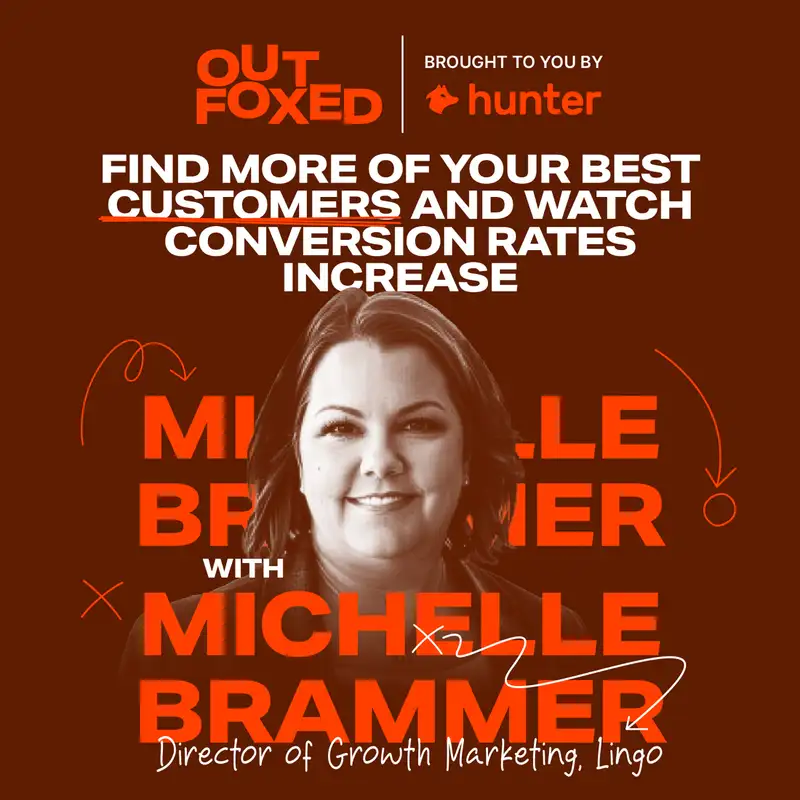
Outfoxed · Ep 12 · Michelle Brammer
===
[00:00:00] James: This is Outfoxed, the podcast brought to you by Hunter.io, the trusted B2B lead generation platform built for every professional. Get ready to know playbooks, no posturing and no egos. This is the show for the builders and not the theorists. Let's get into it.
[00:00:16] Matt: Well, welcome, Michelle. Welcome to Outfoxed. It's exciting to have you here. I'm looking forward to the conversation. I know James is as well, so, if you don't mind, introduce yourself to our audience.
[00:00:29] Michelle: Yeah, my name is Michelle Brammer. I am the Director of Growth Marketing at Lingo and we are a digital asset management and brand guidelines platform.
[00:00:39] Michelle: I have been in various marketing roles in the SaaS space for a little over 20 years. Did a little bit of work as well in restaurant and CPG too.
[00:00:49] Matt: A little over 20 years puts you at the beginning.
[00:00:50] Michelle: A little over 20 years.
[00:00:51] Matt: That's like the genesis of SaaS.
[00:00:54] Michelle: I've been able to see a lot over these years and
[00:00:56] Matt: Yeah.
[00:00:57] Michelle: a lot of scars from it too.
[00:00:59] Matt: That's the [00:01:00] best part, right? You get to,
[00:01:01] Michelle: It is, it is.
[00:01:02] Matt: Yeah, like I,
[00:01:03] Michelle: Gives you a little character.
[00:01:04] Matt: I have all the gray hair and I'm like, yeah but every one of those I've earned, I feel okay with that.
[00:01:09] Michelle: Yep.
[00:01:09] Matt: So tell me a little bit more about what growth marketing looks like at Lingo right now.
[00:01:14] Michelle: So I am considered a growth marketer, but I am also the only marketer at Lingo.
[00:01:19] Michelle: In fact, I'm marketer number one. And Lingo has been able to grow for many years on the back of the Noun Project, which is our parent company. They are iconography, photography, specialty specifically for designers. So when you're looking for icons and things like that, and Lingo kind of came from, the genesis of,
[00:01:42] well
[00:01:43] Michelle: we have all these icons, we have all these photos, we need somewhere to store them. So why don't we just build an asset management solution? And as we did that, we found that a lot of folks were using us in very different ways, and when they brought me on as a growth [00:02:00] marketer, it was, we've kind of burned out as far as we can go with the Noun Project side of things and how do we actually start to separate ourselves in the asset management space and start to grow into specific niches?
[00:02:14] Michelle: At which point they said, Hey, we should probably bring somebody in that knows a little bit more about what they're doing from a marketing perspective.
[00:02:20] Matt: Nice.
[00:02:20] Michelle: So my day to day, as much as I have the growth marketing title. I literally do everything from content to growth marketing to lead generation, to, you know, even just basic research projects for marketing as well.
[00:02:32] Matt: I imagine that's both kind of awesome and empowering in one moment or maybe one day, and then the next you sort of wanna pull your hair out. What's it like being like a solo marketing department right now?
[00:02:47] Michelle: That's a thousand percent accurate on how you'd like to describe that. You know, some days are really interesting because, a lot of where we're focusing our attention right now is in a space that I have not traditionally worked [00:03:00] in before, and
[00:03:01] Michelle: that's cool, 'cause I love to learn new things and I like to do new things. I enjoy the growth marketing side of the business, but I also enjoy kind of connecting the pieces together. So building the foundation up that you kind of need when you first launch a marketing department and you're figuring out, like,
[00:03:18] Michelle: something as simple as, oh, what CRM should we go with? You know, I enjoy that aspect of it, but yeah, it is a challenge because you're consistently juggling a lot of priorities and sometimes, you know, the priority for lead gen should take precedence over maybe recording a podcast, but you know, at the end of the day it could pay off dividends down the line as well, so.
[00:03:39] Matt: Right, right. Well we appreciate you cutting into your growth time for this. That's great. As you probably know, I think James has mentioned it, you know, we do a lot of primary research to drive both product direction, but also our marketing. You know, it was something we felt in the market was missing.
[00:03:54] Matt: There's a lot of, what I'll call kind of anecdotal best practices about [00:04:00] outreach and lead gen and, this part of, the go-to-market stack, but not a lot of like hard evidence. And I think, you know, there's good and bad reasons for that, but we've been filling it, filling that gap. We just dropped the most recent benchmark.
[00:04:15] Matt: One thing that came up a lot. Is personalization and we know that this has been a topic for what feels like probably as long as you and I've been in software. But especially when we surveyed the decision makers themselves and we were asking about what are the things that make an email stand out.
[00:04:33] Matt: What we saw was that personalization in the email, you know, increases it at a minimum by like 25% to 50%. We've seen that there's a direct correlation between list size and personalization. Smaller the list, the better the personalization gets to be. I'm curious what your experience has been with that. Can you talk a little bit about your experience trying to balance personalization and scale?
[00:04:59] Michelle: Yeah. [00:05:00] So there was definitely a point in time where personalization simply meant like, oh, let me pull in the city, or let me pull in, you know, the college you went to, right? And we're, past those days. So I think that that's, you know, right off the bat, like the easy ones to say, okay, you're trying to take the easy way out.
[00:05:17] Michelle: And now with AI, we have the ability to personalize our outreach in such a way that it can be incredibly impactful if it's done correctly. And I think that as a marketer, you're consistently balancing the scale behind, you know, if we're being honest here, most folks are like, we need leads, we need volume, we need leads, we need volume, right?
[00:05:39] Michelle: So you're consistently pushing for more leads and more volume, but sometimes when you do that, it's because you're not spending as much time on the personalization, right? So you're like, oh, this one kind of matches my ICP. I'm gonna go ahead and add them to this cohort or this group, that I wanna go ahead and get these emails sent out to.
[00:05:59] Michelle: And in [00:06:00] reality, they probably needed to be in a totally separate cohort all by themselves. So when we're starting to really look at, you know, how do we balance the size of our list versus how personalized it can get, we get a little sloppy sometimes. Especially because marketing teams are getting smaller.
[00:06:16] Michelle: We have more demands on us than we've ever had before. And it's just, I mean, I hate to say it, it's easier to send a, okay, maybe this will resonate with some people email than a, you know, Hey, I'm gonna go ahead and send a super targeted email towards 10 different people. And those 10 different people may resonate more, but it doesn't sound super impressive when you're talking to a member of leadership and they're saying, Hey, how many of these emails did you get sent last week?
[00:06:44] Michelle: Oh, 10.
[00:06:45] Matt: Right?
[00:06:47] Michelle: 10 does not move a needle. 10 can move the needle if it's the right message with the right person at the right time. And I think right now we're just in this weird spot where volume has become so much easier because of how much [00:07:00] AI can handle that we're walking away from the personalization side of it.
[00:07:04] Michelle: And at least for me and Lingo, we've kind of gone the opposite way, where we're going hyper-personalized and skewing away from mass targeting.
[00:07:12] Matt: I mean, everything in our research seems to support what you’re saying, which is great.
[00:07:17] Michelle: Yeah.
[00:07:19] Matt: We see that smaller list sizes, more personalization, better targeting, but one of the things that I hear a lot on webinars or even just sometimes conversations with customers or prospects, I bring this up, that being more targeted, being more personal really starts with the list.
[00:07:37] Matt: And honestly, what I've learned is like, I don't think there's a lot of really well established understanding like, if I wanted to show you a template of a email, I could show you a million email templates. But if you said, well, great, but how do I do segmentation? I feel like there just isn't the wealth of information out there about segmentation the way there is about [00:08:00] things like an outreach example.
[00:08:01] Matt: How have you gone about that process? Because you know, it sounds like you are very much aligned in terms of your point of view.
[00:08:07] Michelle: Yeah, so I think for me in particular, I knew. We're in the digital asset management space, which is probably one of the more aggressive spaces in the market. We have 300 plus vendors in our space.
[00:08:20] Michelle: And we're the little guy. Right? So we don't have the marketing team, we don't have the budget to go against, you know, even the top 10, top 20 who are consistently marketing towards the enterprise level folks. So we have to figure out, you know, what is the niche of our niche to make the largest impact, where maybe those big guys simply can't make an impact.
[00:08:40] Michelle: And for us, we found that incredibly validating because when I did come on board, and I did our first analysis, there are some clear and present industries we do well in. Reality is we can't target every single one of those industries. Not with our budget, not with our volume. So let's take a look at who it is [00:09:00] that we're doing really well with
[00:09:01] Michelle: and why we're doing well with them. And oh, by the way, are they sticking with us long term? And what we ultimately came down to is retail was already a really good segment for us just because of the way we structure our asset management solution. But more specifically cannabis. And cannabis is a very unique subset of retail that has very unique problems and issues that most industries will not have.
[00:09:28] Michelle: And we've done really well just by word of mouth in that industry to begin with. So by being able to take a little bit of time and a little bit of effort to understand the problems, understand the information that's being sent from point A to point B between different dispensaries or different wholesale locations or different retailers.
[00:09:50] Michelle: Why are they using asset management? What information are they communicating? That really helped us with then honing in on what is the exact message we need to deliver [00:10:00] to them that speaks to the outcome that they're looking to achieve. What problems do they consistently have? And what's come from that is we actually haven't seen where many enterprise folks can meet the needs because they're a little bit more,
[00:10:16] Michelle: I don't wanna say overpriced, but they're way too expensive for what these smaller niche brands can handle.
[00:10:22] Matt: Right.
[00:10:22] Michelle: And not that we're the cheapest out there, but with the way that we've segmented those folks along with the needs that are being met, it's a value add to them versus a distraction to them.
[00:10:34] Matt: Yeah. This makes a bunch of sense. I mean, what I heard you say is the first thing you did was a big ICP analysis project so that you could kinda understand where you're going to have the best success. And that makes a ton of sense, not just for product, but for marketing perspective. I'm curious, had you done that kind of exercise in past companies as well?
[00:10:56] Michelle: Yeah, I did. Yeah. So I knew coming in here, especially because there had not [00:11:00] been marketing in the past, and if I'm being honest, we didn't have robust tool sets. We didn't really have data. Our CRM was a glorified to-do list, like, we knew in order to figure out like who are we best marketed towards,
[00:11:14] Michelle: like we have to figure out, hey, who are our best customers to start with? And not our perceived best customers, like we have some pretty large brand names in the space, but, that's our perception, right? Like we see them because they're large, they're internationally known, but they're one small segment.
[00:11:31] Michelle: Which ones are the ones that are consistently growing the business for us, and very quickly had seen in a 24 month timeframe that the cannabis space went from pretty much zero to number one in terms of folks that we were targeting. And they're not high volume clients, so it's not something that you might think like, oh yeah, they're one of our top 10 in terms of like ARR each year.
[00:11:53] Michelle: No, they're absolutely not. Not even close. But when we take a look at the sheer quantity of them and [00:12:00] their totality of ARR, they absolutely are adopting our product because we're solving the need that they have. But that all started with taking the time to do that initial research, because otherwise I probably would've been led in a completely different direction just based on, oh, these are the logos we have and here's the volume they bring us each year.
[00:12:20] Matt: This happens,
[00:12:21] Matt: oh man, I, we're gonna go super tactical on this. I love it. But this is one of the things that drives me crazy. 'Cause a lot of times I'll see someone, a team go through an ICP exercise. And really what they're doing is, oh, just let me see the top 20 customers. Or, oh, here's some big logos. Let's just go find more like that.
[00:12:38] Matt: But you're right, it's not that. It's about what is the population that creates the biggest opportunity for you. And that opportunity is probably more about better product market fit than it is the market opportunity size. And that's a really interesting point that I feel like not enough information is out there about.
[00:12:56] Michelle: No, and I mean, if you think about it, we're in a space with 300 plus vendors. [00:13:00] Surely somebody can solve for this, right? But clearly nobody really has, if we've grown it that way, just be of word of mouth. There's not any one tool out there that's solving that problem. There are multiple tools that probably any, say computer software company can walk into and be successful with.
[00:13:18] Michelle: But the exact niche that we solve a problem for is one of the fastest growing niches out there. They just don't have a solution that's currently serving their industry.
[00:13:26] Matt: Right, right. Yeah, that's really interesting. Okay. I want to double click on the cannabis space for a second because
Yeah.
it's gonna lead to my next question.
[00:13:34] Matt: So one of the challenges that I understand in that space that's unique is that not only is it regulated, I think that's the part a lot of people might understand. But you have, businesses that operate across multiple states, but they have to do it in a unique way where a brand might be national, but the operating entities have to be more local within the states so that you're not [00:14:00] essentially supporting cannabis marketing across state lines
[00:14:03] Matt: 'cause that's, I think, where everything gets messy, right? So, because of that, you mentioned like having unique needs, so you're right, they're kind of smaller, not as high volume, but they've got some really complex challenges. Is that something where you're seeing, oh, because we found this like really unique challenge they face, that makes it easy for us to pivot to find the next segment?
[00:14:25] Matt: Or does that actually make it harder for you?
[00:14:27] Michelle: So it's interesting because it has 100% sent our product team in a completely different direction this year,
[00:14:37] Matt: Okay.
[00:14:38] Michelle: in terms of roadmap. We're solving the problem for the cannabis space, knowing that it is like the most niche need, and then we can actually branch that out up into retail because retail has said they have this problem too.
[00:14:50] Matt: Okay, yeah.
[00:14:50] Michelle: But not to the same degree what cannabis does. So case in point, yeah, you're pretty much spot on. You have single state operators where a brand may be in a single [00:15:00] state. You have multiple state operators where they may have operations set up in multiple locations, but cannabis cannot cross state lines.
[00:15:07] Michelle: And each state has their own rules and regulations. So for example, I might have a bag of gummies being sold in California. Their packaging can be bright, it can be beautiful, it could be really aesthetic on the shelf. You know, you could have it named called Blueberry Bliss. Totally fine. That works in California.
[00:15:28] Michelle: You may try to then grow and you wanna go into say Missouri. And in Missouri you have to have plain packaging. The name can be the same.
[00:15:37] Matt: I was gonna mention Missouri is the counter to California. Yeah.
[00:15:39] Michelle: Yep, a hundred percent. So you can have plain packaging. So all those beautiful colors, all that beautiful marketing material that your team has put together is now completely moot.
[00:15:48] Michelle: You can keep the name, but when you move into Connecticut now you can have a white bag, black name, the name Bliss is no longer accurate. You could call it like Blueberry Standard, right? So it's the same [00:16:00] product, three different bags, three different locations, three different needs. So it's not like a Nike shoe where that SKU is the same across the United States
[00:16:08] Michelle: regardless of where you go. Depending on where you're selling that particular product, one single product could end up with multiple SKUs underneath it. Now you start taking that, and it has to be sold in a point of sale system. So when you walk into a dispensary, you have a computer system that can kind of help you figure out like what it is you wanna sell.
[00:16:27] Michelle: But that becomes kind of a mapping nightmare of figuring out what product it goes with what item, especially when they're named different things in different areas. And right now the cannabis industry is doing that all by way in many circumstances, by way of a Google spreadsheet. That's not sustainable long term for them to the point where many of these brands have told us like a big priority item for 2026 is focusing on menu remediation,
[00:16:55] Michelle: so that menus are actually showing what products are available and when they're [00:17:00] available. And it's not showing a stockout simply because you're matching a Blueberry Bliss to a Blueberry Standard, right? So we know that that's an endpoint problem that they have, and ultimately, at the end of the day,
[00:17:10] Michelle: those descriptions, those images that are all inside the menu, those are coming from us anyway because they're using us to house all the descriptions, all the menus, all the images. So it's just a matter of how do we make that more efficient, not only for the brands to transfer data onto the point of sale systems,
[00:17:31] Michelle: but then how else are they using our product to communicate maybe in-store education material to the bud tenders, or even using it for wholesale purposes in different states. Yeah, a very unique need in the cannabis space, but has kind of driven our entire thought process on not only how we go to market, but what we're building to support their needs.
[00:17:52] Matt: That's super interesting. So is the plan, as far as you can share to continue to try to work and focus [00:18:00] on that industry for a while before expanding or? Yeah, okay.
[00:18:04] Michelle: Oh yeah, we're doubling down on, pretty much all my efforts for at least the first half of 2026 is focused on cannabis. I'll, tell you, 'cause this will be out by the time it goes live.
[00:18:15] Michelle: We are launching a product information management system specifically for the cannabis space to kind of solve that entire Google sheet issue going between multiple point of sale providers. So, we're really doubling down on the fact that we understand their needs and what it is they're trying to solve for.
[00:18:33] Michelle: And we know we sit firmly in the middle of that right now.
[00:18:36] Matt: Yeah. A PIM is such a desperately needed thing in the cannabis space. That's a really cool,
[00:18:40] Michelle: A hundred percent.
[00:18:41] Matt: cool thing. That's great.
[00:18:50] Matt: Was there, okay, so think, so, I am, let's say. I'm the Michelle at another company, and I am being tasked with, as a [00:19:00] solo person here, how do I figure out how to, they've given me some ICP data. I know I can run the analysis. I'm not worried about that, but I'm not entirely sure, how do I avoid ending up not just chasing our top 20 customers in terms of volume or not just chasing the big logos on the sheet?
[00:19:17] Matt: Was there a particular insight that stood out or a particular stage of the process that you used that allowed you to find cannabis?
[00:19:26] Michelle: Yeah. Gosh, it pops up in a multitude of areas. So when I first did the ICP analysis, cannabis was already on there, but I, like I knew it was a big factor, but I didn't realize how much of a factor in terms of how do we focus our attention and growth moving forward until around the same time I was actually finishing that first ICP analysis.
[00:19:51] Michelle: We were running Google advertising and in the digital asset management space, which, hello keyword, expensive, right?
I bet.
[00:20:00] And we were not getting the volume in return we were hoping to get. But again, you know, you're targeting some keywords that are generally fairly broad. And I was already thinking about like, what is the better way for us to target something a little bit more niche, a little bit more specific.
[00:20:14] Michelle: And I was using a tool. One of the beautiful things about the way that Lingo is set up is when folks are entering a Lingo portal or kit. They could be private, public, password protected. We're able to see kind of who's coming in and out of kits and portals and I was continuously seeing on my intent signal reports that folks were going in and outta these cannabis brands, but I didn't really understand the full scale of why they were going in and outta the brands. And two groups emerged.
[00:20:44] Michelle: It was either other brands accessing another brand's kit to be able to pull assets, materials, etc. from like a wholesale perspective, or it was a point of sale provider, specifically their account managers accessing their clients’ [00:21:00] spaces to pull the assets and descriptions to be present on the menus.
[00:21:05] Michelle: And those became two streams of people that were like, okay, well they have different needs and they're using it in different ways. Okay, great. Let's go take a look at our client and understand. Folks keep coming into this kit and portal. Why? And once we had a sense of why they were coming in, we kept digging and understanding and doing interviews and starting to meet with our customers to say, Hey,
[00:21:26] Michelle: we are consistently seeing these brands going in and outta your kits and portals. Help me understand why that is. And then that's where we started to learn around how brands were using it from like a wholesale perspective to be able to sell their catalog into other spaces, but then also how they were using Lingo for not only education at the
[00:21:44] Michelle: dispensaries, but also for point of sale materials as well. And once we started to understand that entire relationship of exactly who's accessing brand materials and for what reasons, that was kind of like that eureka moment to us of going, [00:22:00] well, I don't have to try really hard to be looking at kind of vague intent signals around how people are using us.
[00:22:06] Michelle: These people are already using or already coming to our kits and portals to understand, Hey, I need assets, I need, descriptions, I need bud tender materials. I need all this information for this particular brand. They're already brand aware of us, whether they know it or not. They already know the space because they're accessing it on behalf of other brands.
[00:22:27] Michelle: So if I go ahead and I reach out to them and say, Hey, if you happen to be working with brands like A, B, C, X, Y, Z, which I know they are 'cause I can see them going in and out of the space, right? Now, I'm starting to get into a level of personalization where it's, I don't wanna say, it's like, Hey, I‘m watching you go into these spaces.
[00:22:46] Matt: Right.
[00:22:46] Michelle: But like, I'm watching you go into these spaces.
[00:22:48] Matt: Yeah.
[00:22:49] Michelle: I know that, you know, we know who you are. We can help you too. And that kind of was like the break open moment for us of saying, Hey, rather than trying to target all of the people, we know this [00:23:00] space is successful. We can see it in our ICP analysis.
[00:23:02] Michelle: We can see folks are continuously accessing these kits and portals nonstop, and there's multiple streams in which we can actually target. This is our focus for this year.
[00:23:11] Matt: That's a great process. Yeah, that's, I love it. That's a great description. Hopefully we can use some AI listener to like take that and summarize that into a process.
[00:23:21] Matt: Because that's like, that's exactly right. And you went farther than I think a lot of people talk about going, which is actually looking at what's the product data say? Like in SaaS, we should take for granted that like product usage data is super critical and super valuable as a feedback loop for the marketing engine,
[00:23:40] Matt: but like often that gets overlooked. Marketing's doing their thing, product lets 'em know when there's an announcement. But outside of that, often those, feedback loops don't get closed. I think that's a great story. Okay. Let's talk a little bit about your market. Yeah. 300 competitors. In any, I like to point out that go-to-market is definitely [00:24:00] a dogfight, but I don't think there's 300.
[00:24:02] Matt: So what makes you think in a company that's that, in a space, that's that competitive that like, Hey, we should just keep fighting this fight. Because I think other folks might just feel like that's too daunting of a challenge, especially as a single marketer, like you have to, I assume Adobe is a competitor of sorts.
[00:24:23] Matt: Is that right?
[00:24:24] Michelle: Yeah, technically Adobe would absolutely be a competitor of ours. And the irony of it is, as you know, we came from the Noun Project. And the Noun Project is very well known within the design space.
[00:24:38] Matt: Okay.
[00:24:38] Michelle: So some of our largest competitors are also some of our partners at the parent company, so it's a very weird dichotomy to be going up against some of those folks.
[00:24:48] Michelle: But one of the things that we realized pretty early on with the way that we went about structuring Lingo is we needed it to be very fluid and very flexible for multiple [00:25:00] use cases. So you can use us for asset management to be able to show your images, your designs, all of those things into one canvas.
[00:25:08] Michelle: But you can also use it for your digital brand guidelines. And for many of us, it was a PDF that got left on somebody's desktop with like, the correct colors and the correct fonts and all the things, but like folks didn't ever really use that. And then it diverted into like bad branding, right? So when we built out the space itself, we knew it needed to be able to house multiple purposes.
[00:25:31] Michelle: And not all folks out there are gonna be ready fit for us, right? So of those 300 competitors, yeah, there's absolutely some that are very tied into like higher education, specifically in the athletic space. Even more specifically with having like athlete bios and pictures in real time to be able to share with media companies.
[00:25:52] Michelle: We're not them, we're not pretending to be them. Right? There are also niches out there that focus way more so on, like [00:26:00] maybe the gaming industry that has very heavy graphics type of available. We're not that either. We don't think we need to compete with them too. But we do think that we are the preferred DAM of the cannabis space, just by the signal, the signals that they've told us.
[00:26:17] Michelle: We're not even trying to become the preferred DAM of the cannabis space, and we already were. So now we're just gonna double down on that a little bit harder.
[00:26:24] Matt: Nice.
[00:26:24] Zach: Today's episode is brought to you by Hunter.io, the B2B lead generation platform made for every professional, whether it's prospecting, fundraising, recruiting, link building, or just trying to connect with the right people, Hunter makes it easy.
[00:26:41] Matt: Okay tangential question as we pivot to the next topic segment. How often do you have to deal with somebody asking you if you're related to Duolingo?
[00:26:53] Michelle: So fun fact, they're actually a client of ours.
[00:26:56] Matt: I saw that. Yeah.
[00:26:56] Michelle: Which means we get that all the time. [00:27:00] I would love to say we never get confused, but I unfortunately see a lot of confusion where folks think we are Duolingo. We get it also because Lingo is not exactly a not uncommon name. There are other companies out there with the name of Lingo, so we get Duolingo all the time.
[00:27:18] Michelle: There is a Lingo glucose monitor that for some reason, folks love us. At Voiceover Internet, that's also named Lingo. So a lot of folks do confuse us not only with Duolingo, but a whole handful of other companies too.
[00:27:32] Matt: Does that ever actually become much of a challenge for you in, your growth activities?
[00:27:38] Michelle: So the glucose monitor was actually one of the first things I had to try to solve for because the sheer number of customer support questions that would come in about, Hey, my glucose monitor is not operating, or it won't let me download results and send 'em to my doctor. And I'm like, well, 'cause we're not a glucose monitoring company.
[00:27:57] Michelle: Like I can't help you, right? So [00:28:00] that was actually one of the first exercises that I had to go through was looking at, why does that confusion exist for folks when they're coming into our forms? And is there a way we can help differentiate or overcorrect on, Hey guys, we're asset management, we can't help you with your blood sugars.
[00:28:18] Michelle: So that actually happens a little bit more often than not.
[00:28:21] Matt: Was there a particular thing that you did that ended up working the best, that seemed to have the biggest impact on people asking that question?
[00:28:28] Michelle: Yes and no. For a while there, I wanna say about like spring to early summer last year.
[00:28:34] Michelle: Our general contact form, it didn't matter. I could draw a picture of like, we are not this, we are this, and we would still get people overcorrecting on it. But at that time our website was fairly vague. It had not been updated in many years, at least to like a large degree. I could easily see how people would get confused because there was nothing really showing [00:29:00] them what it was we were doing.
[00:29:01] Michelle: Yeah, I can see how you'd get in the wrong space. So we already had a website redesign that was very planned out, had nothing really to do with the whole mistake around who we are, are we a glucose monitor or not. But we were very deliberate in when we were rebranding our site and rebranding that we were not using color palettes associated with the other Lingo.
[00:29:22] Michelle: We were not showing anything that could give them the thought process, we were associated with the other Lingo. And then as we got into conversionary forms, we were very deliberate in, you know, so even to the an extent, some of the quotes that we chose, speaking about brand guidelines and asset management and like wrapping in everything that could possibly tell you.
[00:29:42] Michelle: We are the asset management provider. I'd love to say they've totally stopped. They have not, but it has decreased quite a bit. Every once in a while I have to send a nice email of like, Hey, I know you really wanna get this information. You should probably go to this website here. They can [00:30:00] help you a lot better than I can.
[00:30:01] Matt: Well, hopefully with all the AI support tools that are becoming available, you can automate some of those responses and, avoid it altogether. I, early in my career, our, my first big startup was a live chat company, and one of the things that used to drive us bonkers, like every few months we would go through a cycle of pulling our hair out to try to figure out why so many of the, so much of the traffic coming to our website wanted to chat with people.
[00:30:30] Matt: Not like support chat or buy a chat software for their website, but they wanted to like talk to somebody. And no matter what we did on our website, no matter how tech we sounded, and no matter how much like IT oriented or sales marketing, inevitably it was like 15% of the chats that came to our own website about our product were can I chat with a female or some like, and what it turns out is that,
[00:30:59] Matt: [00:31:00] live chat was such a basic search term that what drove like 90% of the traffic. Even with all the long tail optimization we did, we never could stop live chat from being like the most valuable keywords that everybody tried first. And so we eventually just kind of had to give up. It was like we were like, well, we were just use automated, canned responses in
[00:31:20] Michelle: Yeah.
[00:31:20] Matt: in our own support model, and that was literally all we did.
[00:31:23] Matt: It was to this, I mean. Even up to five years ago, people I talked to were still suffering from some of those same challenges in that industry. So sometimes,
[00:31:31] Michelle: I can believe it,
[00:31:32] Matt: you know, we, we certainly get our own kind of unique challenges at Hunter too. But yeah, I feel like that's just, it's too easy to find us, right?
[00:31:40] Matt: All of us. You, us, it's just so easy to find us and not if you're delivering good customer experience, you're also making it really easy for people to ask you questions that are irrelevant. I think it's just like, it's kind of the trade off.
[00:31:53] Michelle: Yeah, that's fair.
[00:31:54] Matt: Talk about tech stack for a second. You've accomplished a lot with a one person department.
[00:31:59] Matt: Do [00:32:00] you do that by relying a lot on technology?
[00:32:02] Michelle: The PC response would be, yes. Yes, I do. Reality response is, no, absolutely not.
[00:32:08] Matt: Only reality responses here.
[00:32:11] Matt: That's all we ask for.
[00:32:12] Michelle: We're a small company, you know, we have small budgets. Heck, there's only one of me. Prior to coming on board, the only technology that was really in place
[00:32:21] Michelle: that could be perceived as assisting marketing would be Intercom. And that definitely managed, you know, a lot more of our customer communications, some very light workflows, very light touchpoints. But, the CRM that we previously had in place, I, when I say it was a glorified to-do list, it was absolutely a glorified to-do list.
[00:32:42] Michelle: And nothing speaks to each other. So I actually spent a, pretty good chunk of 2025, helping to at least get the technology in place, get it connected as much as I can. And I say that because ultimately our dev team is responsible for [00:33:00] connecting all the pieces together. And any time I spend, taking away from dev means we can't improve product.
[00:33:06] Michelle: And knowing that we're trying to get, you know, this PIM solution out into the market, that's far more valuable for me in the end than having these items connected together. But yeah, like today, we're sitting on HubSpot CRM, I do utilize Intercom. I do use an email lookup tool to find the email addresses for the folks that I am trying to target.
[00:33:28] Michelle: I'm a big fan of LinkedIn. I'm trying to get others to be a big fan of LinkedIn too. And I use Looker Studio to a pretty good extent just to be able to help me connect the pieces where I can't natively connect them together now.
[00:33:41] Matt: Nice. So that's a pretty, it's a pretty efficient tech stack actually.
[00:33:45] Matt: Is a lot of the sales and marketing in HubSpot, or is that primarily an email or a marketing tool?
[00:33:54] Michelle: So we use both the sales and marketing side.
Okay.
[00:33:57] Michelle: And that was one of my big requirements is because [00:34:00] the previous CRM that we had in place, we did try the janky method of putting it all together with, okay, when this happens, do a zap here, but we don't wanna pay for Zapier.
[00:34:10] Michelle: So like, let's see how many different ways we can get around it, to, oh, fire off this Slack message to make this happen. And it became way more manual than it needs to be. And as a solo marketer, I don't have time for manual. I need as many things automated as I can. So by bringing in HubSpot, we did adopt both the sales and marketing side, which has made kind of like a one-stop shop for me to do probably about 80% of my day-to-day.
[00:34:37] Michelle: I do use, I also use external tools like. I was a big ChatGPT person. I definitely am moving away from ChatGPT a little bit, focusing a little bit more on Gemini and Claude because my goal this year too is on top of targeting a lot of the cannabis spaces, starting to improve efficiencies and remove some of like more of the manual or repetitive tasks from the marketing and sales [00:35:00] roles too.
[00:35:00] Matt: Okay. Yeah, I, find that your comment matches my own experience recently where I went heavy at ChatGPT for a while and I find now it's all Claude and Gemini.
[00:35:13] Michelle: Yeah.
[00:35:13] Matt: Although for creative, I do use, Kimi, which, everybody probably around here is tired of me saying, but for creative writing tasks, I find it's the only one I like.
[00:35:23] Michelle: Very interesting. I'll have to check that out.
[00:35:26] Matt: Yeah. For marketing related things, I, so I'll, like, for business stuff and like processing and research and asking questions. Claude is amazing for doing things in spreadsheets like Google Sheets. Gemini is fantastic. But when I'm like, always I ask all of the AI like, here's my prompt and I wanna see what I get.
[00:35:44] Matt: Inevitably when it's a writing task, I'm like, huh, that's, that's actually a pretty impressive response from Kimi. So, it's worth taking a look at.
[00:35:54] Michelle: Okay.
[00:35:55] Matt: I have no equity in that company whatsoever. This is just, you know, one that I find it actually [00:36:00] helps me in a number of things. And so far it is the only AI that has written
[00:36:04] Matt: a cold email from scratch that I would've, that I'm like, blown away by. It was like, it was just like, really good. The rest of them were like, yeah, okay. I can use that as a starting point. But that was one where I found it kind of hard at times to edit. It was really good.
[00:36:21] Michelle: Got it.
[00:36:21] Matt: Yeah.
[00:36:22] Michelle: Yeah. I'll have to check that out.
[00:36:23] Matt: Did you use Looker Studio for your ICP analysis?
[00:36:26] Michelle: I did. So part of what I needed to understand was not only our search intent data, but also how folks were finding us, and then combining that with the customer data that I had access to, where they came from, how they found us, you know, kind of like their basic information, if you will.
[00:36:43] Michelle: But, I was also trying to figure out like, we're about to make this huge investment in website and a lot of that is to improve some of our SEO efforts, but also to, I mean, quite honestly, our website was so outdated that some of the products we sold or some of the things that [00:37:00] we did weren't even listed on there yet.
[00:37:01] Michelle: So I knew that a lot of this needed to happen, and in order to get kind of the full 360 review, Looker Studio was about the only place where I could pull in all of that, and I wasn't paying anything for it. So it was easy enough for me to pull the reports together with the assistance of some ChatGPT to really kind of like help me with the nuances of writing some of it.
[00:37:19] Matt: Okay. This has been really great. I think, you've covered a lot of the bases we wanted to talk about. Definitely we got into the, tactical talk. Let's, I think before we move off of the tech stack for a second, I guess, are there any recommendations you would share with our listeners about when it comes to tech stack,
[00:37:37] Matt: things that you've learned the hard way or not, but things that you've learned over the last few years where you can maybe help people shortcut their process to doing better ICP analysis or segmentation?
[00:37:49] Michelle: God, that is such a loaded question. Oh, there's so many things. So, all right. This is multifold. So from an ICP [00:38:00] analysis, it is,
[00:38:01] Michelle: and I get it. The last thing we wanna have to do is data hygiene. It is one of those repetitive tasks that nobody really wants to have to do, but when it comes down to actually doing the analysis, it makes things 10 times easier to figure out where it came from, why it came in, what you did with it, and what the outcome was
[00:38:22] Michelle: if you document it when it's fresh. If you have to do that, say you do your ICP analysis even once a year and you're trying to figure out what Joe Schmo did 11 months ago, you're not gonna remember, right? So I've always taken the approach of not only for marketing, but reiterating with sales.
[00:38:41] Michelle: Like even if it's baby steps, I need you to do these particular items, make 'em, mandatory fields so that I'm capturing that information early on, and it keeps me from having to backfill with my best guess later on. So from an ICP perspective, that's number one. I'd also say from a technology perspective, probably more [00:39:00] so now than ever.
[00:39:01] Michelle: One of the most important things that I've done usually about every two years is a full audit of my tech stack. And the reason I've done that is because sometimes we will purchase a technology to solve a right now problem. And then somebody builds a technology to also solve that same problem.
[00:39:20] Michelle: And you're already paying for that technology, but you have this other contractor working with over here. And over time you end up with all these different tools that are sharing all this different information. And what I've continuously found is if it's a really good tool, somebody is going to suck it into their universe anyway.
[00:39:37] Michelle: And they will inevitably cause you to streamline your, tech stack. That has become increasingly important for me because that also means when you have less tech going in and sharing information with one another, you have less failure points as well.
[00:39:56] Matt: Right.
[00:39:57] Michelle: And that is by [00:40:00] far one of the biggest things that will inevitably lead to the quality of your reporting is if you are starting to see multiple failures and then you're trying to do an analysis that includes information from any of those failure points.
[00:40:13] Michelle: If you don't realize it's broken for a long period of time, it's gonna be a hell of a long time to fix it. So they go hand in hand.
[00:40:21] Matt: Is it two years because that's the shortest frequency that doesn't make you wanna lose your mind and feel like you're just an IT person at that point, or do you think that's about the right cadence?
[00:40:32] Michelle: I feel like it's kind of the right cadence and the reason I, for me personally, the reason I aim for two years is I'll, if we're honest here, a lot of your tech contracts are no longer 12 months. They're 18 months or two years long because you're trying to get the better discount. They're trying to hold onto you a little bit longer.
[00:40:48] Michelle: So if I did it every year, I may not necessarily be able to make a change anyway because I'm already locked into that contract. But I also wanna be thinking about, just because I'm doing it every two years doesn't mean I'm not like [00:41:00] thinking about, okay, well now I know HubSpot has this ability that I used to pay for something over here so I can eliminate this contract value.
[00:41:08] Michelle: And oh, by the way, when I go to budget for that next year, I already know I'm gonna cancel this contract. So how can I take those funds and make a plan for them automatically before they disappear because somebody else has realized, oh, I can take those funds and reappropriate them somewhere else? So I do it every two years, partially because of sanity, partially because of contracts, but also
[00:41:31] Michelle: I wanna make sure I'm retaining the budget from that as well so that I can actually invest it back into a marketing project.
[00:41:36] Matt: Yeah. Very sound. Except on the go-to-market tools side. I feel like you should review that once this year and then not after. That way if you wanted to switch out your lead gen tool,
[00:41:50] Matt: you could, and then, you know, you can just use Hunter from then on, and then I think everything is solved. That's,
[00:41:57] Michelle: Definitely could.
[00:41:58] Matt: That's a great way to [00:42:00] go through that process. Any fun stories from your experience recently that you wanted to share that we didn't touch on yet?
[00:42:05] Michelle: You know, there was one question I read from the sheet that when I read it, I laughed because I am, email’s worst enemy, I don't engage with like any cold emails at all, and I
[00:42:17] Matt: Never, not one?
[00:42:19] Michelle: I have one time.
[00:42:20] Matt: Okay.
[00:42:20] Michelle: I have purchased from a single cold email and I laughed about it because I'm the first one to come in the morning and just delete, delete, delete. Like, unless you're somebody that I know and something I'm working on, chances are your message is not gonna resonate with me. But I did receive an outreach email.
[00:42:38] Michelle: It’s been a couple years now, but it was when, I had a small team, prior organization. I had a content marketing person. And I'm nearly positive this was in the height of, job changes are the next big thing. So when somebody makes a job change, this is when we're gonna go ahead and hit them.
[00:42:55] Michelle: Yeah. So I had a, content marketing person that was working with me and he was [00:43:00] running all aspects of content marketing and he had decided to leave the company. I'm already busy enough, I'm now also the content marketing person.
[00:43:09] Matt: Right.
[00:43:09] Michelle: Until I decide to either A, hire for that content marketing role or at that point, we were starting to go away from having, as many
[00:43:19] Michelle: onsite full-time employees and diversifying with a little bit more freelancers, and ultimately that was the round I was going in and this is maybe two, three weeks after he had left the company. And I remember getting this outreach email, wish I could remember the subject line clearly don't have the email anymore.
[00:43:35] Michelle: But it spoke to the exact pain I felt at that moment about managing the content calendar, and all of the content. And granted, this is pre-AI for anybody hearing this, just saying, oh, go to ChatGPT and write it. Didn't exist back then. So you were actually writing content the long way and doing all the research and doing the calendar on top of your day job, which as much as somebody tries to tell you, oh, that's [00:44:00] totally doable, it was not back then.
[00:44:01] Matt: Yeah.
[00:44:02] Michelle: And her message hit me in such a way that I went, dang. You get the pain I am feeling right now to the point where I got her on a phone call. I ended up hiring her as a contractor for us. She was with us about two and a half years before she kind of changed who she was targeting as a business model.
[00:44:21] Michelle: But it was the only cold email. I've actually said yes. Yes, let me schedule a meeting and I also plan on buying with you.
[00:44:29] Matt: That's fantastic. So there is a data point.
[00:44:32] Michelle: There's one data point of me actually buying from a cold outreach. But yeah, I think that that's part of the reason too why I almost overcorrect on personalization.
[00:44:43] Matt: Yeah.
[00:44:43] Michelle: Is because I understand that if you hit somebody when they are experiencing that exact pain, the likelihood of you converting to a qualified call is gonna be so much greater than you hitting somebody with cold outreach that maybe could [00:45:00] possibly, potentially hit the right person with a need that they actually have, but let's be honest here, more than likely not, and you're gonna end up just deleting it.
[00:45:09] Matt: You hit on maybe one of my favorite topics, because over the years, this has been a part of my life for, well, for at least 20 years this has been a part of my life and one thing that I've become convinced because all marketers are trying to figure out how do I get the right message in front of the right person at the right time?
[00:45:27] Matt: And when it comes to cold outreach, I've now become pretty convinced that you can get the right message in front of the right person. That's a solvable problem.
[00:45:37] Michelle: Sure.
[00:45:38] Matt: The time is going to be wrong way more often than it's right, like
[00:45:46] Matt: nine to one, right? Yes. It's like, and so the best thing that you can do is go into your outreach strategy knowing that that's true,
[00:45:56] Matt: and not trying to optimize for time, but trying to make [00:46:00] sure you're doing all of your energy focused on optimizing for the right message to the right person. And I still hear people talk about timing intent signals and this, and I think those are great strategies to try, but I think if you really have to like bank on what's gonna work and how do I make sure that I'm not getting dismissed.
[00:46:21] Matt: Making sure it's the right message for the right pain, the right user who's gonna have that pain. That feels like a way better use of your time in terms of like reward for that effort. That can also be seen as a controversial point of view for people in this space. I'm interested in your take on that.
[00:46:38] Michelle: Yeah, so here's the thing. You could be, you could have the best written email for the best audience. It could be super niche, it could be super actionable. It could be exactly what they need. And if your only input into when is the timing to send is purely an intent signal, yeah it's not gonna go very far.
[00:46:59] Michelle: Right? [00:47:00] I don't think personally intent signals are baloney from what I've seen. I've ran plenty of ABM programs to realize that the intent signals I'm receiving could be any number of things. And I think it's getting even more complicated nowadays of like who really is truly in the buying market. If you take the inverse of that and you really understand who your buyer is and what are the, like, when do they experience the pain point?
[00:47:26] Michelle: Like for us working with cannabis brands, if you have a couple brands, you're not yet experiencing that pain point, I could reach out to you and go, yeah, that's cool. But that's not a pain point you have. When you start to get to the point where maybe you have multiple SKUs underneath you, or you're working with multiple point of sale vendors, that's when they start to feel like, oh, my single little Google spreadsheet here is not going to cut it because it works for this point of sale provider with this set of brands.
[00:47:55] Michelle: But it doesn't have the same information for this point of sale provider, and now I'm either managing two [00:48:00] Google spreadsheets or I'm trying to like cross pollinate between the two and somewhere inevitably you're doing it manually. It will be broken. You have to look for what are those inflection points.
[00:48:13] Michelle: Are they trying to scale? Are they going from one state to a multi-state operator? That is guaranteed to be one of those inflection points in this industry where something can and will break. If you know what those inflection points are, you know what the signals are that you need to be looking for, and it's not just somebody's looking for digital asset management.
[00:48:31] Michelle: No. There are other signals out there.
[00:48:33] Matt: Right, right.
[00:48:34] Michelle: It may be a very small list of people, but they're going to be experiencing the pain that you can solve for right at that moment. That's when you hit them up, not before it. Not after it. That's when you hit them up. And it may mean that you are sending far less volume to people, but the quality of those conversations are going to be tenfold better than any of the other conversations you're having with [00:49:00] inaccurate outbound.
[00:49:01] Matt: And I would say those quality conversations are gonna have a much higher conversion rate based on that.
[00:49:05] Michelle: A hundred percent.
[00:49:06] Matt: Yeah. Absolutely. Michelle, this was fun. This was a pleasure.
[00:49:11] Matt: It's a great time Matt.
[00:49:12] Matt: I feel like I could talk segmentation and ICP with you all day and tell the audience, where they can connect with you online and where they can find out more about Lingo.
[00:49:20] Michelle: Yeah. So I am, best found on LinkedIn, Michelle Brammer. And if you are interested in Lingo, you could visit us at lingoapp.com.
[00:49:32] Matt: Wonderful. It was a pleasure.
[00:49:34] Michelle: Very good to meet you.
[00:49:35] Matt: You too.
[00:49:36] James: If you like what you heard, please like, subscribe, and explore even more of the Outfoxed community by visiting www.outfoxedhunter.io.