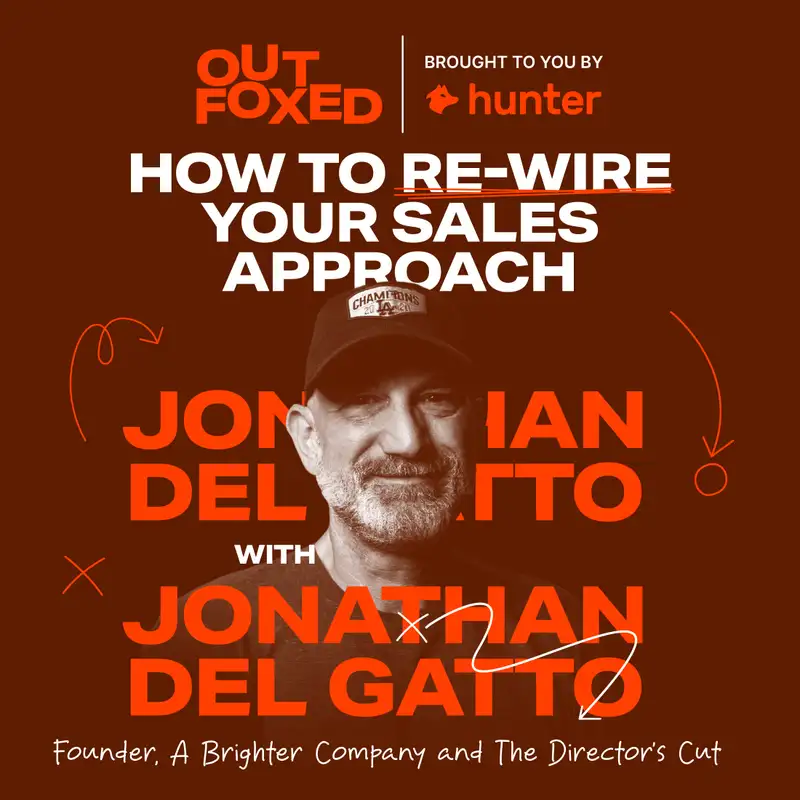
[00:00:17] Welcome to Outfoxed, everybody. Glad you're here, because my next guest, I'm really looking forward to this, sharing this conversation with you and hearing what he has to say on a topic that I think is important to all of us. With me is Jonathan Del Gatto. He's founder of Brighter, A Brighter Company, which is a Los Angeles video production studio he started in 2010.
[00:00:38] And over a 25-year career, he's edited and directed work for brands like Intuit, Freshpet, Amazon, Nike, Budweiser, Microsoft, MTV, and the Disney Channel. So he's, I'm sure, hit some of us at some point. That's gonna be great. Jonathan's work has won Cannes Gold Lion, [00:01:00] an Emmy, multiple AICP awards, Cleos, and Effies.
[00:01:05] I don't know what an Effie is, you're gonna have to explain that. Alongside the studio, though, Jonathan runs Director's Cut, the Business of Video, which is a coaching community where he teaches video professionals how to turn that profession into a real business for themselves. And so I think there's a lot to talk about here.
[00:01:22] Jonathan, really excited to have you. Thanks so much for being on Outfoxed.
[00:01:25] Well, I'm grateful to be here. Thank you, Matt.
[00:01:27] So I... look, we're in sales and marketing space. This is what we live and breathe. But what we don't get to talk about a lot is advertising. Because a lot of what we do is intended to be as one-to-one as possible, even at scale, but that is a completely different opposite end of the spectrum for advertising.
[00:01:46] So talk to me about the through line. What has kept you in the advertising space, especially around video, for twenty-five years? How has it kept your attention?
[00:01:57] I couldn't tell you. I don't know. There's something [00:02:00] magic about the short, concise message that works for me, and I would have never have guessed it.
[00:02:09] I tried to get out of advertising multiple times through thirty-five years. I didn't want to be in advertising, but I keep coming back to it 'cause I really love it. And we tend to love the things we're good at. And whether I liked it or not, I was pretty good at distilling ideas into very, very, very simple, understandable, relatable, connectable, ads, videos.
[00:02:35] You know, the way you talk about it, you make it sound more like the poetry of marketing and sales, which I really like. But, so there's something about this short form thirty-second that connects. And I have to imagine, and, maybe I'm wrong, so just you can challenge me on this, but it feels like video is getting shorter and shorter and shorter I [00:03:00] was reading something the other day that proposed that content is like the optimum content right now would be like an eighty to ninety second show. Now, this is really, really interesting. So given what you've seen in video over the last few decades, talk to me about your perspective. Is this, am I seeing this trend correctly?
[00:03:18] I think you can't be that, specific about it. I mean, okay, you get into marketing, and this is probably something you know more about than me. When you get into marketing and the idea of where in the customer journey does a video hit them, what's the purpose it serves? So I think when you say that, you're probably talking about a telephone, you're probably talking about social media, you're probably talking about YouTube, a delivery system for something of that length.
[00:03:44] Maybe not. Maybe you're talking about Instagram or TikTok or Facebook or any other of those platforms. But in terms of length, the thing I loved the most about when social media entered what I do was the [00:04:00] idea of length went away. It didn't matter as much whether something was fifteen seconds, thirty seconds, sixty seconds, or ninety seconds.
[00:04:08] What mattered is that it did what it was supposed to do. Was it supposed to inform? Cool. Ninety seconds is probably pretty good. Is it supposed to just grab attention and get someone to take action? Actually, I like fifteen seconds a lot for that. So, you know, in terms of how long something should be, whether it should be long, whether it be short, it depends what you're doing with it.
[00:04:28] And, does it have a beginning, middle, and end? Does it give someone a satisfying journey from the minute they see it to when they're done?
[00:04:36] And so in your, from this perspective then, you would say that something that might be ninety minutes could potentially still be just as successful as something that's nine seconds or ninety seconds.
[00:04:49] Yeah. I've made ninety-minute ads. I've made ninety-minute ads, okay, for car manufacturers, and they were movies. They called them a movie. And they had big stars in them. But, everybody making the [00:05:00] movie had no qualms understanding that the ad was completely one hundred percent sponsored by an auto manufacturer, and cars were placed throughout the ad as the central character, and all the models of the brand were throughout the ad.
[00:05:12] That was an ad. Those were thirty-second ads starring people like Dennis Hopper.
[00:05:17] I feel like you also potentially described the relationship between BMW and, Tom Cruise with the Mission Impossibles there for a while. It felt like that was in that, Bond actually as well. This doesn't feel like a secret pattern that's out there.
[00:05:33] It's actually.
[00:05:34] No, the car manufacturers and the soap manufacturers and every manufacturer goes back to the very beginning of advertising in television. The Bond franchise being associated with an automobile goes back to the beginning of the franchise, I think it goes back to the beginning of the Bond franchise.
[00:05:48] Someone could correct me, I'd love to know. But I, quite frankly, love the cars in all the early Bond movies. They were awesome. And remember when we did BMW Films with Fallon, about 20 [00:06:00] years ago, some of the most important automobile advertising cooperations that ever happened, and they were amazing.
[00:06:05] Amazing.
[00:06:09] Okay. So my perspective has been that video is changing, but you're, telling me that maybe it hasn't. But-
[00:06:15] Oh, no.
[00:06:16] It used to be that we'd sit there, right? We'd watch, 30-minute shows or an hour-long show. We would watch a couple of hours a night, and we would get advertising interspersed in the middle of that.
[00:06:26] But nowadays, I feel like the, the platforms have become ad platforms. Like Instagram, as you're thumbing through it, I feel like you're seeing more advertising content than you are content content. Like, there's, this, the platform and the ads and the content kind of all feel like they're just all squished together.
[00:06:48] Is this... I guess even if that's true, you don't see that changing the format of video?
[00:06:57] I think what you describe stinks. I mean I [00:07:00] hate it. And it's so true. I mean, you know, well, and particularly when Meta changed everything from being social media to be intent marketing, which it is now, it really went downhill.
[00:07:14] And it is just a big, long ad, but people love it 'cause the targeting is so good that, they're getting things they're actually interested in. So in a lot of ways, you know what happened there is truly astonishing. But back to your question, the or, quandary, has things changed?
[00:07:32] Yeah. Boy, oh boy, things have changed. And the single most important thing was part of it, it was in your question, the answer, which is astute. We're no longer captive. It used to be we were a captive audience. If you wanted to watch, The Love Boat, if you wanted to watch whatever show you love, you tolerated the ads.
[00:07:52] That's no longer true. But it's becoming true again, which is just a nefarious way [00:08:00] advertising is so hungry for our attention. They'll get there somehow. But, yeah, that's the biggest difference, is we're no longer captive, so advertising had to get really good. And it did,
[00:08:11] Yeah.
[00:08:11] for a while.
[00:08:13] Well and I feel like that was the whole thing about social media.
[00:08:15] It was like, "Oh, and we're gonna let you monetize your followers and your attention. How? By shilling. You can be professional shills, and this is gonna make social media better for everybody." It's like, is it? Is it, though?
[00:08:27] A lot of people, a lot of people sipped that Kool-Aid, didn't they? Everybody,
[00:08:30] Yeah, they did.
[00:08:31] So many people thought that they were gonna make a fortune by being an influencer and, getting on social media or YouTube and monetizing their content. But the truth of the matter is, yeah, that worked for some. Hell, I think MrBeast has proved that to be one hundred percent true, and, he makes amazing content, and I love that.
[00:08:49] I just so love that about what's changed, and what you're kinda getting into is how talent and ideas and, inspiration comes from anywhere. The [00:09:00] ceiling being blown off, it's just fantastic.
[00:09:02] You know, I was talking to somebody the other day. I was like, I don't know, maybe it's a generational thing.
[00:09:06] Maybe Gen X and Boomers are still weary of being sold to, and Millennials and Gen Z are just like, 'Look, we're all selling to each other all the time. Let's just lean into it.'"
[00:09:19] I think you got it. I think you're one hundred percent right. They have bowed to it. They get it. "Okay, sell to me, but just make it decent.
[00:09:28] Make it-"
[00:09:29] Exactly.
[00:09:30] And the brands have taken, hold of that. I mean the brands, the good brands, the big brands, and some of the smaller ones, they feel a responsibility to their audience. They feel a connection to their audience. And that matters because when they tend to that, they create customers and following and, real connection to their customers that's a dream.
[00:09:53] So the fact that the people you say that this generation has leaned into it a little bit, they're willing, it's a marketer's [00:10:00] fantasy.
[00:10:02] Yeah. I, it-- We're in B2B. We work with primarily B2B companies, the large majority. And so it's interesting in a lot of ways, video and advertising in the traditional sense just, it's never been logical for B2B companies, right?
[00:10:18] And then influencing happens, and then it's like B2B, "Ah, I don't know, maybe there's some, some opportunity here." But I don't know. You've worked with some amazing brands. I have to imagine they've suffer- they've struggled a little bit with this the same way I have, which is what I envision in my head as good video content has good production value, you can tell it's polished, you can tell the people involved are professional, is not anything I would use to describe most B2B content out there today.
[00:10:49] Do you think advertising is coming back? Is the things like are, platforms that allow you to do programmatic marketing with video ads, are they gonna expose B2B to [00:11:00] advertising in a way that I think it hasn't been for a long time? Do you see that happening?
[00:11:05] It's a good question. B2B is so interesting as just a simple topic.
[00:11:11] We could spend an hour on B2B. And the idea that programmatic television or just programmatic whatever, however it's getting dished out, it will be useful for B2B. Yeah, I think so. And I don't think for B2B marketing, being polished is a prerequisite. I don't think it has to be. But for many brands it is, because that's their brand.
[00:11:36] Their brand is a polished brand. They're a high-ticket item. B2B typically is something that costs more, so they want to look fancy. But the truth of the matter is I think so. And then to bring in the word advertising into that, as a function of one tactic of marketing, I guess that's an okay way to put that, yeah, once something is on programmatic television, it basically is [00:12:00] advertising.
[00:12:00] I mean that line between advertising and marketing is getting blurred with the kind of two-way data stream that's happening with these new platforms.
[00:12:10] Yeah. Yeah. I've been interested in this for a long time. There was, many, many years ago, I worked to build ads for the business that I was in, which was local.
[00:12:22] And so advertising, local ads especially, made a lot more sense, and there was good infrastructure for that. But, you know Hunter appeals to so many different industries, and so many different professional types and professions that I've struggled a little bit with there's an opportunity here for a broader message.
[00:12:40] Video feels like the right format, but it also feels like the whole landscape has changed so much in the last twenty years. I'm not sure it still makes any sense. I'm not sure it actually does, even though it feels more approachable. Because there's platforms like MNTN, right? M-N-T-N. Which make it seem like if I wanted some Hunter ads on Hulu, I [00:13:00] could probably accomplish that.
[00:13:02] Do you have much of a sense for how that is opening things up in the opportunity for companies like B2B or companies in the B2B space?
[00:13:11] Well my company, Brighter, the primary product and offer we have is CTV ads. That is really what we do. And I work with, MNTN, I work with Vibe, I work with all of the CTV providers, producing content.
[00:13:26] And do I think that that is a place to go? I do. I really do. Not just because I do it, but because I've seen how effective it is. I've seen brand after brand after brand enter into the CTV space and just mind-blown. The amount of investment for the return, astonishing.
[00:13:52] But, it does require a little bit of money to get going.
[00:13:56] Yeah, even with AI, there's still [00:14:00] production costs and things that you have to think about, I'm sure. Okay, so this is, so one of the things that seems like it's interesting about this is that having advertised online for a long time, I know how precise we can be, which we couldn't in traditional TV-based ads, right?
[00:14:16] It was a much, much broader categorization. This would theoretically open this back up and create a new potential wave if I'm thinking about it where you could... we talk about outreach and about how narrowing your audience to be as focused as possible is always the secret to better outreach.
[00:14:34] It sounds like that could actually be, that, that could start to be applied to video though as well.
[00:14:39] That's right. That's totally right. I am a huge advocate of narrowing your audience as much as possible. I mean when it comes to marketing, I like-- I am a complete advocate for six times the amount of research and one amount, you know, one-third the amount of time of actual, you know, sending out things and putting that energy out.
[00:14:59] And all [00:15:00] of that learning that we did on social media is now coming into TV. And, also at the same time, people are opting out of the paid streaming services, so they're taking the ads back in. They're going back into free streaming services, which is not surprising. We're going full circle back to 1955, where people are now watching television again and are now being offered ads.
[00:15:23] What happened? We didn't get rid of the ads because we ended up being perfectly comfortable with having to sit through an ad in order to watch TV for free. And I think part of the equation is what made people more comfortable, not entirely, but to some extent, was that the ads were better targeted now.
[00:15:41] As a matter of fact, they were targeted. They were not targeted before. Everybody saw the same ads, and now we all see different ads. I was watching TV with my family the other day. It was wonderfully funny, and we got served a golf ad, and I just looked at my daughter. I went, "I'm sorry. It's my fault." I know.
[00:15:59] I know. [00:16:00] It's totally my fault. I was shopping.
[00:16:03] Yeah. Our... So, we're gonna start influencing the algorithms around our video ads the same way we have all of the algorithmic ads that we have in all of our other feeds is,
Oh, yeah.
[00:16:13] Yeah. You already are. You already are.
[00:16:16] Yeah. Ah, this is great. This is great.
[00:16:17] I, look, I think video is fun, and I live in the world of email, right? This is where I get to spend all of my time and creative energy, is thinking about how do we make this channel better. But I really like the idea that there's a principle here that, that, is real in both places, which is getting the message right for the audience, making sure you get it in front of them.
[00:16:39] Look, we make sure the emails are verified and that they're the right people, but a lot of the rest of the work is still on the individual. And so there's a lot of overlap. Even though video and email couldn't seem farther apart, there's some themes here that are very consistent across both.
[00:16:55] Yeah, I don't think they're very far apart at all, actually. For me, in [00:17:00] terms of messaging and being a marketer, and, I market my company, Brighter, with Find Clients, I also market my coaching, company with Find Clients. And, in doing so, I find it doesn't matter what your touchpoint is with a potential consumer.
[00:17:15] If your touchpoint is video, if your touchpoint is an email, if your touchpoint is social media, it doesn't really matter. The intent is the same. What you're trying to do is the same. So if you can think of it all in a holistic way, in what is your purpose in these things? Are you building trust? Are you raising awareness?
[00:17:35] You know, simple marketing principles. It's the same. And whether your ad takes place over a video that's gonna get placed in the Survivor finale this week, or whether it's gonna be an email that's gonna get sent out to, 100, maybe 100,000, I don't know, people, the intent is the same.
[00:17:52] You know, the words on the screen, the ideas you're representing, that's what matters.
[00:17:58] I like that. [00:18:00] I harp on message a lot, because in my space everybody's so focused on the tech and the scale.
[00:18:05] Yeah. Yeah.
[00:18:06] And they're in such a rush to figure out how to send 100,000 emails and I'm like-
[00:18:10] Yes.
[00:18:11] I don't think that's actually gonna help you accomplish what you need. It's not that you shouldn't send 100,000, but just think about how you're sending them and try to make them smaller and,
[00:18:19] Sure.
[00:18:19] really try to focus in on that, which is, yeah, I think that's exactly what you're talking about.
[00:18:25] Yeah.
[00:18:26] So talk about Brighter for a minute.
[00:18:28] Sure.
[00:18:29] We get introduced because you use Hunter, but at the same time I know you're also not a big spray and pray methodology person.
[00:18:38] No. So talk to me a little about, not trying to pull a plug out of you, but I'm trying to, piggyback off of how you use Hunter given your philosophical approach to things.
[00:18:47] Yeah. It's a great question. I came to Hunter very early for you guys. It's been a while. And, a lot of the AI has come into Hunter, and I, and you can correct me, I don't know if you would represent it as AI, [00:19:00] but, the ability to do actual research and it was wonderful as it rolled into the platform because I was doing all of that already.
[00:19:08] I have always been a huge advocate of research, research, research
[00:19:12] and my research was spending a lot of time on LinkedIn. I'd spend a lot of time on the Facebook ad library, for example. I'd research who's spending how much, what kind of work they're doing, to really understand a potential customer well.
[00:19:27] And, I always think, if you have something someone needs, saying hello to them is a favor to them. And that's my simple approach to marketing. I know you need this thing. I have it. Would, you like it? So if you can approach everything that way from your emailing, it changes everything a lot.
[00:19:51] You just spray... What did you call it? Spray and pray?
[00:19:53] Spray and pray, yeah.
[00:19:54] Yeah. That becomes silly, you know, now, that's not to say when I first came to Hunter, I [00:20:00] wasn't doing more, traditional newsletter type of marketing, and I did that primarily to what I would call, I guess I would call warm clients.
[00:20:10] I mean people who I know already. And they're not just simple updates. I've always been a huge fan of not doing fancy emails. I come onto a platform like Hunter, and the first thing I try to figure out is how do I get rid of all these gadgets? I don't want any gadgets. I want it to just look like an email because normal people, that's how we talk.
[00:20:28] Yeah.
[00:20:29] And I don't want anyone to think I hired a designer overseas to make a fancy email. No, that's not me. I'm calling you, Matt. "Hey, Matt, what's up? How you doing?" That's exactly my approach. So I used to spend a lot of time doing a lot of research, and what I love that's happened on the platform is you've helped me.
[00:20:46] I don't have to do quite as much. I double-check everything. I triple-check everything. But the fact that I can immediately put in some parameters and get some ideas is very helpful.
[00:20:58] So one of the things that I've been [00:21:00] thinking, and you brought up, AI, is, technology weirdly seems to be getting better at making us impersonal.
[00:21:11] Despite its claim otherwise. And if you think about a lot of the video content and why influencers are valuable in the first place, is because they don't feel like an ad, they don't look like an ad, right? They're bringing you a message in maybe a more palatable way because it's more trustworthy if it's not an ad.
[00:21:29] Like, there's a theme there, right? Which is that we've created a new form of advertising that doesn't feel like advertising. But I wonder, have we saturated that idea? Have we gone... Have we- Yeah. have we just fully saturated that idea now?
[00:21:46] I don't know. It's a good question. I'm tasked with making ads just as you described all the time.
[00:21:53] You know, paid, quote-unquote, creators, influencers, whatever you wanna call [00:22:00] them, and we hand them a script. It's how it's done. Sometimes it's not, but often it is. And are we done with that? I think for that younger generation, they've gotten pretty wise to it. But again, it's funny you talked about the technology at the beginning of this question, and I love that.
[00:22:20] You know, it's funny, in my coaching community, I spend a lot of time talking people away from the technology. I tell them, "Please just don't waste your time with technology. Don't-- it's a distraction. It's no different than the television or social media. The technology is a waste of your time."
[00:22:37] So as you talked about younger people and the targeting and how good it's become, and their almost, willingness and openness to have, they don't care. It's not that we're fooling them. We're not fooling them. They just honestly don't care. And if this influencer or this celebrity or this pseudo celebrity is endorsing [00:23:00] this soft drink, well, I'm watching this person I like.
[00:23:03] I like her. I like watching her. Whatever she's doing, I wanna watch. And that's where it gets interesting, does she even care that she's working with so and so brand? Well, maybe she just needed something to talk about anyway. She, it's awesome that they're paying her, whatever it is, a couple grand to do this video, but, it also just filled some time that she needed to fill.
[00:23:31] That's so interesting. I feel like if you were to revisit MNTN and thinking about it this way, it's okay, if we're no longer captive and our advertising has been repackaged as social sharing, then I wonder, should TV ads kinda do the same where you're watching a show, but then the interlude is a commercial, but it's actually more like a show with your favorite influencer talking about,
[00:23:57] like, it feels like there's a twist here that [00:24:00] if-- to go to your point earlier, you like to go left when everybody else is going right. I feel like there's a moment coming for video that's going to be exactly that, where we're somehow gonna find that all the lines of video have gotten crossed in weird ways, and now a thing that's an ad is almost like a show in the middle of a thing that's a show.
[00:24:19] Yeah. I don't know, there just feels like there's some interesting twists on the horizon when it comes to video.
[00:24:24] I love that. I absolutely love that. And there's been many people who have bridged that. I remember decades ago working on Budweiser ads, and, we would create at my company, we would might create five or seven or eight Budweiser ads that were all gonna play on the Super Bowl.
[00:24:39] And Augie Busch would take the ads, and he would program his show in the Super Bowl. "We're gonna play this ad, then we're gonna play this ad, then we're gonna play..." So that kind of thinking of putting a show in the show, it goes back, and,
[00:24:57] Okay.
[00:24:58] Good idea. It's a [00:25:00] wonderful idea. And the line blurring between, the TV show and the advertising, when you also consider the fact that the TV show was very likely heavily sponsored and has tons of product placement and might even have been motivated by ad dollars.
[00:25:14] They're all motivated by ad dollars, actually, but maybe more so. So there's always that. Interesting. The line between advertising and entertainment, they've always been blurred. I mean
[00:25:23] they've been blurred from day one.
[00:25:25] It's a good point. Yeah, I'm remembering black and white, shows that where the host would talk about the ad in real time.
[00:25:35] Yeah, the, sort of live read the, of, the olden days. Yeah, that's great. Okay, you have a long history of doing this. I'm sure there's just a reputation there. But when you think about going out and finding a new client,
[00:25:48] Yeah.
[00:25:49] A lot of the folks that are on, that are watching or listening to Outfoxed, this is where they're spending a lot of their mental energy.
[00:25:55] Sure. Yeah.
[00:25:56] It's like, how do I connect? If you think about the things [00:26:00] that have worked really, really well for you, do you mind giving some, some advice or some guidance to people who are listening to Outfoxed?
[00:26:06] Yeah. Yeah. And I think my advice would be very, very specific to the creative industry, particularly more so to video people, but advertising people and marketing people, but definitely creative people.
[00:26:22] You just have to lean into your weird. The weirder you are, the more you, you can be, the better. Because there's this race to sameness that it culturally is so deep in us. The idea of the, tall poppy, don't be a tall poppy, you'll get your head cut off. I say do the opposite.
[00:26:46] Whatever it is that makes you really spicy and interesting and different, that's the good stuff. Do that. Do more and more and more of that, and don't be shy about it, and be [00:27:00] proud of it. That is really the way to stand out to do work that matters, 'cause it does. It does matter. Your voice is beautiful. All of our voices are really cool, when they're unleashed. So that's my big advice. But, more practically, I think, talking to you and we're on Hunter Podcast, so it's really more tactical. You know, how do you do that? How do you find people? 'Cause that's really where people struggle is, it's easy to say, "Yeah, be more you."
[00:27:33] Sure. Nike told us that a long time ago. But how do you actually find people? I think it's really just don't be shy about talking about it. And whether you're talking about it on social media, whether you're talking about it at networking events, whether you're talking about it with emails, it really doesn't matter.
[00:27:54] Just enjoy it, lean into it, and find your [00:28:00] community of other people who are interested in that too. That's how I did it. How I got involved in what I do is I love music. I started in the music business in New York City, and I wanted to be around those kind of people. I like music people, so I hung out where there was other music people, and that led me to a job at MTV, which led me a job in advertising, which led me right here to talking to you.
[00:28:23] So that's really is the path. And again, I'm not like, there's not some giant wisdom here, but, the truth of the matter is, the wisdom is don't try to be like everybody else.
[00:28:36] Yeah. Which sounds sort of like a platitude, but no, there,
No, it's not.
Yeah, there's some reality to that. I have a recent example, my oldest son, who's having a phenomenal successful tech career of his own, was recently talking to a new company where he's now employed [00:29:00] and, apparently he was so different in his response that they basically said, "Every other person who interviewed gave us almost exactly the same response to each other.
[00:29:11] You were the only one that said what you said. And we thought it was the right answer." And I was like, yeah. And usually in society you're told, no, conform." You know, find your way to the middle so that, the tall poppy I like. But yeah, he did exactly the opposite, and not necessarily as a weirdo, although, I, that's a whole other topic.
[00:29:36] But yeah, but he did it by just like sticking to his guns. That like, "No, I think this is right and I'm gonna continue to say it until somebody takes me up on it." And somebody finally did, which I love.
[00:29:48] Well his bravery is probably what showed up more than anything else. Whether they agree...
[00:29:52] and I find that when I'm talking to people too, when someone's willing to really like go, "Huh? I don't get something," I'm immediately [00:30:00] leaning in.
[00:30:00] Yeah.
[00:30:01] Because I love that. I love how brave you are. Just that you're willing to say something that wasn't what I expected you to say. I think that's fantastic.
[00:30:10] Today's episode is brought to you by Hunter.io, the B2B lead generation platform made for every professional. Whether it's prospecting, fundraising, recruiting, link building, or just trying to connect with the right people, Hunter makes it easy
Okay, I would guess you don't consider yourself a salesperson. Is that correct?
[00:30:40] I do.
[00:30:41] You do?
[00:30:42] I absolutely consider myself a salesperson.
[00:30:44] Okay.
[00:30:45] I think any entrepreneur or business owner, you have to wear many hats as an entrepreneur or business owner.
[00:30:52] But the sales hat, it never really completely goes away. If you're not... it's very [00:31:00] nice to create great ideas, and they're wonderful, and they're very satisfying. And, I find it what my fuel is the idea of creating. But if you're not giving it to anybody else, if it's not connecting with a consumer of any kind, what's the point?
[00:31:16] So there's always a sales aspect to everything we do. So yeah, I totally consider myself a salesperson.
[00:31:23] But when you describe yourself to people, what do you, how do you usually describe yourself?
[00:31:28] Yeah.
[00:31:29] I assume you don't lead with a salesperson.
[00:31:30] No. No, definitely not. Because that's not, but again, in saying that everybody has, not everybody, any entrepreneur or business owner, you end up having to have a certain amount of sales responsibility.
[00:31:40] But when someone asks me what do I do, I, it's, most people who ask me what I do kinda already know what I do a little bit, so I usually am just trying to fine-tune it, and I try to define it more clearly, which would be I create director consumer advertising for CTV or for social. Now, that sounds like a lot of jargon, but the [00:32:00] point of the pre-mumble is for people who know something about video already.
[00:32:05] That's what I do. And when I work with my coaching business, people ask me what I do with that, I typically tell them, video professionals are amazing creative people, but they absolutely suck when it comes to talking about what they do or sale, or, marketing, and I help them fix that." You
[00:32:20] know,
[00:32:21] that's how I describe the things I do.
[00:32:23] That's great. Yeah. Why is it creative people are so bad at this?
[00:32:29] I love that question. I think it's because by and large we hide in the creative. I think we are actors in our hearts. We love the act of creating. We love the act of, turning the lights down low and getting in a small space and creating.
[00:32:48] And that's a bit of a hide, if you will. It's a bit of a internal, process. So we're not great at being out in the world. You have your actors who are, [00:33:00] obviously that's a little different. But most of us, like me in, in the video production world, we didn't wanna be in front of the camera. We chose to be behind the camera.
[00:33:07] So when it's time to talk about ourselves, that gets very, awkward quickly.
[00:33:14] It does. I feel like, creative people all should be assigned, like, when you raise your hand and you're like, "I'm gonna pursue a life in the creative field somewhere," you should just be assigned a hype man who just follows you around for the rest of your life to tell people what you've done in a way that isn't downplaying it, you know, it's not just giving people the facts.
[00:33:37] That's a big part of what I coach people who are entering the video space. That is a huge part of it. And I wouldn't have said hype man if I was gonna do it, but I like how you said it very much. But I do like to help people in terms of understanding that the world has changed quite a bit, and we're all unfortunately a little bit of islands in, little islands and have to do a lot more than we did when we worked for [00:34:00] networks and ad agencies and, studios.
[00:34:03] So you do have to have that component into what you do. And again, getting back to the younger folks, they know, you know, having come up in the world of social media and influencers and stuff, they get it.
[00:34:14] So anybody listening at this point who's like, okay, background in video, big ads, big brands, shows like, channels like MTV, which resonates with me, but they would probably think, hey, Jonathan is an expert at getting as big of a, is doing as much outreach as possible, hitting the largest audience possible.
[00:34:36] So how many, when you do an outreach campaign, when you're reaching out to try to find new clients, how many people are you generally targeting at any one time?
[00:34:43] At any one time for Brighter, I'm typically looking at a list of probably 10 people that really matter. I have, obviously, I have will have a cold pile of people who I will send occasional emails [00:35:00] to for awareness.
[00:35:01] I don't really think anything will come of that other than just I'm big believer that you need to stay on top of people's radar, and the best way to do that is just keep going and keep going. And we send a little piece of value in every email if I can, and I do the same with social. I post on social media most days.
[00:35:17] But in terms of real, it's, like, 10, and it's an evolving list. I'm always looking at, who's doing what on, like I said, on Meta. That's where I really look, and I also look at what is happening on CTV, on Vibe, on MNTN, on all of the platforms, and I keep an eye on what's being produced and who's there and who's leaving and who's coming.
[00:35:39] So, it's a really small list. I mean, there's not that many people who need exactly what it is I love doing.
[00:35:47] Because they're usually bigger brands, or is there some other criteria?
[00:35:52] No. What I do specifically are the transitional brands. They're typically brands that are mid to small and are on their [00:36:00] way to hiring a large ad agency, but they probably haven't yet, or they just did and they don't completely trust them yet.
[00:36:08] Or occasionally it's a brand that's bigger, like Intuit, who have to create some of their marketing internal, and they have some of their other marketing at a big agency in New York. But by and large, I'm looking for that transitional brand that, maybe just got some big funding and they're trying to get out bigger and so it's a smaller gang.
[00:36:30] Okay, so 10.
[00:36:31] That's, this is obviously the polar opposite end of, broad outreach. Is that because the numbers don't work for you? You said it's because there's a small audience, but like, there's surely more than 10 at any given time,
[00:36:47] Yeah.
[00:36:47] That are a fit. Yeah.
[00:36:49] Yeah, but I only have capacity for 10. Fair.
[00:36:51] Because my feeling about marketing, about for my company, for Brighter in particular, is I really wanna know them. I wanna [00:37:00] know, that head of marketing, that founder, that chief creative officer, what are they up to? What do they care about? What are they doing? And I want to build trust.
[00:37:13] That's all I think about. I wanna become aware, them become aware of what I do and what my company does, and build trust with them. And the only way to do that is to really dial in and,
[00:37:25] Yeah.
[00:37:25] have great conversations and really engage. So I really only have capacity for 10 at any given time.
[00:37:32] And I do spend a lot of time on this. I have to, to keep my company going, it's, really necessary.
[00:37:39] Makes sense. So then your outreach is probably very different. You've talked about value, and I wanna come back to this because I think we have, we talk a lot about it. We talk to a lot of people that mention value.
[00:37:51] What does that, what is a, what does a piece of value look like for you? So like, let's say you were gonna email those 10 folks next week, or it's a new [00:38:00] 10 folks, whatever.
[00:38:00] Yeah.
[00:38:02] What would be a piece of value that you would try to share with somebody?
[00:38:07] You know that story you told about your son?
[00:38:09] Yeah.
[00:38:10] That's value.
[00:38:12] Okay.
[00:38:12] Being honest, being real. Telling someone that they're doing something wrong, that's value. Telling them that they're doing something really right, that's value too. Or just offering perspective on how it could be done differently. But it's really adding real thinking. Add real thinking to the story.
[00:38:35] The tactics, like the word value is so interesting 'cause this gets into this marketing speak that's so popular right now. And, everyone talks about lead magnets, and they're gonna write a fake book, or they're gonna, what, create a quiz using a quiz app or, all these value things which are not really all that valuable.
[00:38:56] It's astonishing to me 'cause the thing that's the most valuable [00:39:00] in the world is time. Your time is the only thing that really has value. So all of those things I just mentioned, the book, the quiz, they require your customer's time. That's a huge ask. That's not value. Value is when the time was worth it.
[00:39:22] So you have to really have something in there, otherwise you piss them off, quite frankly. Yeah. And it's exactly the opposite of what you want to do.
[00:39:32] This is great. I think, I almost feel like I need to do another series of these conversations just talking about what value means, because honestly, I don't think people really understand.
[00:39:44] I think you're right. We've been told by marketing companies selling things to us that this is value. Yes. Landing pages, right? HubSpot has a feature for landing pages, so they tell you that's valuable, but.
[00:39:56] Invaluable.
[00:39:57] It's totally different. Yeah, I like that. I like [00:40:00] that. That's,
[00:40:01] There's a very popular podcast about how quiz apps are very, very valuable.
[00:40:06] But are they?
[00:40:08] Exactly. This is a great transition into a segment, where we actually will share emails,
[00:40:16] Oh, great.
[00:40:17] That we've each received, and we'll kind of just give real feedback and kind of rewrite them live. And so I'd love to do that with you. James has popped up the first one. I'll read these.
[00:40:28] This is our outreach ASMR segment, so let me get my ASMR voice on. So the subject is, "Quick one about Hunter.io's content." "Hi, James. I've been looking at how Hunter.io shows up online. Strong messaging, but I noticed there's limited original photo/video content featuring your team."
[00:40:50] Are you currently producing in-house content for LinkedIn campaigns or your website?
[00:40:55] I work with London marketing teams to create sharp, on-brand visuals without disrupting the [00:41:00] team. Fast turnaround, on-site setup, fully managed. Worth a quick chat to explore." What do you think of this one?
[00:41:08] Well, the person who wrote it has some good ideas. They have some good intent. But unfortunately, it sounds like a robot wrote that.
[00:41:16] So immediately it gets thrown away for that. I don't, I haven't really established any trust. I don't know why I would, because it looks like a robot wrote that. While it says that Hunter shows up online with strong messaging,
[00:41:34] well gosh, why didn't they cite some actual messaging? That wouldn't have been that hard.
[00:41:42] Why didn't they, why didn't they just take a Hunter piece of content and rework it with an actual example of how they would do it, and just send a really simple email, "Hey, James, I love the ad you did. Here is a way I would have redone this [00:42:00] using some of the capabilities we have." Now, that kind of sucks. I would fix that.
[00:42:04] But, actually do it. Show that you really did see the content, and just go right ahead, show them what you would've done with it.
[00:42:14] Yeah.
[00:42:14] Why not?
[00:42:15] Yeah.
[00:42:15] I would love this for have done. Even if they got it wrong, which they undoubtedly would have gotten it wrong, it wouldn't have been the right brand colors, or it wouldn't have been the right logos or whatever the,
[00:42:24] but just the fact that they were willing to put skin in the game, I would have been like, "Oh, that's cool. They did that."
[00:42:29] Yeah. It's a good point. I actually, even if we just piggyback on this one for a second.
[00:42:33] Yeah.
[00:42:34] How hard would it be to screenshot a webpage,
[00:42:37] So.
[00:42:37] And overlay a graphic that illustrates what you're talking about, right?
[00:42:42] Like, I'm pretty sure you could even automate some of that if that was the direction you wanted to go, although that kind of defeats the purpose. But the point is, that's something that's real value. You're giving them a perspective on their website that they might not have thought about, and you're [00:43:00] delivering a potential solution to that.
[00:43:01] So yeah, I think.
[00:43:02] I love your example. Even if they just would've handwritten on top of it, that would've even maybe been better.
[00:43:08] Yeah. Here's a box. Yeah. Photo here. Yeah, it's something like that. Yeah. Also, trust building. You mentioned that without being prompted. There's no signature. There's no brand name.
[00:43:19] There's no references to other social proof. There's nothing here to create any legitimacy or, I don't know, trust of any kind. Do you, see anything here? Would you have trusted this email?
[00:43:32] No. And I didn't even notice that it didn't put it, because it's funny you say it, because I've become accustomed to that now.
[00:43:39] I think I put two examples for us for this talk, which we can use or not use, I don't care. I think both of them lacked, a signature.
[00:43:48] Yeah. So it turns out the three dots there is the Google Gmail thing that hides your signature. And so what happens is when you send it, it [00:44:00] should expose it, but often it gets collapsed.
[00:44:03] And when you open it, that collapsing of the signature stays there. And so what ends up happening is this is exactly what it will look like to your recipient. Not all the time. If you put your signature above and you don't just have Google stick it in. But it's, yeah. But regardless, is they didn't think about this.
[00:44:20] Yeah. Yeah. That's great. You're right.
[00:44:23] Yeah.
[00:44:24] Yeah. That's what I think of that. I don't think that email is useful. And the thing that's really, sad about that email is that, if this is a video or a photo creation team in London, to land an account with you all, that would be a good land.
[00:44:42] That would be really good. You'd think this might be worth some time.
[00:44:46] You'd think so, especially fully managed on-site setup. Honestly, to me, as a potential buyer of services like this, I feel like they've really buried the lede.
[00:44:54] They blew it.
[00:44:55] Yeah.
[00:44:57] Like, wait, you do on-brand [00:45:00] visuals that don't disrupt the team with a fast turnaround on-site setup that's fully managed?
[00:45:04] All right. Like, okay, you've addressed all of the potential pain points that I would have. Tell me more. They just kinda hid that like it's a throwaway line. Yeah. Anyway, it's, those are some good comments. Let's take a look at the next one. Thank you for that, John.
[00:45:17] Yeah. Oh, here are the ones I put in.
[00:45:20] The other one makes me laugh. I get this, like, six times a day.
[00:45:24] Right? Only six? Open to qualified meetings, it says. Hey, Jonathan. If I could deliver fifteen plus qualified meetings for you every month on a performance model, would you be open? Best, Jacob. P.S., we work with thirty plus marketing agencies booking fifteen to eighteen meetings a month per, per month on average.
[00:45:45] We already have the correct infra scripts and leads to copy and paste into your biz.
[00:45:53] Why bother? They paid somebody to do that.
[00:45:56] Yeah. Yeah. This is tough. Well, first off, at least they signed [00:46:00] it. That's a good start.
[00:46:02] Well, kinda. They, it says Jacob. Where does Jacob work?
[00:46:06] We don't know.
[00:46:07] At the Magical Video Factory.
[00:46:09] That's.
[00:46:10] That's the one. That's the Magic Factory. Oh, man, I've been looking for them.
[00:46:14] No, but, seriously here, so first off, can we stop pretend not capitalizing things to make it look human? Like, can we just go ahead and let the whole world know that nobody is buying that? Can we stop just not spelling properly or capitalizing properly or using punctuation properly?
[00:46:32] Like, come on. That's not an indication of AI, people. That's just grammar. So it says, "Open to qualified meetings." Probably not a great start because of what you said, which is that you're gonna get a minimum of 5 to 500 a day of these. "Hey, Jonathan, if I could deliver, would you be open?" Look, I appreciate that it's succinct, it's to the point, it says the
[00:46:56] kind of core thing right up front.
[00:46:58] That's true.
[00:46:59] [00:47:00] I agree they could do a lot of work here to build some trust that they didn't do, like the company name. Even if you're a solo practitioner, be like, "Look, I'm a single consultant. I work with clients directly. I don't have a big team. This is me out there hunting on your behalf."
[00:47:17] Give me something.
[00:47:18] That would've been better.
[00:47:19] Better, right?
[00:47:21] A lot better.
[00:47:22] Give me a reason to look at this and think it's different from the other 100 or so that I've seen in any period of time. Yeah. "Works with 30-plus marketing agencies." So here's the thing. Let me get your perspective on this.
[00:47:33] It starts off good-ish
[00:47:36] Ish.
[00:47:36] "We work with agencies like you, booking meetings regularly." And then it's then to me, I think it kills itself because it says, "We already have the correct infra, scripts, and leads to copy and paste into your biz.” Now—
[00:47:53] No, thanks.
[00:47:55] Okay, right?. Like-
[00:48:00] You're telling me that the value you're gonna provide me is that you've already done all the work that you're just gonna copy and paste into my business?
[00:48:08] Like, that's your pitch?
[00:48:09] Yeah, that's their pitch.
[00:48:11] Oh. Would you ever have one of, would you ever say that to anybody?
[00:48:19] When I see these emails, I so often want to just hit respond and just say, "Why? Why?" And I know that it wouldn't help. It doesn't matter who would bother, but, it's just, it's funny that email is used in this manner.
[00:48:35] And, and it's, the it's the problem for all of us who like to use email for real. To cut through this noise and to actually try to connect with people who would benefit from our connection.
[00:48:50] Look, we are all responsible for finding good ideas for our businesses.
[00:48:55] That's right.
[00:48:56] We need the information that you might have, but if you're [00:49:00] not able to articulate it enough in an email for me to at least know whether it's worth my time, and how do I know it's a qualified meeting? How do I know that this is 15 plus? What's qualified? Because you say you copy and paste.
[00:49:13] How do I know that this is gonna have any, like yeah, there's just, I get the idea they're trying to make it turnkey, right? I'll give them the benefit of the doubt that's what they're trying to communicate is, "Hey, I'm gonna make this dead simple for you. I'm gonna bend over backwards so you don't feel..."
[00:49:28] "Maybe you're not prepared. Don't worry. We have systems in place to help draw the right information out." There's so many different ways you could say it that make it at least sound like you're making an effort, not the opposite, right?
[00:49:39] That's exactly what I meant on the first one. Yeah. The effort matters.
[00:49:44] The effort matters. Yeah. This is a terrible one, James. Maybe we just from now on, we need to just say that you can't use, "I'm gonna give you 15 plus meetings," as an email for this anymore.
[00:49:57] Just copy paste this one.
[00:49:59] Yeah, exactly. [00:50:00] All right, so let's read the next email here. The subject line is, a system to scale ads.
[00:50:07] Hi, Jonathan, or Hey, Jonathan.
[00:50:09] Not sure if my last email was seen. Just curious, do you have a system that gets you more brands scaling ads every month, or are you mainly relying on word of mouth, referrals, and posting on social media? It's something we see a lot with services businesses, service businesses, busy months followed by quiet months, and it's exactly what we help with.
[00:50:31] Would this interest you or have we missed the mark? Angela. P.S. if you don't want us to contact you can just... Okay, wait. Just curious, do you have a system that gets you more brands scaling ads every month? Oh, I think what it's doing is I think this is on your website where you talk about how you help brands scale.
[00:50:51] Yeah, okay. Yeah. So they just.
[00:50:53] This is an AI scrape of our website.
[00:50:55] Yes. Okay. Oh, okay, a system to scale ads. [00:51:00] I feel like every one of these starts with the same. So first off, what did you think of this one?
[00:51:06] Slightly better.
[00:51:08] Okay.
[00:51:08] Slightly better. They have some understanding, even though I don't believe it's a real human, of what we do.
[00:51:15] So that's an advantage. But at the same time, we're not a service business, so that's very far off. And again, very generic. Very, very generic. I mean that seems to be the over, that seems to be the common thread with most bad emails, is just being so generic.
[00:51:35] Yeah. Look, that's the thing, right?
[00:51:36] You, this to me is a telltale sign of scale before message. If the message you read smacks of being overly generic, it's because they're playing a numbers game, and they're just sending out a jillion of these emails.
[00:51:52] Yeah.
[00:51:53] And so yeah. And so to your point, this is what,
[00:51:58] there's kind of two things that need to make sense. [00:52:00] Relevance. So the message they're sending you has to be relevant to you in some capacity. And then personalized. And what personalization means, I think, has just gotten somehow lost in the ether. But it's supposed to mean that you put in something into this message, into the, copy that is going to be specific to this individual, right?
[00:52:22] Yeah. Like just stealing some words from somebody's website doesn't do that. You got to follow that up with something a little bit more. And if you are selling to services businesses and you aren't talking about scaling ads, they're probably worth enough to put that kind of energy in. I get it if you're talking about super high velocity, low cost, small software applications.
[00:52:45] Like I get it. You've got to worry about cost. I'm not, I'm not, that's not lost on me. But you, if you sacrifice good for more, I think you end up losing. Like it just [00:53:00] you've sacrificed any value for mass. And I think they'll argue all day, "Yeah, but if it only converts it half as good and blah, blah, blah."
[00:53:08] And it's like it's still 15 meetings a month. It's like, are they gonna be meaningful? Are they gonna show up? Are they gonna be good? Do they really care? Like you can't believe if they've responded to that email that they're actually probably gonna be a good client. It just doesn't, I don't know. It doesn't seem like that's possible to me.
[00:53:25] Listen, I'm on social media every day. I post on social media every day. It's super duper easy to write me an email that pertains to that. It's really low lift. And when you're talking B2B, and that's what we're talking about here, right? Each transaction, each, it's, pretty high value. It's worth it.
[00:53:49] It's worth the time. If you're going to really be interested in working with, how many conversions do you need? How many sales calls do you really need if you can get good ones, [00:54:00] if you can get the right ones? And that ain't gonna do it, what we're looking at right here. That's the first thing I think about is, you have no idea where I am in this moment or what I'm working on, and it would've been really easy to find out.
[00:54:13] And my last little nit to pick on this, if you can't put what company you work for.
[00:54:19] Sure.
[00:54:19] Why do I think you know how to deal with brands? Like.
[00:54:24] Why do I think you're a real human being? this person put, they put their last name, which, maybe is a real person, maybe isn't, but, you know.
[00:54:33] Maybe. We'll see. So Jonathan, this is your, this is your email, a real cold email that you used?
[00:54:39] Yeah. Yeah, I wrote this to, a larger list for me, probably a list of maybe 300 people. I don't do this commonly, but I did this for this moment.
[00:54:50] Okay. Let me read it then with my best, ASMR voice.
[00:54:54] "Subject: Is there a new way to make ads?" Question mark. That's provocative. I would've probably [00:55:00] done a double-take on the subject.
[00:55:02] Hey, James. There is a lot of talk about new ways to make ads, but every brand we work with ends up coming back to the same thing, real connection. A real person talking in an honest way still outperforms almost everything else.
[00:55:14] It is what audiences trust and respond to, and it is what keeps brands from drifting into the generic. That's the approach we take at Brighter. Real cameras, real people, produced quickly and built to perform. Happy to talk. Just reach out." Okay.
[00:55:31] No last name.
[00:55:34] No last name.
[00:55:34] No signature.
[00:55:37] No company.
[00:55:38] No company.
[00:55:38] Although-
[00:55:39] If you hit the three dots, you'll get it.
[00:55:41] Yeah.
[00:55:43] Okay. So let's, let me give some feedback. So first, is there a new way to make ads? I like this because if you're in marketing or sales, at some point you're probably asking yourself something like this. And if you're on any media format, you're asking [00:56:00] yourself about ads or video today, so that's good.
[00:56:03] I'm curious. There, it says there's a lot of talk about new ways to make ads. Where do you find that kind of talk usually? Is it LinkedIn? Do you see it on LinkedIn quite a bit? Are there blog posts? Does Adweek talk about it? Like, where do you see that?
[00:56:19] Yeah. My customers are being bombarded with, the idea of making ads with AI.
[00:56:28] Ah, yes. But you don't say AI, I think, anywhere in here.
[00:56:33] Nor would I. Why would I plant that? It's like doing a Pepsi ad and putting Coke in the language.
[00:56:40] A real person talking in an honest way. So this is, I like this because I feel like it's a bit what we all suspect anyway, which is like everybody keeps doing these, the personal conversational, testimonial style commercials ads, generally, or content, [00:57:00] generally because they seem to outperform.
[00:57:01] So confirming that, I actually like that value, that helps. That's the approach we take at Brighter. So your brand is in there. Real cameras, real people produce quickly and built to perform. I think the only thing I would really change here, I might have added an exclamation point to the subject in addition to the question mark.
[00:57:26] Oh, cool.
[00:57:27] Because I would have wanted it to just be slightly more provocative.
[00:57:32] And it's just a subject line, so it can only do...
[00:57:34] You can only do so many things before it's distracting. And I think that changes the tone of the subject line just a touch where it's kind of both excited, concerned. It adds a little something to it. The other thing is I probably would, love either a request, a call to action, something where what you're actually offering is, "I'm not asking anything [00:58:00] of you,
[00:58:00] Right.
[00:58:01] But I'd be happy to send you if you're worried about this, if this is something you're thinking about, I've, got a video reel you could look at, or I have a course. I do a five-minute talk from a podcast a while back that might be relevant, it might help you with this. And I talk about what performs and what doesn't and how to make that work for your brand," right?
[00:58:23] Like something direct like that where you're saying, "Here's a piece of value. I'm happy to offer it." You explain what the value is, so they don't just think it's a quiz.
[00:58:32] Yeah.
[00:58:32] Or some,
[00:58:33] I love that.
[00:58:33] Some jank.
[00:58:34] It could ju- Yeah. Yeah. Can I send you an example of what I'm talking about?
[00:58:38] That's a good opt-in. It keeps you from putting a link in the email.
[00:58:41] Yeah.
[00:58:43] Which is gonna help deliverability. I think this is the thing, I think you're a really good example where the brand should be more present.
[00:58:53] And it's, dangerously close to a P.S. of your background and the [00:59:00] brands that you've worked with. Now, here's why I say dangerously close. As a buyer, as a business decision maker around marketing or anything else.
[00:59:09] The second you slap MTV, Nike, and brands like that on there, I'm immediately gonna say, "Ooh, too expensive. I'm gonna move on."
[00:59:18] I agree.
[00:59:19] And so the problem with your testimonials or your, the value of those logos for you is both good and bad potentially. So I don't know. That's tricky. But I want to find some way to pull some additional credibility and trust mechanism into this email.
[00:59:36] That's the thing I think I would like to see in addition to the other comments.
[00:59:39] Love that. Love that. And we do do that, and I have done that in other emails, and I do not cite
[00:59:44] Okay.
[00:59:44] Nike, Budweiser. I do Intuit, Joybird, and I just make the brands appropriate.
[00:59:51] Yeah. That's great. I think that fixes that and, if you really push it, I think you could try to incorporate some like, we help brands that are [01:00:00] transitioning into doing ads and video and maybe just aren't ready for big agencies, something to that effect.
[01:00:07] 'Cause when you said that to me on this call or on this, in this discussion, I was like, "Ooh, that's really good," because that really does mean to me that you understand both the sort of high production value world, but you understand that not everybody is there yet. I like that.
[01:00:23] It's a big jump, and that's a big jump.
[01:00:25] I bet you deal with that at Hunter.
[01:00:27] Oh, yeah. Yeah, yeah. And like, you know, and honestly, not just as a company people come to and are evaluating whether they're ready for this, but also as a company who's trying to figure out the best ways to market themselves with a broad audience. Yeah, I'm constantly thinking about this.
[01:00:45] So yeah, I think, there's a lot of meat here. I would add a couple of other pieces of, really meaty bits. But no, I think otherwise this is a good cold email.
[01:00:57] Thank you, Matt. I'm very grateful.
[01:00:59] My [01:01:00] pleasure.
[01:01:00] I really appreciate it. It's not easy doing that stuff. No. That's why we have a,
[01:01:04] that's why we're talking about it. Yeah. It's interesting. People struggle.
[01:01:08] It's hard. Yeah. I, so I've done it personally. I've done it for a brand. I've done it to build a business. I've been a founder, so some of my first customers came from outreach. I know the value of it. I know how hard it is.
[01:01:21] I can't tell you how many times I've sat down to write an email, and I've just choked on the first sentence being like, "I hope this finds you well." I never will write that. I will never allow that to be sent on my behalf, but God help me, as soon as I sit down to a blank piece of paper, it's like the first thing that goes through my head.
[01:01:38] So it's, yeah, it's tricky. It's not as easy as we try to make it sound like it is on Outfoxed.
[01:01:46] I love that this, I never forget one of my cousins who works in Wall Street, wonderful guy. I'm so very close to him. We grew up very close. And, he really rose high on the, ladder of, in Wall Street and done very well.[01:02:00]
[01:02:00] But as he rose, he found himself flying to small towns in the Midwest talking to, investing groups, mainly teachers unions and stuff. And it occurred to me, I remember talking to him one time when he was in, I don't know, Wisconsin or something, talking to some union, teachers union.
[01:02:18] And I, was like, it's funny as you rise and you become a founder or you become a leader, you end up right where you started, selling." And it brings me to what you said about, do you consider yourself a salesperson?
[01:02:31] Well, the higher you rise, typically in the structure of a business, the closer you get back to that.
[01:02:37] It is funny, isn't it? Yeah. The more responsibility you get, it somehow ends up being you're selling, all the time, and those skills are important.
[01:02:45] I felt bad for my cousin. I was like, "Dude, you've done well. You should be in the south of France sunning yourself, but you are not.
[01:02:53] Everybody thinks, I think, like once you get to be the boss of something that you no longer have to do some of the hard work.
[01:02:59] I'm like, "No, are you [01:03:00] kidding?" It actually increases. There is no rich guy golfing until you reach a very different level of the stratosphere.
[01:03:07] And typically the person who does that, they're enjoying it. That's why they're there in the first place. I mean, and it's fun. I love it personally.
[01:03:15] It's the, Sisyphean, what is it, Sisyphean challenge, I don't... It's the challenge that keeps me getting up every morning for sure. This is great. Jonathan, what's your favorite podcast right now?
[01:03:29] I am a music fanatic, so my favorite podcast is The History of Rock & Roll in 500 Songs. Love it.
[01:03:37] That's pretty good.
[01:03:38] That's pretty good.
[01:03:38] Highly
[01:03:39] recommend it. And then an old one called, oh god, Rhinestones.
[01:03:45] Oh, it's a country music podcast. It's, Cocaine and Rhinestones.
[01:04:00] Wonderful podcast about country music, but.
[01:04:02] There we go.
[01:04:03] Those are my favorites.
[01:04:04] I like that you mixed it up too, a non-business podcast. That's really nice.
[01:04:09] Well, I got to put my friend's podcast. Hacks On Tap. It's a political podcast that I absolutely adore. David Axelrod and Mike Murphy, contrarians,
[01:04:19] Yeah.
[01:04:20] wonderful podcast where they disagree with each other.
[01:04:23] I love it.
[01:04:23] I love that. Not enough disagreement for fun these days, it seems. That's great. Listen, where should people find you, like you want, like you've got so many projects going on. Tell people where they can find your work.
[01:04:38] I have two projects. As a production company, doing D2C work, we are at abrightercompany.com.
[01:04:45] And, for coaching and to, work with me one-on-one to help develop your creative business, you can find me at directorscut.studio.
[01:04:56] Directorscut.studio. Awesome. Jonathan, this was great. Thanks so much for being [01:05:00] here today.
[01:05:00] Thank you, Matt. I'm very grateful. This was a lot of fun.
[01:05:03] Same.