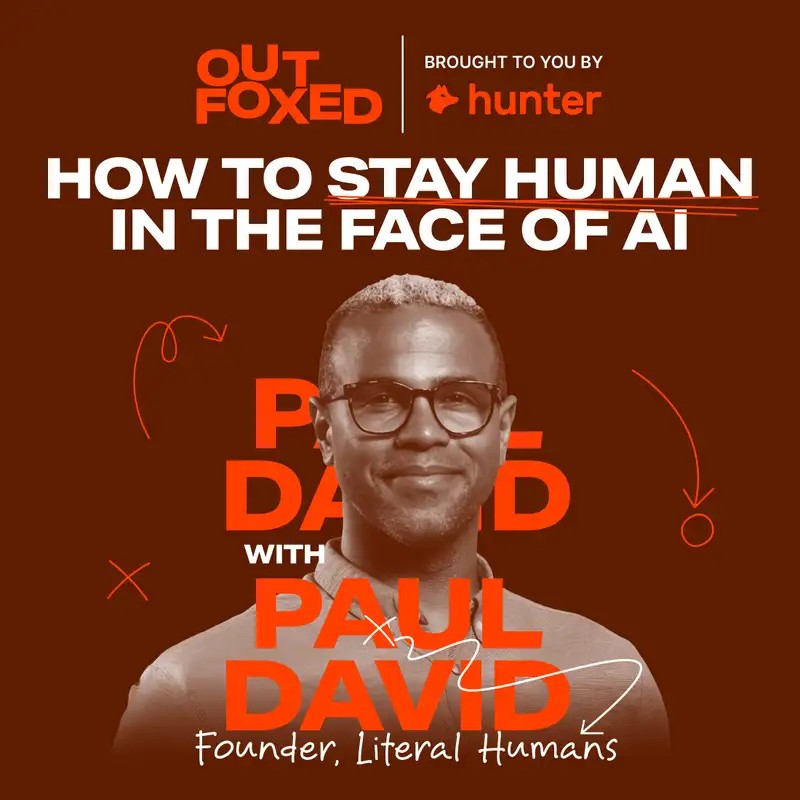
[00:00:17] Well, hello, and welcome to another episode of Outfoxed. I am Matt Tharp with Hunter. Excited to be here, and really excited to have this conversation with you. With me is Paul David. Paul is co-founder and CEO of Literal Humans, a London-based digital marketing agency that's helped companies like Wise, Aura, Chipper Cash, and OysterGro without surrendering that human touch.
[00:00:44] Interestingly, and this is one of the things I'm anxious to pick his brain about, is before his agency life, Paul was in the New York City public education system, both teacher, school leader, and an architect of a new public high school concept in the largest [00:01:00] district in America. So anxious to kinda hear the through line there.
[00:01:03] Paul earned a doctorate in education leadership from Harvard, then pivoted to what he's doing now with writing, journalism, and content, which led up to Literal Humans' launch, right around the pandemic, I believe. Literal Humans is now a B corp running a four-day work week. And Paul also hosts a podcast called Tech Can't Save Us, which feels particularly prescient at the moment.
[00:01:25] So Paul, excited to have you. Can't wait to hear some of these stories, and welcome to Outfoxed.
[00:01:31] Yeah, thanks for having me on. Appreciate it, Matt.
[00:01:33] Before we get into the specific things that I know the Outfoxed audience is gonna be dying to know about, help me understand the through line here. Tell me what led you from obviously a deep knowledge of education and the education space, doing some really interesting things to an agency that isn't a, as far as I'm aware, a normal career path.
[00:01:53] Yeah, it's an interesting one, and as I work in the space, I realize and kind of like [00:02:00] untangle the layers of connection that I maybe implicitly knew existed, but, didn't bring to the forefront. I mean, the functional path was essentially working in education.
[00:02:13] I ended up as an executive director of nonprofits and, I was fundraising, I was selling, I was doing a lot of writing, and that kinda led to writing about education philanthropy for an outfit called Inside Philanthropy. I just really enjoyed writing and interviewing and kind of, service journalism.
[00:02:30] And then that led into, kind of that, the departure and saying, "Hey, I really like writing on the internet and producing content, making the internet a more interesting, informative place, getting paid for it, having a more flexible location, traveling." And so I did that, and I just kinda flicked the switch, as it were.
[00:02:47] Started working for, another agency in the States that served B2B SaaS, got picked up by the TransferWise, the Wise, content strategy team. Was on the ground floor for that. And then that kinda led into [00:03:00] focusing on tech for good, startups and, nonprofits, and basically just giving them the growth partner that I wish I had when I was running charities in the States.
[00:03:09] That makes sense. Okay, great. Well, thank you. You made it seem obvious like I'm an idiot for not seeing it, but, no, I love the connection. What was particularly interesting for me is just having had kids come up through public school and feeling like the model doesn't perfectly fit the world anymore, I was really interested to see how much time and how much energy you put into that particular part of the world.
[00:03:37] And, yeah, I get what you're saying. It certainly feels like it would be more fun to teach people the way you're doing it now.
[00:03:44] Yeah. And like one of the, you mentioned the role that I had in, New York City Department of Education. It's the largest school district in, America. I don't know how many kids they have, over 1.5 million kids maybe now, which is insane to think about.
[00:03:56] But, it was the best job I ever had. I was basically a [00:04:00] school designer, and I got to go out and meet with families and communities and kids. And we worked in this co-working space. It was very hip and cool, like in Chelsea. And then we'd take these ideas out to, market to actual high schoolers and we're like, "Oh, we have this idea for this high school."
[00:04:13] And they're like, "This is complete crap." And it was so humbling, and rightfully so 'cause it just shows you how like as adults, we like to kind of sit around and concoct these things and not actually build with people and co-design. So we ended up launching three schools, in Queens and Brooklyn that were focused on, competency-based education and, mindsets and skills, and frankly, a lot of the things that I think are crucial in the age of AI.
[00:04:39] So in a weird way, we're ahead of the game, and, I'm really proud of that. It was one of the proudest, proudest moments of my professional career.
[00:04:46] That's awesome. Congrats. How, like are those schools still active today? Are they, were they experiments that then gotten-- have been woven into the greater fabric of the school system?
[00:04:57] Like what ended up happening there?
[00:04:58] To be honest with you, I mean, [00:05:00] institutional inertia, man. It's a thing. Yeah. And so, you have these points of light, these moments of innovation, especially inside a massive, bureaucracy like the Department of Education in New York.
[00:05:12] And so I think they persisted for a while. One of my good friends was a principal who kind of kept it going. And then, you have folks come in, and they just have a different philosophy or they've been sort of marinated in the system for quite a while.
[00:05:26] And, it's hard to maintain that kind of innovation inside a system like that. But we like to think that we made, we made some inroads. There was a spinoff, charter school that started as well. And there's a whole movement, I think, in the States to kind of move us towards competency-based learning, which is more about, kids being able to demonstrate their skills and, elect and do more projects and less of this drill and kill test, stuff.
[00:05:51] So yeah, I'm proud of that.
[00:05:52] That's great. Yeah. If we could somehow get to a place where we're fostering youths’, young people's creativity instead of stifling [00:06:00] it, I think that would be a pretty good thing for the country, right?
[00:06:03] Right. Right.
[00:06:03] Yeah. That's great. I love this because now the pattern of you kind of zigging instead of zagging and trying to maybe focus on things in a different way and being a change agent makes sense.
[00:06:16] But then if we come into outreach, which is our world, you've said something I wanna unpack with you. You've talked about cold outreach needs to be warm, and I think one of the things that you've added to that is something about offering value or engaging in a human way, and I guess let's use your brand as a indicator here.
[00:06:37] Literal Humans is the name of it. So like, talk to me about your perspective on this, how you've come to that, how you practice that. I would certainly love to hear more about your take on real, genuine, authentic outreach.
[00:06:53] I mean, I think it starts with, I know we're gonna get into this, like, really good qualification, because I [00:07:00] think with, qualification and, really, identifying your true ICP, your true, IBP or your, individual buyer profile, the actual buying committee, especially if you're in B2B, you're saving yourself and other people a lot of time.
[00:07:13] So there's a lot, there's a, we wouldn't always think of that as like part of, kind, helpful outreach, but it is. 'Cause if you're talking to someone that you have no business talking to, you can't really share value with each other, then what are we doing? So I think that's kinda step one.
[00:07:28] And then I think, warming up cold outreaches is about taking the time to kind of understand that individual, that human. I'm of the belief that B2B is actually more emotional and more human than B2C, because it's people's jobs on the line and their professional reputation and their livelihood.
[00:07:46] So really like deepening your thinking about that buyer and how they're trying to be the better dean of nursing or the better vice president of procurement inside the organization and talking in that language. So [00:08:00] yeah, jobs to be done. But it's a growth to be had for that individual human and, how do they walk away from their engagement with you as a better dean of nursing or a better vice president of procurement in their role and not be dependent on you?
[00:08:14] So I think it's about, thinking about that and then thinking about fun stuff like, do they like the, Philadelphia Eagles? Or, do they have a dog? Or can you send them something in the mail? We have a new client who's into comics, so I'm sending him some, comics. And those little extra unreasonable hospitality touches, I think, those are all ways you can kind of warm up outreach.
[00:08:34] And we've seen it work really well with ourselves and with clients.
[00:08:36] That's great. This is a level of personalization that goes beyond, I think, the way people typically think about personalization here. You're actually, have you found a way to do that at scale, or do you found that you need to do a more literal hands-on one-to-one outreach to be able to reach that kind of precision?
[00:08:56] Like, 'cause like figuring out their comic book interests is pretty [00:09:00] narrow, right?
[00:09:01] Yeah. Yeah. I mean, and there's different levels to it based on sort of where they are in the funnel, as it were. I think scale is a really funny. It's a funny word. Like if you're doing it that way, then scale changes.
[00:09:15] Essentially, it, diminishes, it reduces the right scale you need to reach, if you're reaching out to people in a certain way that engages them more deeply, more effectively is hopefully. And isn't that what we all want? I mean, I think a lot of marketers, they try to boil the ocean, and we got to get, ten thousand touches.
[00:09:33] And if we get that, then one percent, and then that's gonna give us, it's like, do we really need that, want that? Like, is that like, 'cause we're just, we're filling up people's inboxes. It's just clutter. And I think we need to be really honest with ourselves as marketers about how we've crowded the field, with a lot of needless stuff to reach numbers that we probably could have reached differently or didn't need to reach at all, in terms of like actual selling and conversion.
[00:09:57] So I'd rather focus on like, what is the leanest [00:10:00] scale that we need to achieve with the most effective, targeted outreach. That's kind of what, I try to focus on with our outreach and our clients.
[00:10:11] I have slapped my own hand about this repeatedly in like webinars and things where, we've seen the data, and the data says smaller lists perform better, just full stop.
[00:10:23] Now, what it doesn't say is why. It's not just because you sent a campaign to 10 people that worked. It's, there's something to it. And it's interesting 'cause when I talk to marketers, when I talk to folks like yourself, creativity, messaging, adding value seems to be something people talk about.
[00:10:43] But I imagine if you and I opened our inboxes for a minute, we would, be able to prove or demonstrate that not a lot of people seem to be following that advice. What do you think gets in the way? What do you think is actually happening that so many people that think this way about marketing aren't actually [00:11:00] doing it?
[00:11:00] Because I don't feel like technology is the problem.
[00:11:03] So your question is around, why aren't marketers, sort of, following their own advice on this stuff? Or like, Yeah. Help me understand it. Yeah. Yeah. I mean, yeah, I think there's a lot of, as I mentioned, like, inertia is a real thing, and I think people are pulled into ways of performing their role, that are, kind of social, they're baked into the organization, they're institutional.
[00:11:26] I feel like I go to conferences these days and I'm just like, "Man," like everyone is kind of like we're all just like drinking the same Kool-Aid and singing from the same hymn sheet when we should actually be kind of thinking about how to innovate in our roles, especially now with AI, that's frankly just like eating our lunch in terms of production and so many things.
[00:11:44] So, I think we're very social beings and we, you like to be part of the, the in crowd and, standing out and doing something a little bit different, I mean, it works, but also it's, very friction-full and it's very scary, sticking your head out there. [00:12:00] So we've tried to like take a sort of middle path that's like, yes, we're Literal Humans.
[00:12:03] Yeah, you're still gonna get an automated email from us, we're not like a, we're not above that. But what goes into that is there is a better research, is a better, sort of, qualification, understanding of you, some level of personalization. And you can't always do that with an AI tool.
[00:12:19] So we're gonna use the tools, we're gonna grow, we're gonna move, with the market, but we're also gonna hang on to the stuff that, that makes us human because I think that's what everyone's kind of yearning for right now, is okay, these tools can do a lot, but like where's the us? Like, how does this make us more, more human? And it's cool to see that, that sort of, that response.
[00:12:39] Do you think that's helped you capture your ICP better, being direct about that? 'Cause I feel like the messaging around Literal Humans is pretty clear about that.
[00:12:49] Yeah, I think it helps to, qualify folks in, qualify folks out.
[00:12:54] I think especially nowadays, like people are looking for, I [00:13:00] keep saying this, looking for like a platform and a partner. And if you can, if you can kind of, I say to the team, we can be breakthrough on one thing, distinctive on one thing, and competitive on one thing.
[00:13:10] That's just about energy. So if we can be breakthrough on solutions, that's why our clients come to us. They want us, to help them earn revenue so they can grow. Bottom line, if we don't do that, we're done. And then the second thing, we talk about is service and hospitality. They have to enjoy getting on a call with us and, connecting with us, and we have to, really be, unreasonable with how hospitable we are, almost like a hotel or a, some luxury brand would.
[00:13:39] Because that's gonna be the difference maker these days, 'cause every, we're competing against, the junior designer who's got Midjourney now. And so that last thing that we can be competitive on, we need to be competitive on creative and sort of, product output because that's the floor now.
[00:13:55] Like, competence around creative is the floor. And not everyone's gonna get it right, [00:14:00] but I think that's kind of the right mix, I'd say.
[00:14:02] There was a line that you wrote, it said something, "Founders treat marketing like a vending machine rather than a science." Talk about that.
[00:14:10] You're giving me a lot more credit.
[00:14:11] I don't, even remember writing that. Yeah, I mean it's something I really struggle with. Like, I feel like I've been in two professions, like education and marketing, that, like, everyone thinks they know and can do and are, like somewhat disrespect, like I say to the team, I'm like, "they would never tell a brain surgeon, like, which scalpel or tool to use and which part of the brain to..."
[00:14:37] But, like, regularly people come in and like, "We need to do this. this is the problem, and this is the tactic that we need to do." And I'm just like, "What?" Like, like, that's your entry here is like, and some of it, a lot of it, I would argue, is self-inflicted. I think, there's been a lot of waste.
[00:14:54] I think there's been a lot of deception, a lot of, frankly, just, like, snake oil [00:15:00] sales in marketing, and we need to own that. And so people come to us and we're like the house of the burned, a house for the burned, like, because they've, they've had bad experiences with agencies and marketers.
[00:15:13] So I think we need to do a better job of, like, self-organizing and regulating our profession, like doctors do or, other sectors.
Which is interesting 'cause I feel like marketing is the place in your organization that should be the most scientific.
[00:15:49] And yet you're right. I think a lot of times it's like, "Well, gosh, I put fifty dollars in, shouldn't I be able to get, a bag of Twinkies?" What drove you to write that? What's an example of [00:16:00] something you've seen where you, felt like that was the thing that needed to be said?
[00:16:05] Yeah, I mean, I was-- I think I was actually a little bit bitter.
[00:16:07] We, had pitched a health tech company. This is my way to process, Matt, a rejection. It's a good way. Yeah, I thought it was all right. A coded way to talk about it. And, in the case of, this sort of rejection here, we must have pitched this, this health tech company like four or five times.
[00:16:29] They kept coming back to us and the team was like, "Paul," like, "what are you doing?" And I was like, "Oh, we're gonna get it this time. This is gonna be the time," Like, and, the... And at the same time, another health tech company came to us and just had totally different energy. And it was really like I had, I really, I was like, "Wow," like, "the universe is showing me, like, two very different in the same sector, startups and I need to talk about them.
[00:16:55] And so they would just come to us and say like, "We need this, we need that," and they changed their mind and they were treating us [00:17:00] like almost like a vending machine. And then I think what's happening a lot now is people are going to agencies and strategists, getting the strategy, and then just like chucking it in Claude and being like, "I can do this myself."
[00:17:28] But for other folks, they really treat us as partners, and they, we have clients who have been with us, Matt, since 2021. That's unheard of in the agency space.
[00:17:37] Yeah.
[00:17:37] Unheard of. And it's because we've had ups and downs, they've trusted us, we've built strong relationships.
[00:17:42] I have a client that I celebrate Thanksgiving with every year. I know, his kids' names, and I ask about them. And, I saw one of my clients over Christmas break in Philly, drove in from New Jersey just to get a coffee with me. Like that's the kind of like textured, layered, thick relationships that we want with our [00:18:00] clients because we know it's gonna, in the long run, that loyalty is gonna bear fruit.
[00:18:04] Now this, one of these clients, they're, they've been acquired by a larger agency, and they've essentially cashed out and we're continuing to work with them. And, another one's been acquired twice now and has just, continued to grow. And so, we think those sorts of partnerships where you actually look and you respect the work of the other person are what's gonna get you over the hump, and we can prove it.
[00:18:24] That's amazing. Like so, is it that you're investing more in the service and in the relationships so that they listen to you when you tell them an idea is not good? Or is it that they become more respectful in that way, or are you choosing your clients so that they fit the mold? Like, how much of it is one versus the other?
[00:18:49] Yeah. It's a really good question that, I think it's a bit of both. I mean, we've done the classic agency thing where we've chased revenue because we needed to. And, frankly, we've known, [00:19:00] more than I'd like to admit that certain clients, they pay well, but they're not a fit.
[00:19:05] And we're kind of moving into this space of like, which I think speaks well, coming out of our name and our branding of like, we can put together the best strategy in the world, but if the, humans leading that company do not understand and sort of effectively integrate and, help us, execute the growth strategy that we build with them, then we're all stuck.
[00:19:27] So we're now moving into the space of like coaching and sort of leadership development and because we're realizing that, the blocker is often the humans, like shocker, spoiler alert. And we need to deal with that, and we need to be really honest and upfront and, that's a hard thing to sell to a client saying like, "You're a little bit deficient in your leadership."
[00:19:47] Like, "We need to work on X, Y, and Z because here's this amazing growth strategy you paid for, and the way that you're moving right now, is gonna really hamper that." So we're, so there's a piece of selection there, like trying not to [00:20:00] select people that it's maybe too hard-- clients that it's too hard to get them through that.
[00:20:04] But I do wanna work with the folks who they need a little bit of that nudge and that coaching and that support, and then they can, effectively execute that strategy. And then it's also the downstream stuff of making sure that we're delivering for them, in the mix, execution, strategy, pivoting, being nimble.
[00:20:21] So it's a bit of both.
[00:20:22] Okay.
[00:20:22] Today's episode is brought to you by Hunter.io, the B2B lead generation platform made for every professional. Whether it's prospecting, fundraising, recruiting, link building, or just trying to connect with the right people, Hunter makes it easy
[00:20:39] So you've been doing this now six years.
[00:20:44] In this agency, six years. In the previous agency, about three. So I'd say, yeah, close to ten.
[00:20:49] Okay. If you think about the time post-COVID and pre-COVID, are there any real structural differences to the way you're doing what you're doing or the way that clients are buying [00:21:00] agencies?
[00:21:00] Like, do you see a difference between the way people would think about agencies, agency partnerships pre-COVID and post?
[00:21:08] It's less about pre-COVID. I mean, I think there have been waves. We joke that, like, all we know is chaos 'cause we started in COVID and now, AI and, you know- Yeah ... it's just, like, I picked a hell of a time to start an agency, but you know, we're still around.
[00:21:23] I think post-COVID and really like post like 2023, where kind of the bottom fell out of the tech industry, it's now much more about revenue. It's much more about like, being profitable and, the days of like overvalued, companies and massive rounds and, just money to burn are effectively gone.
[00:21:41] And I think that's kind of a good thing for our profession, because it needs to be, to your point earlier, we need to be more rigorous, more scientific, more connected to, sort of conversion sales, ROI. And frankly, we should have been doing that already, and working closely with product teams and sales teams and C-suites.
[00:21:59] And it [00:22:00] boggles my mind that, there are agencies out there that don't, but sure. And so I think that, that's been an important shift. And then now recently, I think AI has really shaken things up. I've had a client, one of our longest-serving clients, one of our biggest, pull me aside and basically say, "Look, I can execute most of your remit with Claude Cowork and Code and Perplexity, but, I'm not gonna let you go.
[00:22:26] I'm gonna be loyal to you because I know right now I'm ahead of you because I've been-- I have the time to kind of build and research all these tools. But I know at some point you're gonna get ahead of me, and that's gonna provide value for both of us." And, now it's about getting into that sandbox with clients and other partners and building together faster, more efficiently using AI.
[00:22:45] But, also, isn't that a beautiful thing that I'm now working more closely with our CEO, the CEO of our client, his sales director, a partner agency that does additional strategy, their technical, their product person, essentially. [00:23:00] That's great. And, what the tools allow us to do has brought that on.
[00:23:05] And I think that's amazing because now we're humans who are now working in closer concert, and getting to know each other more and, syncing more. And that's wonderful. So I think it is provoking a really interesting change, and we're trying to scale that across other clients.
[00:23:17] That's a really interesting change, though.
[00:23:20] To go from, because what you've just framed is a completely different way of thinking about the impact of AI on these kinds of situations and relationships. Like, the fact that you can use the tool to collaborate better together kind of speaks a little bit maybe to the fact that if you I think the magic secret with AI is if you know exactly what you want, you know exactly kind of where taste comes into play, and you know how to describe what you're looking for, AI can be a pretty amazing unlocking tool.
[00:23:54] I think the misnomer the, the sort of misunderstanding is that people think it's smarter [00:24:00] than them, and they can just ask it to do a thing that they don't fully understand yet. I feel like that's kind of the thing that everybody thinks AI is gonna do, is like, "Oh, I'm terrible at marketing, so I'll just get Claude and say, 'Be my marketer.'"
[00:24:11] But unfortunately, you don't probably know the difference in the first place. Like what, how, what's your take on this? Like this is a really interesting concept that is bringing you guys closer together.
[00:24:21] So I think there's a couple things here. I mean, one, that point about competence being the floor, I think what's interesting is like a bunch of people, and I say this with all, sort of like kindness and understanding, like everyone's at a different level of understanding in their profession.
[00:24:36]It's blown my mind how the steep learning curve that I've needed to take moving into the professional marketing, ten years ago, like it's, wow. And I mean that very with utmost humility. Now with AI, people who are like twos and threes out of ten in terms of their skill level and understanding are now baseline five, sixes because of what's [00:25:00] inside the LLMs and stuff like that, and that's insane.
[00:25:02] That, that's crazy to think about, right? Now they're, not gonna get to seven or eight because of, like, limitations, what they don't know. But that changes, what the market looks like in terms of talent and, perspective, right? So what does that mean for the rest of us?
[00:25:20] It means that like, we need to invest in these tools and scale ourselves up to be even more competitive and to, really distinguish ourselves from folks who, time was, it was easy for clients to just, ignore those folks because it was clear that they just didn't know what they were talking about.
[00:25:35] But now they can show up and kind of compete and, put together a document that looks kind of like what I would propose to a client because I've dumped a bunch of data in there as well, and it's pulling from that. So like, I think there's that. And I think, yeah, the other piece is, we have to figure out a way to give these gains from AI back to clients transparently.
[00:25:59] And that's go- I [00:26:00] think it's gotta be speed. I think it's gotta be efficiency. I think it's gotta be, quality, and pace. So I think the more transparent we are about that, the better, 'cause clients are, they're doing it. They're doing it themselves. And so, we might as well be open about it.
[00:26:15] Yeah, that's interesting. I wanna think more about it, but I'm sensing, from what you're saying is like this, there was a time where you could have creative agencies or performance agencies, and they often did kind of different things. A little bit about what you're talking about is almost like AI is forcing, a convergence here where it's no longer acceptable for you to just purely be a creative agency or purely be an execution agency because the real benefit of getting above that five or whatever the threshold is, in the merging of those two.
[00:26:49] Yeah, that's interesting.
[00:26:50] It's a great example, and, I recommend, I listened to Lenny's podcast, Lenny's newsletter. It's so good. And he had Cat Wu, the head of, product, [00:27:00] or sorry, the head of, products at Claude Code, she's the head of Claude Code, on recently, and she was talking about, product taste as, like, a key, sort of, hiring factor for people and how you do get these designers who are also developers and now you get product managers who can also do a bit of code and you're right, convergence is the word.
[00:27:21] Like we're-- things are converging, things are blending together. And so that person with the range to operate across those different functions is gonna be an advantage and the tools are gonna advantage them even more. So we need to be conscious of that 'cause that's just gonna, I think, increase so.
[00:27:35] Is this, ah, this is so interesting. Look, our customers, part of the reason for my fascination and sort of deep dive here is I think Hunter customers, not all, but a large number of them, especially in our SMB segment, are forced with this decision all the time, right? Their, inbox is chock-full of offers to just have meetings show up on their calendar magically, right?[00:28:00]
[00:28:00] There's such a push to outsource the performance angle of sales and just sort of get meetings to show up. And I feel like there's such a push towards this, but like I'm not sure how to tie this all together. But it feels like there's something. I'm gonna come back to this because I do think, I think that there's a thing here, and I just haven't put the words together yet, but this is a really interesting thread.
[00:28:24] Let's talk about specifically how you go about getting new business, right? You, like, you're familiar with Hunter because, you've used Hunter, but, like, if I'm thinking about all the emails I get and I'm thinking about how you pitch, how you would pitch your business in my head. I'm like, how does Paul make sure that Literal Humans doesn't just sound like everybody else?
[00:28:47] Like, not giving any secret sauce away, but how do you make sure that your pitches break through the noise?
[00:28:53] I mean, a couple things. One, I think timing is, timing is everything and, qualification as I said. So making [00:29:00] sure that we're, meeting them at the right moment where the- it feels like a good mutual partnership.
[00:29:07] Qualifying them to the point that, I can say, "Look, I've got the team for you, in this moment." And also maybe the sectoral experience and sort of the strategic, know-how to, really, fill your pail. I think back to that point about like personalization at scale.
[00:29:25] So, investing and understanding, their, pain points, who they are as individuals. So, if you've got a buying committee and it's the head of marketing and the head of comms and the, and, head of growth, really, we had that pitch the other day for a huge energy company and really speaking to each of their needs once in the pitch and even looking at them directly and saying, "Hey Alice, hey Greg, hey Sarah," like, "I know you're worried about this.
[00:29:48] I know this is happening in the market. We're, gonna, add this in here." I think there's a piece about too just like being memorable. Like so much of it is just like [00:30:00] drivel and like slop, right? So like, say something funny, Be, irreverent. Be quirky, catch them, off guard a little bit.
[00:30:08] So tailoring it a little bit. I think also the piece about adding value. We, get a lot of folks who... I just had a great like sort of junket to New York, and we hear this a lot, which I like. It, warms my heart where they're like, "You know what? I don't normally respond to these emails, but something about yours," and they just took a random meeting with me at Soho House, and I'm just like, "Yes."
[00:30:27] I'm doing a podcast with one of them, after this. and so really thinking about the quality of your writing, the value that you're adding, the personalization I think is, key. And again, rethinking what scale is. Scale is like, I wanna meet with five great people in New York, so I'm gonna target, maybe 50 and, really invest in those 50, and I'll get, five out of that, and that's exactly what we did, so.
[00:30:52] Okay. This is good. I love this because you're not saying scale is bad, which is, No. The trap that I think people [00:31:00] think we're leading them into. And I'm like, "No, it's, not that." But small lists work for a reason, and it's because you can spend more energy on the people who are in that list.
[00:31:09] You can make sure that the messaging makes sense because all 50 people are very similar. That doesn't mean stop at 50. Yeah. It just means be thoughtful about the goal, be thoughtful about the audience, make sure you're lining up the right set of things. Yeah.
[00:31:26] Yeah. I think signal matters.
[00:31:28] Like, like, a lot of people operate on volume and noise, but not signal. And so, how are you, like, I mean, a small thing is like, when I went to Amsterdam, a couple months ago, initially, we were trying to get people to come to Starbucks, and then we're like, "This isn't working." We switched to Soho House, and people just completely.
[00:31:44] Okay, so what does that signal, right? And then, mentioning maybe that you're meeting with, like, a couple other folks in their sector who they know, and it kinda sends them, a little bit of a signal that, okay, this person, he's connected to people that I respect and I know, and so I should probably meet with him, [00:32:00] so it's stitching that together, and not giving up as well, and being persistent. And then I think also, too, how you reflect on that. So after, I went to Amsterdam, I, basically did, like, a synthesis post where I talked about how every person I talked to, had this interesting through line, which was kinesthetic.
[00:32:19] It was tangible. There was something you could hold, you could feel across all these varied types of companies. And I thought that was interesting. And I got on a call, a sales call, with one of the [...] and they were like, "We loved that included us in that post and you reflected on it."
[00:32:33] And so now, they're gonna refer me to someone else or, meet with me again, and I didn't close the deal, but I will in the future. So I think it's the follow-up, it's the reflection, I think, that can go a long way as well.
[00:32:46] Okay. So, our customers, let me get back to the topic I was thinking about earlier.
[00:32:52] So our customers are, or I think actually just people, small businesses in general, but we talk to a lot of them [00:33:00] who are trying to make a decision about, do I do this myself for outreach specifically, or is an agency the right answer? And I'm imagining from this conversation that, like me, you probably don't think there's one size fits all here.
[00:33:15] So imagine you're talking to our audience. They are trying to figure out if they should try this or if it is, if an agency is a better option. Tell them how to make this decision.
[00:33:27] Is it agency versus, versus what, I guess is your question. I don't understand.
[00:33:31] Versus doing it yourself, just buying software and doing your outreach yourself.
[00:33:36] Yeah. Yeah. I mean, I think, for me, the, again, back to the, partnership and platform, right? I think it's fine to, get a tool and use it and take it as far as you can, but at some point, like, you're really gonna benefit from using that tool with other people, and, building some kind of community or partnership with someone who, [00:34:00] knows, a bit more than you do about these things.
[00:34:02] And also, I think that implicit in that is, a respect for the profession of marketing and sales, and I think a lot of people are too easily cynical about those professions. Daniel Pink's book, what is it? To Sell Is Human, is fantastic, right? It talks about, like, salespeople standing in their power.
[00:34:21] And I think salespeople are gonna become even more important. Like, look at what's happening now. Like, if you can talk to another human and sell, and then you can execute as well with all these AI tools, you are unstoppable. Like, that was the joke about salespeople. They can't execute. They just, they can sell, but they don't, they can't project manage all that stuff.
[00:34:37] It's like, okay, well, now they have Perplexity computer and Claude Cowork and like, so if you can convince other people to buy what you're selling and deliver it, oof. So I'm bullish on salespeople and people who can liaise and connect with other humans and also now get a lot of the work done with AI.
What is it about where they are in their business that suggests an agency is a better fit for them?
[00:35:26] I like that you said where they are in their business, 'cause I think timing is everything, right?
[00:35:30] And I think it's less about conceptually choosing an agency versus a freelancer versus an in-house hire, than it is about choosing the right partner. And sometimes that partner is that freelancer, or it is that, full-time hire, or it is that agency. I think, agencies these days best position themselves when they show up as a holistic partner who can kind of pivot from, different priorities that the clients have month to month, quarter to quarter.
[00:35:59] And that's [00:36:00] how, we're rethinking it. Not everyone agrees with that. Some people are absolutely niching down. I think that also works too, because sometimes that party that you need is absolutely incredible when it comes to, web experiences, and you need them for a year, and that's fine.
[00:36:15] But I think it's about chemistry, it's about fit, it's about alignment, and taking that time to, like, build that relationship and yeah, thinking of it that way. 'Cause if, you, set a really strong criteria for, "I need this type of partner right now at this stage of the, life cycle that my business is in," you'll always win.
[00:36:36] You'll always win. And it's about, like, nailing the brief. You go to our website, we have a little, that, you know- drop down that says, "How to brief an agency." We have a guide 'cause we're so tired of getting shitty briefs. And so if you really think of your brief or the kind of partner that you need to invest in that, you will always win.
[00:36:54] You'll always win, and it'll help you decide what kind of partner to select as well.
[00:36:58] I like that. That's [00:37:00] good advice. Then it's a great transition to the way it often gets framed in our emails, which is, not about partnership. Okay, so here is an actual email that is, by the way, very similar to a hundred I get a day probably.
[00:37:16] Says, "Buyers on Reddit" is the subject line. "James, noticed you posted a couple of case studies and four blogs about your new software updates this month. We grab content like that and get it into the Reddit discussions where buyers search before buying. That is how brands start showing up in ChatGPT and AI results.
[00:37:33] Doing this for seventy-plus companies right now. Should I put together a Reddit audit for Hunter?" And then a sort of signature, no reply, reply no. But no interest, reply nope, and I'll bounce. What are your thoughts here?
[00:37:47] Should I start with the good, the bad, or the ugly? What's your, what's your.
[00:37:50] You choose.
[00:37:51] What's the good? Yeah, let's do good, bad, ugly. What's the good?
[00:37:53] I mean, I like buyers, so the fact that they've identified in the subject like, like buyers, like that's the thing I want. [00:38:00] Reddit, that's a platform that we are not operating as much on as we should be, so, the subject line is, kind of okay for me.
[00:38:08] I like that they mentioned that they're working with seventy-plus companies. I would love to know who they are. But that could potentially be social proof. But yeah, in general, like it just looks like one of those, you know, like sort of simple text, automated, oh, we're gonna personalize at the top and say your name, and then basically, the rest is boilerplate.
[00:38:29] And, yeah, they threw Hunter in at the end there. Obviously, that's a little bit of personalization, quote unquote. But and obviously like the no interest thing at the end, is very welcomed, 'cause for this one I'm definitely gonna, reply nope or unsubscribe. But, also when I see that, I immediately know that is likely, an automated with the, kind of out there, so yeah.
[00:38:52] So the good was the subject line and that they made a passing attempt at personalization. What's the bad? 'Cause it sounds like there was [00:39:00] more bad than good.
[00:39:02] Oh, no, I mean, I'm actually saying that I think the personalization is like minimal and could be much stronger. And the what they do is interesting, like, grabbing, mining content, getting into Reddit discussions.
[00:39:16] I'd like to understand that a bit better, 'cause that's, I think that's very hard on Reddit, nearly impossible. And but also this piece about showing up in ChatGPT and AI results, like, like they kind of buried it a little bit, 'cause that's on the top of everyone's mind. So to me that's like a missed opportunity to, speak to, okay, here's the result.
[00:39:34] Here's the business outcome that we help you achieve. So how do we, how would they maybe prioritize that in this, in this email?
[00:39:41] Okay. So what's the ugly?
[00:39:43] I mean, maybe the title, like John D. Growth. As soon as I see growth hacker I'm like, "I'm out." The brand name Go Manifesto I don't love.
[00:39:54] I'm big on naming things. I hate that name. Yeah, the no [00:40:00] capitalization in the subject line totally turns me off as an English teacher, former English teacher. Yeah, just the structure is like, ugh, like it's just this is, yeah. It's just, yeah.
[00:40:10] Would you, if you could change one thing about this that you think would make it improve its reply rate or improve the outcome of this, what do you think that change would be?
[00:40:21] Or what would you recommend?
[00:40:22] I think focusing on that, that business outcome, like, helping brands show up in AI search results, and prioritizing that, whether it's in the subject line or much higher. This personalization line, like, you posted case studies and four blogs.
[00:40:38] Like, of course I did. What do you, what, how is that personalization? What, like, what are you doing? So yeah. That's what I prioritize.
[00:40:46] Thank you, Paul. That was great. Sure. Just to make it more challenging, I get an even harder, more worthless email. Yeah.
[00:40:54] Just for you.
[00:40:55] And you're right actually. You had some meat in yours that you could actually work with. Oof. This [00:41:00] one says, "Subject: Connect with teams needing marketing." Yes. "Connect with teams needing marketing." Okay. "Hey, Paul. Reason I reached out is I noticed your expertise in human-centered marketing strategies, and we can connect you with 15 mission, 15-plus mission-driven brands in edtech, fintech, and healthtech, looking for marketing support.
[00:41:23] Open to learning more." Not named, no subject, no, or sorry, no, signature, no social proof, nothing in this one. Yeah, this is terrible. You actually got this email, though. Is that right?
[00:41:38] Yeah. Yeah.
[00:41:39] This is, okay.
[00:41:41] We get a lot of these where people key in on the human-centered marketing thing and think that repeating that back to us and telling us they're gonna find mission-driven brands is gonna, and I never respond.
[00:41:51] Yeah, well, yeah. It's the lowest form of, yeah, I pulled a line from your website keywords. What do you think? Yeah, okay. So where would I go with this? I'll use your [00:42:00] good, bad, ugly framing here. Good, it's short. Short is good. I appreciate that it did ask if you were open to learning more.
[00:42:12] That generally means you're not being too assumptive in the first message, nor are you trying to get the wholesale upfront, so that's good. so a couple of bright spots. They did capitalize the first word in the subject. So I'm with you there, and I'm not an English teacher. I just don't know why people think that's a good idea.
[00:42:29] Sure.
[00:42:30] Bad. Okay, bad is there's no subject. There's no brand association. There's no credibility. There's no trust. They've done nothing in this email to actually suggest they know about you, your business or the fact that this email was sent to you or your business. There just seems to be generally no attention paid.
[00:42:51] And I think the ugly, ah, I think actually the bad and the ugly are the same. I mean, just zero attention paid to trust and credibility. You're showing up [00:43:00] randomly on somebody's email doorstep and asking for their attention and time, but not willing to part with any of your own. And I, that to me, is always the big rub.
[00:43:12] It's like you spent no energy sending me this, but you want me to spend energy replying. Like I don't like that sort of trade. That value exchange feels, incorrect to me. In terms of how I would do it differently, honestly, I think I'd scrap the whole email and start over. Yes. I'd probably do something different.
I guess if I'm in this context, I am just a, an appointment setting agency or a lead generation agency, and so what am I really selling? I would probably lead with a with almost a takeaway or something that's really authentic here that shows genuine interest and tries to engage in a conversation.
[00:43:58] So what I would say something to the [00:44:00] effect of, "We work with companies in a lot of industries, including ed tech, fintech, and health tech. I'd be really, I really like what you have on your website, or I really like what you've said about your mission. I really like your case studies," something to that effect.
[00:44:15] "And I would love to see if there's a way we could work together because we get meetings for companies like that all over the place. Would you be willing to spend ten minutes with me and explain to me what you look for in a client? What is, like, is a mission-driven brand a good fit, or is it something else?"
[00:44:31] Like, I might try to provoke a conversation where I'm genuinely not saying I already have your problem solved. I'm actually trying to see if there's a way we can solve it together. I don't know if that's a very good on-the-fly rewrite, but conceptually, that's what I would probably try to achieve. Yeah.
[00:44:49] I don't know if it would be more successful, but it would at least be a better attempt.
[00:44:52] I think, too, like, like, getting real about, like, what, again, back to, like, empathy and understanding of, like, your, sort of B2B buyer. Like, [00:45:00] what, do I need? Like, what does Paul need for his, like, I need a list.
[00:45:04] I need names. I need copy. I need, maybe a warm intro. I, need, an understanding of the market that will maybe get an email that I send cold answered. So, like- Yeah. If you're, if I'm gonna spend ten minutes with you, fifteen minutes with you, I better get something off the back of that, or I better get something, in that.
[00:45:25] So if you can give me value and commit to that, then I'll give you some of my time. it's really simple. Like- Yeah. It's actually like, yeah, it's not that, it's not that complex.
[00:45:33] Yeah. No, I like that. All right. This has been great. I got much of what I was hoping we would get out of this conversation. I really appreciate you giving us some time.
[00:45:43] I guess two final thoughts. One, favorite podcast right now?
[00:45:47] Ooh, that's a good... I mean, yeah, definitely Lenny's podcast. I'm really- Lenny's ... like, enjoying that. Yeah, I mean, but maybe everyone says that, but it's that good.
[00:45:55] No, it is really that good though. okay, and then the last thing.
[00:45:59] Your brand [00:46:00] and your website are Literal Humans.
[00:46:02] But all of the drawings are of animal faces. Was that intentional?
[00:46:07] Yeah, you kinda caught on. I mean, that was the initial, sort of inside joke was like, oh, we're gonna be literal humans, but it's gonna be animals doing human things. And, yeah, it's been fun.
[00:46:17] Like, we have the, drunk panda and kind of, different characters. We don't do enough with it, but it's, gotten us some good, praise in the branding department. So yeah.
[00:46:27] Yeah, I love the kinda tongue in cheek about the literal humans bit, so that's great. Totally, well, Paul, runs Literal Humans.
[00:46:35] You can find him at literalhumans.com. And of course, the podcast Tech Can't Save Us, which feels more needed than ever. So, Paul, thank you so much.
[00:46:45] No, it's been great to be on. Thank you so much for having me on Outfoxed. And yeah, thanks for a great conversation.
[00:46:49] If you like what you heard, please like, subscribe, and explore even more of the Outfox community by visiting [00:47:00] www.outfoxed.hunter.io