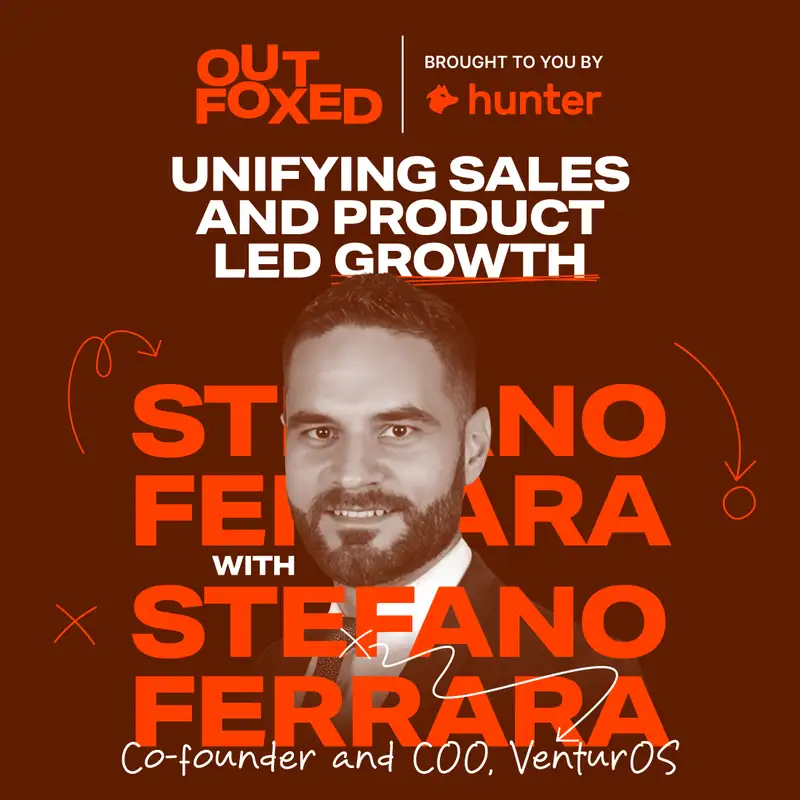
[00:00:00] Matt: Hey, everybody. Welcome to Outfoxed. Excited to be here and, super excited to introduce you to Stefano Ferrara. He's an investor, go-to-market advisor to countless SaaS companies and revenue agencies across EMEA, tapping into fifteen years plus of advisory and enterprise tech sales at companies like Gartner and Cisco.
[00:00:22] Most recently, Stefano has founded VenturOS, at getventuros.com. There's a plug for you, Stefano. An AI native operating system for solo builders, micro SaaS operators, vibe coders and, it's here where he runs growth and operations.
So previously at Gartner, he led emerging markets, business development team across that region, which is a very different kind of sales than Hunter is used to and in a lot of my experience, which is PLG.
And I know recently you're really going deep on freemium, and, so I'm anxious to get into that as well. So Stefano, welcome to Outfoxed and it's good to see you again.
[00:01:16] Stefano: Thank you. Thank you so much, Matt. It's a pleasure to be here with you.
[00:01:19] Matt: So to get to the point here, there's an interesting balance of experiences. So I've spent a lot of my time in freemium, and then I've, in many cases, I've had to layer in sales-led or enterprise sales into a product-led growth or freemium environment. You are kind of going the opposite direction.
[00:01:39] You've spent a lot of time in really consultative enterprise sales. I think if I remember right, when I was researching, the challenger sales model and methodology came up quite a bit, which I've spent a lot of time with. And so I, would really love to just like dive into the tensions around this 'cause I know you've been thinking a lot about this.
[00:01:58] So, like, talk [00:02:00] to me a little bit about specifically the tension that you've seen companies experience who are trying to balance product-led growth initiatives with a sales-led growth initiative, which both of which I think are challenging for people to figure out how to balance in exactly the right way.
[00:02:16] Stefano: Absolutely. So I think we're coming kind of to a synthesis from two separate directions. Yeah. And for me, spending almost fifteen years in B2B tech sales and advisory, where I learned and then taught the craft of prospecting, that was the bulk of my experience until very recently.
[00:02:40] And so for me, crafting short, compelling messages built on these three components of why you, why now, and the clear call to action was always paramount in order to be able to get in front of a customer. And I believe that when this is done properly, [00:03:00] it still works. But then in 2020, I sat in this revenue architecture course led by Winning by Design, and that's where I met this gentleman, Dave Boyce, who was talking about PLG and who later wrote the book, Freemium as well about PLG.
[00:03:17] And for me as a sales guy, my first reaction to PLG was, is it a threat to my career? So I was both scared and curious at the same time, and I decided to go deeper. And nowadays I can see it clearly that PLG and SLG, they do not, they're not rivals, they actually are stages. And where PLG earns you the meeting, then SLG tends to close the deal.
[00:03:45] Matt: So this, it's an interesting perspective where you're thinking of PLG as more of like a stage or a phase of the sales process, and that the sales process is still critical to, getting deals over the line, getting customers over the line. But, and I, [00:04:00] love this perspective because in my experience, one of the challenges, or to build on your comments about did you see it as the enemy or a disruptor to you, I often find that at some point at scale, enterprise organizations or sales-led organizations and product-led organizations tend to create-- tend to find friction with one another because the best leads are entering in a very warm state into the product directly. And so unless you instrument this experience correctly, you end up with sales folks saying, "Well, the best leads are in the product already, and they're-- those go to account managers," or something like that. So like I have found that in various stage companies, whether that's small, early-stage, kind of pre-series C or even at scale in publicly traded companies, this friction exists.
[00:04:48] So how is, like, talk to me a little bit about this idea of framing PLG as a phase that also then leads to, SLG and how that removes some of that friction. [00:05:00]
[00:05:00] Stefano: Sure. Absolutely. And by the way, I don't disagree with you. I think that we are saying the same thing at the end of the day. Okay. Also because SLG has been the de facto way of selling into large, customers most of the time, and also, in mid-size organizations.
[00:05:21] So and also David, Dave Boyce himself, when he speaks about an organization looking into PLG and whether it's a good fit for them when they're an SLG organization, he suggests to take it slow, to invest about three years of time, resources, and effort, and craft a task force within the organization that will build that out for one specific product in order to then make it a product-led growth.
[00:05:51] Many founders or many organizations that I've also come across, in my career think that just taking a product and offering maybe [00:06:00] some subset of it for free means doing PLG, but that's not really the case. We've seen PLG emerge more into, B2C solutions, most of the time, but we're seeing this now going into the B2B and also larger sales, deals and organizations, as you mentioned earlier.
[00:06:22] So Dave also speaks about that in his book, where he mentions that in some of these multi-billion dollar organizations who are adopting PLG, the sales team actually is not even allowed to contact the customers who are already using the product, even if it's a larger deployment. But this is all handled then by, to your point, the account management or the customer success team.
[00:06:47] So the two can coexist, and there are sometimes some very clear swim lanes there.
[00:06:52] Matt: Interesting. So in this model, like, do you think it really comes down to the size of the organizations that you're targeting as customers [00:07:00] where, you know, 'cause like one of the things that comes up for me as I'm talking to customers of various sizes, I still see that big organizations are often uncomfortable with product-led growth.
[00:07:11] They don't seem to adopt technology that way. And so the idea that most of these enterprise or even larger mid-size organizations, the experience I've seen them go through is one where PLG is interesting to them, but it still doesn't totally align with how they buy. And showing people that this is self-serve, and they can just do it, they don't need to come to me or come to a sales or an account manager, is still a bit foreign.
[00:07:34] Do you, have you seen that as well?
[00:07:36] Stefano: Absolutely, and especially in the Middle East, where rapport, relationship, trust are a strong element of any relationship between a buyer and a supplier. So, I think in general across the board, this still applies to highly regulated, environment or [00:08:00] organizations to what we might call also, the dinosaurs, the old style companies who are used to doing, buying, purchasing software or technology a certain way with very tight, procurement processes and steps that involve RFIs, RFPs, selection, and basically the whole,
[00:08:23] Right.
[00:08:23] dog and pony show, right? And also if the buyer himself and the user is somebody in the organization that legitimately cannot purchase, based on PLG alone after using the product like a CISO, for example, because of the many implications that that would have. I will talk maybe a little bit about the Middle East as well and where the trust component comes into the picture because that's where I had direct personal experience for the past 11 years that I have been living and working in Dubai and working across the emerging markets.
[00:08:57] So here as well, sometimes if you're [00:09:00] offering a product for free, this is perceived as you're not being serious, right? So there needs to be a hand-holding between having a product experience, maybe as, PLG or there is a, POV running, a proof of value or a proof of concept running. But then all of this needs to be always backed by a trust-based relationship between the seller and the buyer.
[00:09:32] I'll give an example. In my days at AppDynamics, which has then been purchased by Cisco, I was the second salesperson on the ground in Dubai covering the Middle East. And AppD's, playbook at the time said that you must touch every advanced opportunity twice a week with an in-person, meeting with the prospect, no questions asked.
[00:09:59] [00:10:00] And so in my efforts to apply the process by the book, I would make up reasons to show up at the client's office and, I did this one too many times with a VP, an Emirati gentleman in, one of the largest telcos in the region, until he basically started screaming at me across the open floor and, I had to leave, embarrassed and, obviously the deal then stalled because I hadn't earned the right and the trust to show up and to bring more value.
[00:10:37] It was a stage where they were now huddling internally in order to come up with a decision, and an extra touchpoint from the sales guy was really not needed. So obviously, I say this story to the startups I advise and to the teams also that I managed because this shows how it's important to take, in taking [00:11:00] the playbooks that might emerge from Silicon Valley, SLG and PLG alike, and then you need to actually, make sure that the reality on the ground and the trust is there wherever such requirements are needed.
[00:11:14] And believe me, in such a large deal and large customer that, I spoke about, it was definitely needed.
[00:11:22] Matt: Yeah, it sounds like it.
[00:11:43] Matt: You know, we find that, what's interesting here is the number of touches that needed to be in person. So much of what we do in software is virtual now or is remote, to the, fact that it almost feels strange to get on a plane and go somewhere and [00:12:00] meet someone face-to-face, like it feels a little foreign.
[00:12:04] Do you, also find that that is true, or do you find like in the Middle East, for example, the opposite is true, where in fact they expect some sort of in-person or kind of more face-to-face experiences?
[00:12:16] Stefano: I find that, despite the COVID days democratizing virtual meetings and Zoom calls or Microsoft Teams meetings, even in the Middle East, there is still a preference to having in-person meetings, especially for the meetings that matter, like big negotiations, board presentations, and also in bringing in the more senior person, in the organization.
[00:12:47] That still has a weight. We're often taught in B2B sales, that you are the CEO of your own patch, of your own business, so it's down to you to [00:13:00] go from prospecting to booking the meetings to conducting the sales cycles and closing them. However, in the Middle East, there is still this, attraction and this proclivity by the buyers to want to see the senior person in the organization.
[00:13:17] So if I'm dealing with a general manager or a CEO, they would expect that sooner or later they will see my own general manager, VP, senior person, or even CEO. And that's probably why you're seeing the big CEOs of the large tech giants like Satya Nadella or, Chuck Robbins at Cisco and many others taking trips from time to time to Saudi Arabia, to the UAE to meet customers in person, because that's still very much needed in order to show them that we care about you and that you are important to us.
[00:13:58] Matt: Yeah, that makes a lot of sense. [00:14:00] Now, this all makes sense if you're dealing with large deals, large businesses, especially if you're dealing with at-scale software products, but you've started your own, right? You have your, own business now, VenturOS. I have to imagine there are some differences that you're finding as you do the go-to-market for that business.
[00:14:19] Stefano: Absolutely. So many differences because VenturOS is, targeted to, startup founders, vibe coders, micro SaaS. And these individuals are usually younger, and they are most of the times tech-savvy themselves already and used to purchasing after having used a product- which is, has product-led growth in it.
I was, I wrapped up my, enterprise career in the corporate world with [00:15:00] Gartner in June of last year, and I decided that I needed a break and to decompress from the past fifteen or so years in the corporate world. So I took my wife and daughter, and we went on a eight-week trip across Europe.
[00:15:15] When we came back to Dubai, I took the remainder of 2025 as a sabbatical, where so many of the interests, hobbies, and bucket list items that I never had the material time to actually do when you're working ten, twelve, sometimes even sixteen hours a day for a decade plus. And so I got that out of my system.
[00:15:39] And as part of that, I also went back and met with so many interesting people from either my professional past or that I always looked up to, and I, reached out just to say, "Hey, I'm on a sabbatical. I would love to buy you a coffee and get to know your perspective on life, on things." And so many people [00:16:00] accepted that, perhaps also because it's not every day that you find somebody on a sabbatical.
[00:16:07] I've heard many times the comment that it takes a little bit of courage to kind of step out of the, safety also of, a paycheck or a salary and then do this without knowing what comes after. But I knew that, something that would come after would happen naturally if I just let things take their natural direction.
[00:16:29] And so in mid-January of this year, a former colleague, João Tapadinhas, who used to be, one of our VP research analysts at Gartner in the space of data and AI and analytics, he reached out to me, and he already had a third co-founder lined up and offered for me to join them and start what became VenturOS.
[00:16:52] So I found myself from leading a team of corporate B2B salespeople to being the COO and head [00:17:00] of growth at this startup designed for vibe coders and people who have an idea and want to ground it and make it a, make it come true basically, or who have a nice GitHub repo, have a bunch of nice, little lovable projects or, vibe coded with some of the other tools out there.
[00:17:20] And then they're wondering, "What would it take for us to, make this, or for me to make this into a business? What would it take for me to actually start getting paying customers, and so to turn my little repo into actually a thriving business?" There are a number of ways you can go about it.
[00:17:39] One would be you hire some fractional people. Another could be you would find the business co-founder, which is what my two guys did. Another way could be going with a marketing agency. You could also stitch up together a bunch of solutions. and obviously all of this would come at a higher cost or, higher amount of [00:18:00] time and stress, I would guess.
[00:18:02] And so we decided to take all of this, and with the power of AI, we were able to go from first idea to releasing the MVP within the span of three months. By mid-April, we launched our MVP. Two to three weeks later, we had a couple hundred users organically, basically converging into the platform. And, really every principle that I am applying to VenturOS is based on PLG and on freemium.
[00:18:32] I want them to have this unbound experience that delivers first value. I want them to be able to experience it before they even basically, sign in or create a profile so that they can get some tangible value in exchange for that first login. And then obviously creating the right experiences and the right gates, if you like, to, the paid experience of the product at a later [00:19:00] stage.
[00:19:00] Matt: That part often is the hardest, figuring out where to draw the lines so that your free users are really also leads, and then also figuring out where to draw those thresholds on conversion or, putting them into sort of a paid, plan. How did you choose where to draw the lines initially, and did that work?
[00:19:33] Stefano: Absolutely. So, and this also came not just by us, but also by putting, the MVP out there quickly, what today is being called as building in public, so that we would actually get guidance from the actual user base as to what to do next. And so the first decision that we took within probably a week or so was not to [00:20:00] force people to, sign up at the very beginning, but to open their onboarding experience just as a guest.
[00:20:08] And then they would get, to the first deliverable, which is you basically put in your idea into VenturOS, into the tool. You have the team of AI executives starting to analyze this idea, asking you some follow-up questions and building for you two main deliverables. You would get a competitive landscape, and you would get an idea assessment brief.
[00:20:34] And so these two first deliverables is, where we would place the gate of going from guest to now you would basically sign up. We showed you some goodwill, and we delivered to you tangible value by making something for you that can bring you a step closer to make your idea come true. In exchange, now you can continue using the platform.
[00:20:59] And we [00:21:00] would show basically what we call a venture map, which is how far you can go within VenturOS if you were to continue using it, taking it from idea to actually a product, and then into basically a product that grows an audience, a user base, and obviously revenue as well, and potentially fundraise, and obviously much more than that.
[00:21:27] So that was the first, step.
[00:21:29] Matt: How well is that working?
[00:21:31] Stefano: It's been working great. We saw, skyrocketing the number of users who would actually go in and who would then leave their basically credentials by creating a profile. And now the next step is where do we place the paid gates, basically.
[00:21:50] And so for instance, if you want to work on multiple ideas, there would be a gate there where, okay, you can work on one idea, but then if you want to work on [00:22:00] more ideas, that's where you would basically come into one of the paid tiers. Or if you want a certain subset of this expertise to be delivered to a bigger number of individuals, maybe it's not just you, maybe you have a team, you're a micro-SaaS, then you would also basically, have a paid tier for that.
[00:22:20] And to be honest with you, we are still figuring it out at this stage, and we do not want to, hasten any decision before we have the data points. But what I know for certain is that I want to give that experience, that "aha" moment to the user when they start using it. And I want to make sure that I can reciprocate that trust so that when they become a paid user, they know what they're in for and what they can expect by basically rewarding us with their hard-earned money.
[00:22:51] Matt: Has this been natural for you to try to think about a go-to-market motion that is more like the [00:23:00] product selling itself, as opposed to using tools to funnel opportunities into sales reps to get them over the line? 'Cause like this is really removing sales from the process more so than instrumenting it into it.
[00:23:13] Was, does this feel like it's coming naturally to you? Or is there-- Like, do you find some internal sort of mental friction that, from your past where you're finding it not feeling completely natural?
[00:23:25] Stefano: It definitely is not completely natural. Okay. And, sometimes I catch myself defaulting back to crafting my own outreach one-to-one, maybe to specific people that I want to try it.
[00:23:38] And so I go back into sales hunter mode myself. But I know that this will only be the small minority of cases where I can count on my network to go in, try it out, and then become a long-term user. The vast majority of that will come organically by users who come [00:24:00] across the product and start using it, and then they get hooked into it, and they start extracting value before they even start paying for it.
[00:24:10] So definitely that's the harder part for me right now. But I am, educating myself a lot. I am obviously listening to, podcasts like yours that is giving me a lot. I am reading a lot of resources like Dave Boyce's book, Freemium, that we already mentioned. There is also this interesting newsletter from a gentleman called Kyle Poyar, and he also speaks about how, out of a thousand, basically users, you can get 5.6 on average paid customers if you do not gate the experience, and you let them explore it without even asking them to sign up just yet, versus only 3.6 if it's more of a demo or a kind of a closed trial for the product itself.
[00:25:06] So I am a numbers guy at the end of the day, and I'm a very rational guy. And so I trust the research that is being done to be working, and I try to apply as much of it as possible since I do not come with any legacy with VenturOS versus some of the larger organizations maybe trying to retcon, PLG into their existing motions and processes and, that's where perhaps it's trickier than just, leapfrogging and starting from scratch.
[00:25:35] Matt: Boy, you hit the nail on the head with one of my biggest pet peeves. I can't tell you how many times I've either consulted or just inside organizations have had conversations where a leader or the CEO, whoever comes in and says, "Hey, I think we should bolt on freemium. What should we make free?
[00:25:53] Like, how do we make something free? Is a free trial good enough?" What's your opinion on this? [00:26:00] I'm, really interested to hear your thoughts about how would you give people guidance about incorporating a PLG or a freemium motion into their go-to-market?
[00:26:10] Stefano: Yes. definitely it's not as easy as, okay, let's, let's take this product and then, give a bunch of it for free and then, gate it from here on out.
[00:26:21] That is, to me, more of a ticking the box type of exercise, which could be dictated by the board asked us to do PLG, but obviously then the results would not come. And, this is also something that comes up a lot in my experience advising some of the tech startups out there. And, I would say, first of all, it really depends on the product, what it is, what it does, how are the current workflows and ways in which the customer extracts value.
[00:26:58] Second, [00:27:00] which actually should be first, in order would be the customer itself. You cannot just apply a PLG motion to any type of ICP and to any type of buyer out there. So that also needs to be, needs to be researched. And I would say also there is a big shift that need to happen to your earlier point when it comes to the sales force itself.
[00:27:27] It needs to be clearly communicated and structured so that SLG and PLG do not conflict with each other, but they go hand in hand. There are instances in which they might strengthen each other, but there will also be swim lanes to avoid, funny stuff probably happening because we are salespeople, and we know salespeople, and we know that sometimes we're looking for, the shortest trajectory to reach an outcome.
[00:27:57] And perhaps having this [00:28:00] customer, or this prospect using now the freemium solution is seen as a way for me to jump in and then still, vomit onto the customer this big playbook, that we've been applying and, it will mess up the relationship rather than improve it.
[00:28:18] Matt: I find that, my personal experience with sales teams and PLG trying to work together is that often a company has to make a choice, and they have to make sure the business is instrumented around that choice, and that choice is whether or not sales is leading or product-led growth is leading.
[00:28:37] Do you want freemium to be the real driver of your funnel, or is it really just a lead engine? And I feel like, I've tried to articulate this different ways. The way I would describe it sometimes is like you have to choose 60/40. One way or the other. It doesn't, you can't do 50/50.
[00:28:54] 50/50 is gonna create conflicts. You have to choose 60/40, and you can either be 60/40 sales or 60/40 [00:29:00] freemium, but you can't just perfectly strike the balance on both. Do you think that's right? Do you, like, do you think that's a good way to describe it, or do you think that trivializes it too much?
[00:29:10] Stefano: I think it's definitely a great rule of thumb and a great starting point. There will always be nuances, and there will always be use cases in which, it's more, than sixty on one side or the other. But definitely, if anybody needs to start from somewhere, knowing that there will be constant friction if the two have equal weight, is something that they need to make peace with at the very beginning of their PLG journey.
[00:29:39] Matt: You mentioned the word trust a couple of times. I wanna circle back to this because one of the things that I have heard customers say to me in like just conversations or prospects say to me is, "I really am impressed that you guys just make, let the product sell itself." That you make a free product available that's, [00:30:00] that is,
[00:30:00] I mean, it's limited, but it still has the majority of the critical functionality to evaluate the tool, and you have access to real data. It creates trust, is essentially what they've said. But sometimes that's not the case, right? Like if I were to, I think, go into some enterprises and try to say, "Oh yeah, just sign up.
[00:30:18] Just do this directly. Do it by yourself." That doesn't instill trust in the same way. So this kind of gets back to what you were saying a little bit is it starts with the customer, what does the customer, like. But I guess, like, fundamental to that is figuring out how your customer needs you to develop trust.
[00:30:37] Is that, is that kind of the way you think about it as well?
[00:30:40] Stefano: Absolutely. And I think, probably before you can start building trust, you want to learn what trust means for that specific customer. And I definitely am the kind of customer that if you give me a [00:31:00] limited, though free, experience with the product, and I see it solve real, problems I have or give me real value, that builds trust, and I know that down the line I will be willing or I am willing to pay for that.
[00:31:16] I have a few examples on my mind right now. One is Granola. I have been, a free user of Granola for a while, but I already know that one day I will need that critical piece of info that was saved more than thirty days ago. And so I'll be unlocking the paid version, so I can go and I can basically use all of the insights from the conversations that Granola has been a part of.
[00:31:42] Or another one is PostHog. PostHog as well, I'm on the free version still now with VenturOS, but I've already mentioned it to three other startups who have gone on and signed up also with the free version. But, they have an advocate in me without even knowing it [00:32:00] because of how much value it's been delivering.
[00:32:04] And, eventually, as we grow, our relationship with PostHog will probably grow as well, and we might be willing to, or will be willing to pay for that as well. But in some other contexts and some other, situations where you have a large enterprise customer, trust will be what we also spoke about earlier, which is you catching a plane or driving, down to see them, even if it's a couple of hours away, to have that in-person, off the record chat.
[00:32:36] And yes, this resonates in some cultures more than others. But being Italian myself, somebody taking the time to actually, park on the side the business talk and just, grabbing a coffee and, asking me more about myself, my interests, my family, whatever, and me also learning that about [00:33:00] them makes that much more relatable.
[00:33:03] And this is probably, something that in the B2B, sales world, you would want to build that relationship, with the individual, and even many years later, they would still remember you fondly, and you would remember them fondly even after the deal took place or it didn't take place for whatever reason.
[00:33:24] But there is still that, good feeling about that individual, that carries across organizations, and transcends. So there are two elements, and, probably in the PLG world what used to be true, which is somebody needs to trust the product, the brand, and the person, i.e., the seller, this is much more skewed towards the product itself.
[00:33:53] Matt: So it's almost like a balance of depending on the organization or the customer [00:34:00] determines how much of the emphasis for trust needs to be placed on the product, the company or the individual. It's almost like, you're doing trade-offs. Well, if you're a brand-new company, that doesn't establish any trust, so you have to overcompensate with the people and the tech.
[00:34:16] And so if you're a solo entrepreneur or a vibe coder, and you're trying to do this, you don't have the company credibility or the individual, so you have to use the product to establish that trust. That's kind of an interesting way. I've never quite thought about it like that, but I like this idea. It's like you only get so many levers to pull to create trust, and so depending on how, which levers you can pull determines how much you have to pour into the others.
[00:34:40] Yeah, I really, I like that framing. I think that's really a practical way to think about it. That's good advice.
[00:34:46] I know you've worked with agencies, and this is a really curious thing because I've certainly thought about this over the years, and I think most people in agencies or people who work as independent agencies,
[00:34:59] I [00:35:00] guess would balk at the idea or push back at the idea of giving away something for free.
[00:35:05] So how do you advise agencies around PLG and, like, if we have agencies listening, which I'm sure we will, what is some advice, some like, practical advice you would give them about how to think about PLG in an agency world?
[00:35:19] Stefano: Sure. It's quite an interesting question. And what I've seen in recent years, is the emergence of, actually only in the last year or so, is the emergence of the concept of services as software, which is something that, with the advent of AI, has become, popularized and feasible, I would say doable compared to before.
[00:35:47] And agencies or services, businesses, they notoriously wouldn't be, at first glance, a fit for PLG because they do not have a [00:36:00] subset of a product that maybe they can do for free. And offering a bunch of bespoke or custom services beyond maybe the customary, "Hey, let's book a thirty-minute free consultation," would not be scalable for them.
[00:36:16] But definitely now in the days of, services as software, it's definitely doable and, you can definitely think of tools like Harvey, for example, which is this basically, law based, solution, AI solution that is drafting the legal drafts for PWC, for example. And you would therefore have small pieces of work delivered as the outcome itself to the customer and, for free, and that would be the, PLG motion, if you like.
[00:36:57] And then if the customer wants more [00:37:00] deliverables, if they want more outcomes, then they would be looking to engage in a paid engagement and therefore take it forward directly with a salesperson within the agency in order to evaluate how we can then scale this one piece of deliverable further beyond that.
[00:37:18] Matt: Yeah, that's good advice. It also gets me to my next question, which is a perfect pivot. Great transition. Obviously we care and think about, outreach a lot. That's the primary focus at Hunter. And I'm sure you've been on the receiving end of a million different kinds of pitches. Certainly I have as well.
[00:37:40] When you talked about the audit or, the assessment, that was one of the first things that comes to mind. I get a ton of free audit, free assessment emails. Are you doing cold outreach? And if so, how well is that working for you right now?
[00:37:56] Stefano: Right now, I am not doing cold [00:38:00] outreach for VenturOS on purpose, because I want it to be grounded in PLG and freemium principles.
[00:38:09] I am doing warm outreach to people within my network on LinkedIn or elsewhere who might be instrumental potentially for that word of mouth part of growth within the organization. However, I am doing cold outreach with some of the startups that I'm advising, which are still B2B as sales-led kind of focused mostly.
[00:38:37] And, I am definitely on the receiving end of a lot of cold outreach as well. And what I found very interesting, going through also your State of Outreach, 2026 report was how there is a general preference, to being reached through LinkedIn versus email, [00:39:00] right? It's a flip compared to five years ago.
[00:39:03] Sixty-five percent, if I remember correctly, of individuals said that they prefer being, basically, connected with via LinkedIn than via email, and only twenty-five percent still prefer email nowadays. And, there was also a preference towards smaller cohorts of batches, basically, of emails being sent out, where these are much more effective.
[00:39:30] And to me, the why you, why now, and a call to action is still the golden rule. In fact, the CEO at Curvo.ai, which is, a sales, real-time sales, intelligence platform, which I ended up investing in as an angel and also becoming an advisor to, was one of the best sales outreach, cold outreaches that I received, in the last [00:40:00] couple of years.
[00:40:01] And that worked on me like a charm. But equally, there are so many that are really bad. You get laundry lists of services. "Sir, we can do this for you and that for you." Or, easily avoidable typos where the name of the previous prospect is, there where my name was supposed to be. And so I think it doesn't take too much to really fix up some of these things and do that, ten percent of research that you would need in order to get somebody to pay attention to your message, and then to answer and give you a meeting out cold.
[00:40:36] Matt: I was thinking a bit about this as well, and like, by the way, LinkedIn versus email is a variable that's, I think, mostly based on which one is getting more volume at the moment. And in the past, LinkedIn has enabled a lot of outreach on the platform, and I find that when that's true, when they're really pushing [00:41:00] doing outreach on the platform, preferences tend to shift.
[00:41:03] And then when email gets really heavy, the preferences tend to shift towards the other way around. But honestly, at the end of the day, there's only so many channels. So honestly, you should be using them both. You should use them all. You should use retargeting, if you really wanna do this. And, I don't think that they're mutually exclusive with freemium.
To your point about, email, LinkedIn, [00:43:00] yes. I think even in the B2B, sales-led days, we are taught and, we then also teach our teams to use a multi-channeled approach, right? So it might be email today, LinkedIn tomorrow, a cold call as well, which nowadays, especially the younger generations, it's very rare to find somebody who would really pick up the phone and call.
[00:43:28] I will admit that I am, not the person who loves cold call the most myself, if I were to do it. I would tend to default to crafting some very compelling outreach messages and seeing this getting replied to rather than, picking up the phone, and doing volumes of that. But we can also see this how, it's a generational shift a bit because the boomers are now, phasing out of the workforce as well, and this is probably also [00:44:00] why, PLG is picking up at this specific moment in time.
[00:44:04] Millennials, Gen Z, they love to tinker more, to educate themselves before they ever come across a salesperson. And actually, Gartner's research says that eighty-three percent of the time is spent by the buyer on their own, researching, learning, experimenting, downloading that trial or that free version of the product.
[00:44:30] And only seventeen percent of the time is spent with a seller or with all of the sellers combined for that specific buying decision. And so each individual seller sees a much smaller chunk of, time from the buyer. And so I think that's also a big, a big drive towards PLG and towards self-service more than ever before.
[00:44:55] Matt: Yeah, this really started with Gen X, who were leaning away [00:45:00] from traditional outreach methods, and I think especially, like I'll use myself as an example, I had to do cold calls when I first started in my career, and I think part of the reason I've been so focused on technology ever since is because I would like to eliminate that from everybody's diet.
[00:45:16] If I could like have like one mission that I could somehow accomplish before I go, I would love to help, 'cause I, my first product was chat. And then, I worked on chat from an AI perspective, just before ChatGPT came out, now cold email. I'm basically trying to make every communication channel better, so that we don't have to rely on cold calls.
[00:45:39] But you're right. I think millennials, Gen Z, we are trending farther and farther away from those being effective. And the more technically native you get, the less likely you are to accept one of those calls. So, yeah, as I'm sure, you've talked to sales folks, and you've talked to people who just think that's still the [00:46:00] best method.
[00:46:01] Do you have any data to suggest that it's still effective? Even if you don't personally like it or believe in it, have you seen data that suggests that it still works?
[00:46:13] Stefano: It does, I would say more, anecdotally than data-driven, and at least, in the Middle East, I would say, based on my experience of, again, combining a different number of outreaches.
[00:46:30] So sometimes, coming, finding somebody's email address or having them reply to a LinkedIn message is very hard. Whereas if you just, call them, give them a cold call, because it's maybe such a rare method nowadays, they would tend to pick up the phone more. So even there, I think it's a matter also of, volumes, as you were saying earlier, between LinkedIn and email.
[00:46:54] I can see that a little bit. But I would also say that, if I use myself [00:47:00] personally, and it also varies by the industry, but for instance, the real estate industry in Dubai. It's right now, well, obviously, with the current situation, it kind of died down a bit, the whole buzz around real estate.
[00:47:12] But the last couple of years have been just manic. If, you had a property and it ended up on some, your number ended up on some, list, it would be shared with every and any of the forty-eight thousand sales agents that we have, in Dubai. And, there's nothing like, GDPR or, data privacy.
[00:47:36] It's like your number gets out there, and then you are a free for all. And the number of calls I'm getting to this day, I had a property which I sold two years ago. It's multiple calls a day to the point that I've stopped picking up any call who, like, that I don't know who is on the other side.
[00:47:54] And what I say to myself and the way I like to be, if [00:48:00] you like, prospected or contacted is, if this is something really important and this person really wants to talk to me, they've gone to the lengths of cold calling me, I haven't picked up, they will drop me maybe a WhatsApp message or a text that I can read, and I can decide whether I want to have any further engagement.
[00:48:18] And it's sub 5%, probably the number of people who follow the missed call with a WhatsApp message. And that's where I at least take it one level further to then assess whether this is worth my time or not.
[00:48:33] Matt: Well, there you go, listeners. That's a good trick to, how to use multi-channel to actually be effective.
[00:48:39] And actually, what I like about what you're saying, though, is you're almost, it's almost like if they make the effort to make the call, that gives you a little bit of awareness of them. But not because you wanna take the call, because you're kinda looking to see how else they follow up to, because you still want control over that situation.
[00:48:57] Yeah, I like that. I think that's a good, [00:49:00] that's one of the best arguments for still doing cold calls I've heard yet. So thank you for that, Stefano.
[00:49:04] Stefano: Sure.
[00:49:05] Matt: The new segment here on Outfoxed. What I would love to do with you, Stefano, is let's have you take a look at an actual email that someone has received, and I want you to look at this as a person who receives outreach, and tell me what do you like, what do you not like?
[00:49:23] Just, pretend this person doesn't have feelings and,
[00:49:29] Okay.
[00:49:29] and go ahead and, give your breakdown or your teardown of this particular email. So the email says, "Made this for Hunter." So that's the subject line. "Hey James, we checked out your site and put together a custom strategy doc for Hunter.
[00:49:45] It walks through how to find and reach sales and marketing managers who need an email outreach platform right now. Your beautiful company logo's even on it. We've built these systems for other companies and booked well over a thousand [00:50:00] meetings, generating two million in revenue. Want us to send it across?"
[00:50:04] So first things first, would you have replied to this outreach?
[00:50:09] Stefano: Probably not. To me it would probably be an instant delete, for two reasons. One is more subjective and one is more objective. The subjective reason is, the, lowercase M in made this for Hunter in the subject and, I'm very, very detail-oriented and if you didn't even go to the length of making sure that you proofread and that you write things properly, that for me can be a disqualifier in and of itself.
[00:50:42] But even if we look beyond that, the meta here is like these guys are expecting to sell email outreach to Hunter. It's like giving SEO advice to Google. Maybe if they'd done a little bit more of research, actual research before [00:51:00] sending this out, they would have avoided themselves, some shame and probably another delete, that would, be rightfully deserved.
[00:51:11] So this would be my kind of initial observation. But, then if we keep reading further, the fact that, they say, "We've even put your beautiful logo on it," sounds to me like that's the only piece of customization that they've done. Yes. Which is to put the logo rather than, anything else.
[00:51:32] Definitely they do not know or they have downplayed the fact that, basically Hunter does, sales outreach, right, and email outreach in the first place. So these couple of things for me would be disqualifiers. Then they are using, they're throwing some numbers there, 1,000 meetings, 2 million plus.
[00:51:54] Okay, but from where? Is this grounded in some research? What, where are these [00:52:00] data points, coming from? So this would be the, areas that to me would, would basically disqualify it. It's no customization. It's no research really and the only thing that they did is to put the logo on, and expecting me to what?
[00:52:17] To want to see this, this report that you have allegedly built? Sounds sus, to use the Gen Z expression.
[00:52:26] Matt: I agree. It does. And you're right, like, one of the things that drives me crazy on this is they haven't really taken the time to demonstrate that there was really any thought put into this.
[00:52:38] Because we checked your site and put together a custom strategy doc for Hunter. Well, you can use a variable and swap that out with a simple trick, and then suddenly it's, quote-unquote, personalized. But you haven't actually put anything in here that indicates that you did actually learn anything custom to me.
[00:52:56] So, like, if you put together a custom strategy doc, wouldn't you [00:53:00] reference something from it? Wouldn't you wanna do more than just put your company's logo? And also, like, you're saying that your beautiful company's logo is even on it as if somehow that's a really difficult thing to accomplish. Like, I don't know.
[00:53:14] Yeah, it just feels like there's no real meat on this, on this email. And, I've, I'll tell you what, I think I get two a day, from people trying to sell outreach services to Hunter, which I think is just hysterical. But, yeah.
[00:54:49] Stefano: Well, you could have, taken the approach of, okay, let me take the meeting and see whether there's anything these guys are [00:55:00] doing that, we might learn from, if the outreach email was better, as we said earlier.
[00:55:07] But, in this stage, I don't think that there was any point even in doing, some competitive, scouting or intelligence.
[00:55:15] Matt: Yeah. Yeah. Agreed. So subject is, "Stefano?" Question mark. "Stefano, when you find a winning angle and try to scale, what actually slows you down? Colon. A, two to three weeks to warm new infras.
[00:55:33] B, inboxes getting flagged mid-campaign. C, constantly rebuilding your sender infra. We fixed this. Pre-warmed Google Workspace inboxes 45 days ready to plug in to Instantly or Smartlead in approximately 30 minutes. If one gets flagged, we replace it. Worth comparing to how you're set up now?."
[00:55:56] Oof. So this is one you've actually received?
[00:55:59] Stefano: Yes. [00:56:00] And three more follow-ups after this.
[00:56:04] Matt: So, okay. So let me, let me take a crack at this one.
The first is, "When you find a winning angle and try to scale, what actually slows you down:" Okay, first off, terrible intro. First off, what are we talking about? When you find a winning angle to what? And try to scale it how? What actually slows you down? Is that a question or a statement? And then if it's like, is it a question [00:57:00] because then you're giving options, so is it multiple choice?
[00:57:02] Like, what if my answer isn't on the multiple choice? "I'm now at two to three week to warm new infras." Still have no idea what we're talking about. "Inboxes getting flagged mid-campaign." Well, what kind of inboxes? What is this about? I'm now one, two, three sentences effectively into this. Still have no idea what it's about.
[00:57:21] The subject doesn't tell me, w hich by the way, I think is terrible. Are you asking if I'm Stefano, or are you saying, "Stefano, I've got a question for you"? And if so, couldn't you have said that? I don't know. It's just terrible. Constantly rebuilding your sender infra. Okay, again, third choice in a multiple choice option, and I still don't know what you're doing.
[00:57:46] "We fixed this." Oh, great. You fixed the thing I still don't understand. And then you get to pre-warmed Google Workspace inboxes. Okay, so what you're saying is A [00:58:00] and B and C are actually all the same thing, and so it doesn't really matter if I picked A, B, or C. You're saying what is actually slowing me down is one of these three things that you have fixed.
[00:58:13] Oof. Yeah. Okay. You should never get halfway through an email and still not know what it is, what it's about. This is terrible.
[00:58:23] Stefano: Yes. It took me about, I had to read it five times before I even started understanding what it was, why he sent it to me, and what was I supposed to do with it.
[00:58:36] Matt: Yeah. I'm, guessing, Stefano, this was a hard delete as well.
[00:58:41] Stefano: Well, absolutely. And so were, the automated, follow-ups that kept coming every few days, I guess until the sequence on me was over. But definitely, yes, another example of how not to reach out to a, [00:59:00] prospect in a cold way.
[00:59:33] Matt: Yeah. I think to answer my own question from earlier about whether or not I think that this is salvageable, I'm not sure. It's pretty bad. There's a lot of just editing that could happen here that would make it slightly better. And I know this whole thing about like not capitalizing things is somehow meant to demonstrate that a human wrote it, but like, do you [01:00:00] wanna prove that an idiot human wrote it and can't spell or capitalize?
[01:00:04] Like, like it feels like a weird pattern disruption that they're trying to use to try to make, to try to accomplish something that I feel like they've just wildly missed that. Yeah. I think the intro to me, the intro just blows it. Like, if you can't explain roughly in the intro why I should pay attention to anything else, that's it.
[01:00:25] I think the intro is just critically important, and this one just blows it every which way I can think of.
[01:00:32] Stefano: And Matt, this is the epitome of, write it once and send it to everyone, right? There is no,
[01:00:38] Yes! Tiny bit of customization other than, putting my name twice in the subject line and then, in the body of the email.
[01:00:47] Yeah. Like, how is this going to be, making me think, "Okay, this person actually understands who I am, what I'm doing, what my issues are." Or maybe they think that the [01:01:00] problem that they are solving is so commonly felt by everyone that the same email, would work for people.
[01:01:07] Matt: Yeah, you're right.
[01:01:08] It's interesting that is a pattern of both of the emails we've looked at so far, that neither actually does an effective job of trying to make sure the email is relevant to the recipient. Like, that alone is just like the absolute baseline table stakes requirement is failed by both.
[01:01:27] Yeah, good call.
[01:01:28] Stefano: I am actually surprised that, the spam filter, of my Google, space didn't automatically, chuck it in there, that I was even able to see it and to see the follow-ups. So at least they were able to get that one thing right, which is to pass the spam filter, but that's as far as they got.
[01:01:50] Matt: And it's a good point because, if this can get past the spam filter, even anybody making a reasonably good attempt at [01:02:00] doing outreach should be able to get past the spam filter. So yeah, I think if anybody out there who's watching or listening is worried about whether or not their email is gonna make it through the spam filter, I think you can use the last two examples as really good evidence that it, the bar is not that high.
[01:02:15] even though they're trying to optimize that in Google, I know for sure the bar is not that high. Yeah, this is, that's a good one. This has been great, Stefano. Really appreciate your time today. Loved tearing the emails apart. Although I hope it was productive for our listeners. It wasn't just there to bash people.
[01:02:32] The goal is to try to highlight the things that aren't working, so you don't do them. So I guess let's end with some advice for our listeners, other podcasts in addition to Outfoxed that you would recommend to anybody who's listening today.
[01:02:47] Stefano: Sure. I would definitely recommend the Product Market Fit Show.
[01:02:52] That's something I found towards the end of last year, and I have been addicted ever since. Especially, I believe [01:03:00] the audience of Outfoxed would resonate with that a lot, and PMF is probably a topic as big as PLG, for many founders and individuals looking to, build a repeatable and scalable, revenue machine out of their organization.
[01:03:18] Other than that, probably the usual suspects, Diary of a CEO, Modern Wisdom, and, some of these other news shows that keep me current with what's happening out there in the world.
[01:03:30] Matt: That's great. Well, listen, it's been a pleasure. If you are a founder, if you're vibe coding, if you're trying to build something and you're looking for a better way to try to make some decisions, I highly recommend check out VenturOS. It's getventuros.com
[01:03:47] It's getventuros.com. Is that right? Did I get it right?
[01:03:52] Stefano: It's without the final E in Venture, so it's venturos, if you like, from a spelling perspective. Thank you. Getventuros.com. [01:04:00] And thank you so much for the shout-out there, Matt. And yes, if you are micro SaaS, you're vibe coding, you have a shortage of decision-makers and individuals who will actually do some work, VenturOS will bring to you a team of AI executives.
[01:04:19] You will find a chief of staff in there, a COO, a CMO, a head of growth. You'll find a chief product and a chief technical officer, technology officer in there as well. And all of these are highly customized agents who know what a startup founder needs from the first idea to then building a product and then to transforming it into a company.
[01:04:42] We really would love to be part of, Sam Altman's vision of, thanks to AI, there will be a new batch of, unicorns made by only one human. And so we believe, that VenturOS plus the individual walking into [01:05:00] the platform can and should one day become a unicorn organization. And who knows if there is also a path for us to become unicorns in the way, then, we would love nothing but that.
[01:05:12] Matt: Well, good luck with it. I'll keep an eye out. Hopefully, we can have you back and, maybe join a webinar, and we can dive in deep on, VenturOS and how we can potentially use it to help customers. So I appreciate that. It's great to meet you, Stefano, and spend time with you today.
[01:05:28] Stefano: Absolutely. Likewise, Matt. Thank you so much, and looking forward to our next conversation.